
By Daniel Wirtheim, Features Editor
Published in print Mar. 17, 2015
On March 15, 1781, Nathanael Green, the guy who put “Green” in Greensboro, led the Continental Army and the Guilford Militia to battle Lord Cornwallis at the Guilford Courthouse. It was a bloody battle that ended in a tactical retreat for the Continentals. Still, over 200 volunteers show up annually, on the anniversary of the Battle of Guilford Courthouse, to reenact Greene’s retreat.
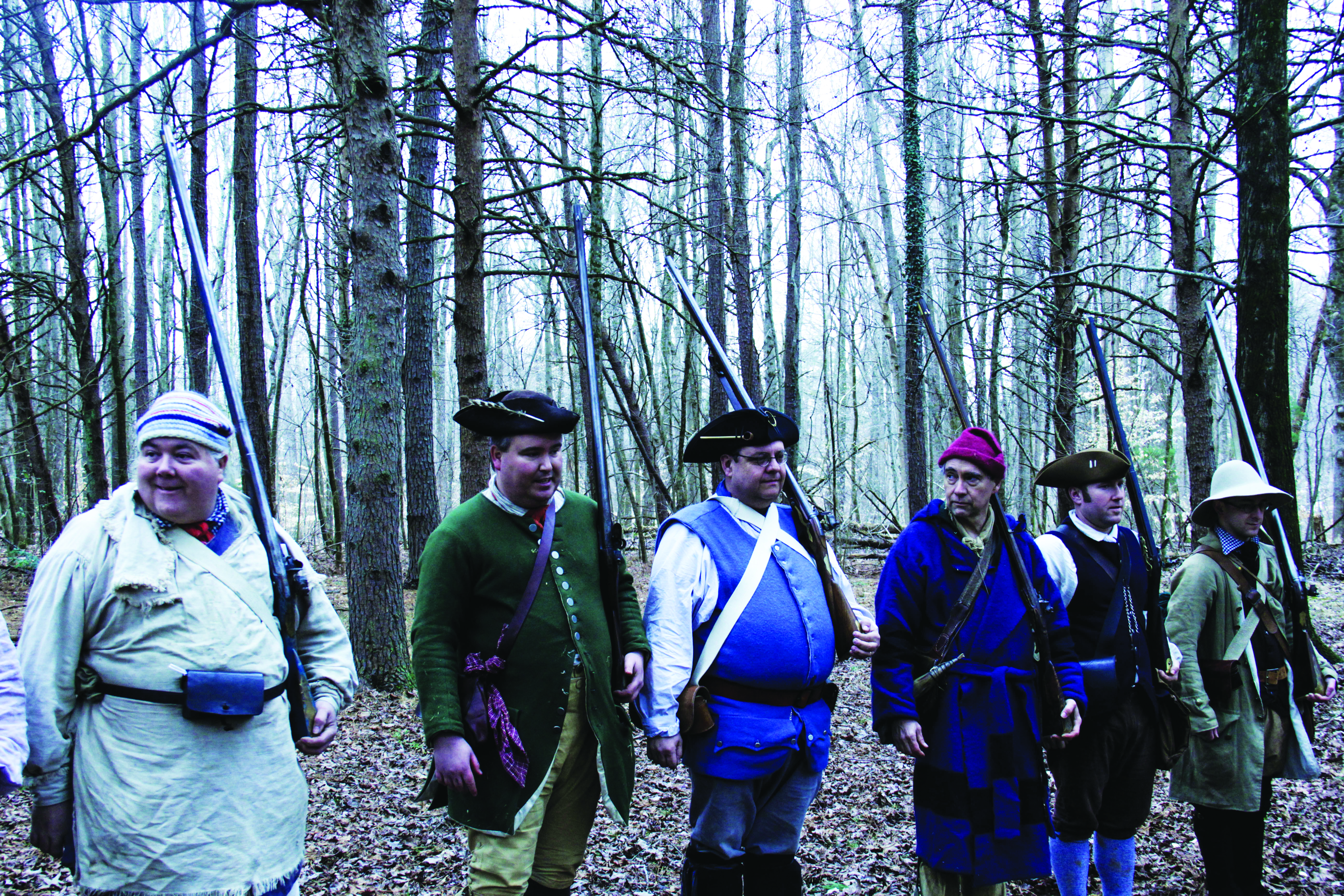
The weather was threatening to rain last Sunday, March 15, when Tom McDonald,an actor in the Guilford Militia, was just waking up in his pup tent.
“You would typically have about four or five guys sleeping in one tent,” said McDonald. “That’s one of the more un-authentic aspects of this thing. The closest guy to the door would be on guard duty.”
I mention to McDonald how it seems strange that in a war where soldiers would face one another in open fields that there would be much risk for night attacks. I figured that there must have been a strong code of ethics, but McDonald said that wasn’t the case, and he seems to know what he’s talking about. If you ask him one question, he goes on for minutes describing in detail the parts of a gun, the cloth of his uniform, or Nathanael Greene’s strategy. He’s enthusiastic about the battle.
The Guilford Militia firearms demonstration was a little unsettling, to say the least. They’re a rag-tag group of guys with farmer’s weapons. When they fire these weapons there’s a loud bang, a cloud of white smoke. They’re inexperienced and disorganized. At the scheduled time of the demonstration, the commander was still in bed.
According to McDonald, his rifle, which was a hand-me-down, had about a 25 percent failure rate. The failed shots are usually due to moisture in the air, and there’s nothing much a person can do when their rifle won’t fire, because most of their weapons could not hold a bayonet. For this reason the Continentals required militiamen to carry a sword as well. Luckily for McDonald, his rifle worked three out of five times on Sunday Morning.
At the British camp, things were more organized. Everyone was in complete uniform and the campsite was clean. Although they were scheduled to win this reenactment, it was a somber moment, because the soldiers were tired from their morning drills.
A Hessian soldier, Matt Mooreshouse, was sitting around the British camp Sunday morning when I asked him why he wanted to be a British soldier. It’s not like his name was drawn from a hat; each volunteer brings their own uniform from home, and it has to match a rigorous regulations test. So it’s by his own choice that he sided with the Hessians, who was also pro-British control of what is now North Carolina.
“You’ve always got two sides to every conflict,” said Moorehouse. “The British looked like they were fighting their cousins, you know? On one end it’s probably a duty thing; you don’t want to let your friends down. On the other end it’s not your war, not your decision.”
The battle ends the same way it does every year, with Greene retreating the Continental army into the woods. It’s easy to understand why Greene would retreat, the cannons are terrifying and there are just too many British. He did it too save lives, and ultimately he helped the Continentals gain independence. He did all of that without knowing that we would be honoring him, 234 years later, in a town called Greensboro.
 THE CAROLINIAN