
Aden Hizkias
Staff Writer
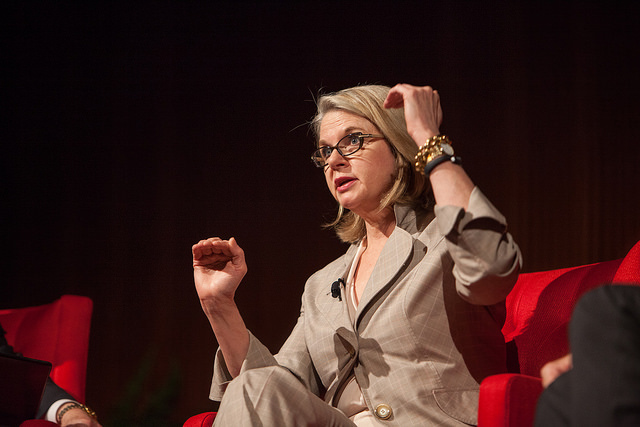
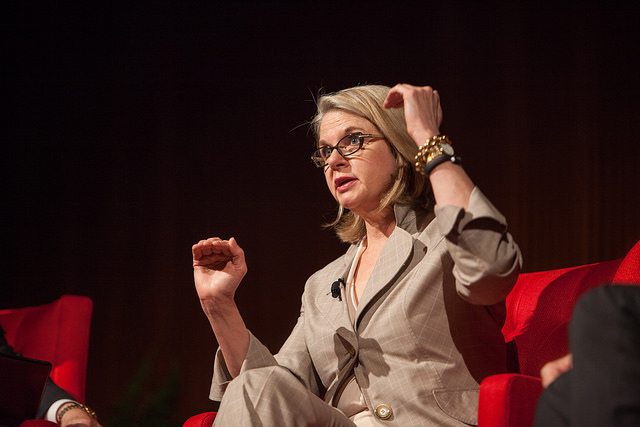
Margaret Spellings, former U.S. education secretary, has been chosen to be the next president of the UNC system, taking the place of current president, Tom Ross.
On Friday morning, the UNC Board of Governors announced the election of the new president after a nearly year-long controversy surrounding what many UNC system professors, staff member and students said was Ross’ forced resignation.
Spellings, who served as secretary of education from 2005 to 2009 under the Bush Administration, is best known for being a proponent of the No Child Left Behind Act.
Spellings also played a major role in the formation in 2005 of the Secretary of Education’s Commission on the Future of Higher Education, referred to as the Spellings Commission.
Former President Bush released a statement Friday congratulating Spellings on her unanimous election as president of the UNC System. Spellings will be the second woman elected to serve.
Spellings served as the president of the George W. Bush Presidential Center in Dallas, Texas.
She met controversy during her years in the Bush Administration due to her oversight of student loan programs. She testified before the House of Education and Labor Committee after receiving criticism from Andrew Cuomo, then New York attorney general, who stated that the Education Department had been “asleep on the switch.”
A statement in 2005 regarding her unease about PBS showing a lesbian couple has some UNC system students concerned about Spellings’ views on the LGBT community.
“It is not an overstatement to say that education is not only fundamental to each individual North Carolinian, but to the success and future of this state, our country, and to peace and stability in the world,” said Spellings at the announcement on Friday.
Spellings will now oversee the 17 campuses and over 200,000 students that make up the system.
“I believe this with every fiber of my being. And that is why I will work tirelessly with all of you to ensure that each and every student in North Carolina has not only access to higher education, but the skills and abilities to fully access the American Dream,” Spellings said.
Current President Tom Ross, a Greensboro native, will be stepping down in January 2016 after serving for five years.
In a press conference earlier this year Ross stated, “I wasn’t planning on leaving in the near future, but I think the board had a different timeline and I respect their right and their prerogative.”
John C. Fennebresque, Board of Governors chairman, responded that their were no negative implications as to why the decision was made to have Ross step down, but he mentioned the Board of Governors had a timeline and were looking forward to a new president with new ideas.
In the formal press conference earlier this year on Ross stepping down, Fennebresque noted that Ross did a great job and neither Ross’s performance or the scandal of the athletic/academic scandal at Chapel Hill were an attributing factors for the board’s decision.
Although the possibility of politics has come into play with with Ross a well-documented Democrat and the obviously-Republican Spellings, there has so far been no evidence that would prove this notion.
The ambiguous nature of the reason for Ross’s soon departure and the need for a new elect left some questioning the board and its transparency. Several board members called for Fennebresque’s resignation.
Fennebresque resigned on Monday, telling the press, “With the search completed, I believe now is the time for a fresh start for our University system and its 17 campuses as well as for this Board of Governors.”
The UNC- system Faculty Assembly sent out a statement outlining the concerns they have regarding the search process for the new president.
“The recent mismanagement of the Executive office of the University, from the firing of Thomas Ross, to the hiring of the new President, is but the most egregious in a long train of problematic governance actions,” read the statement.
The Faculty Assembly expressed concerns about what they considered to be the board’s lacking efforts to seek advice from the staff and faculty and called this “shortsighted and troubling.”
The UNC Faculty Assembly further argued that the counsel of the constituencies are needed when determining important matters such as the new president and that the governance has been flawed.
“It’s probably safe to conclude that most faculty were unhappy with the closed doors and secretive manner in which candidates were reviewed. This is a public university system, not a private commercial venture,” said John Lepri, UNCG delegate to the Faculty Assembly.
Spellings who has a Bachelor of Arts in political science from the University of Houston believes her knowledge in policy-making is beneficial to this new role in the UNC-system.
In response to the announcement, Anne Wallace, UNCG Faculty Senate chair said, “Just as the map is not the territory, so the resume is not the person. There are face-to-face interviews for a reason. Excluding some participation by the various wider constituencies of the UNC system in the finalist interviews leaves that process closed inside a ‘black box.’ We will never know why or how the final decision was made.”
Wallace discussed the lack of input during the search process. The faculty and staff were involved in contributions to the leadership statement, which was vague. UNC faculty and staff, citizen constituencies and some members of the Board of Governors, were not involved in the interview process.
Wallace went on to state that a closed search was possible in which names of final candidates could have been kept confidential or those involved could have signed an agreement of confidentiality. Although the Faculty Assembly had urged for this type of process since June, it was not done and was counter-productive as it did not prevent Spellings name leaking out earlier last week.
“The Board of Governors has never given a reason for their dismissal of Tom Ross…We still don’t know what was ‘wrong’ about Tom Ross’s leadership in the Board’s eyes, or what ‘right’ leadership they were seeking in this search,” said Wallace.
As the chair of UNCG’s Faculty Senate, Wallace hopes to make sure that faculty voices are heard and regarded as crucial decisions are made for this campus and the greater university. As a delegate to the UNC Faculty Assembly, Wallace stated that she is ready to collectively advise the president.
“What I hope for, and will work toward as best I can, is much greater inclusiveness and openness in decision-making than this presidential search has achieved,” said Wallace.
Spellings will assume the position of UNC president in March 2016.
 THE CAROLINIAN