
Daniel Bayer
Staff Writer
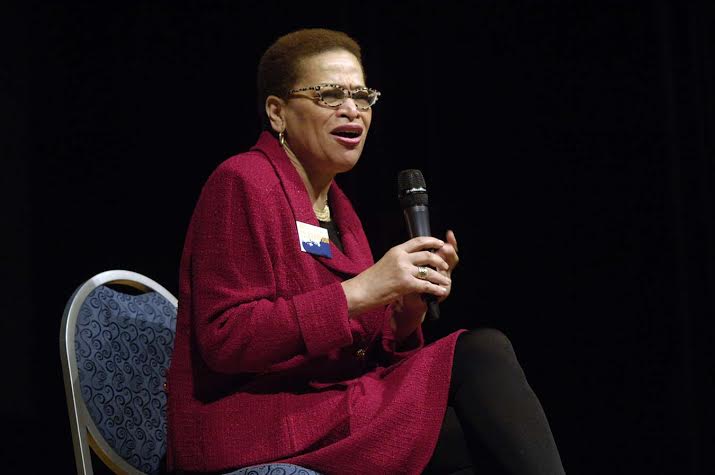
Former Bennett College president and nationally known writer, Dr. Julianne Malveaux called on millennials to pick up where the civil rights generation left off in her keynote speech at the Martin Luther King Jr. Celebration last Thursday at the North Carolina A&T campus.
“Some of the things that my baby brothers and sisters take for granted are some of the things we fought for,”Malveaux said at the beginning of her keynote address. “This is not talking down. A lot of young people will say ‘Don’t patronize me,’ it’s just being you. We come at these things differently.”
The celebration, a partnership between NC A&T and UNC-Greensboro, was entitled “From Drums to Hashtags: The Generational Conversation on Justice” and focused on the progress, or lack thereof, made in the decades since King was assassinated in 1968.
“We’re interpreting things through a generational lens, and that’s okay” Malveaux said. “Here’s what Coretta Scott King said about generations. She said ‘Freedom is never really won. You earn it and you win it with every generation. This is what we have not taught young people, or old ones for that matter. We do not attain a state of freedom that lasts forever. It just doesn’t work that way.In other words, the struggle continues.”
Malveaux said that progress in many areas has met resistance from a society that has been resistant to change.
“As soon as we see progress, we see pushback,” Malveaux said. “We see forward steps and backward steps. We see that today.”
She noted that although we make progress, that progress can often be mistaken for cures to the racial separation we see in the U.S.
“In 2008 we saw the election of an African-American man to the presidency of the U.S.,” Malveaux said. “Now some folks thought we were post-racial; they said that race doesn’t matter anymore. There were some whites who said that we don’t have to have affirmative action anymore. Now, we have a black president. Dr. King didn’t say that he had a dream that we would have a black president. He said he had a dream that people would have three meals a day.”
Even with the election and reelection of Obama, black communities face an uphill struggle, said Malveaux.
“We have more African-American poverty in this country than we did when President Obama took office,” Malveaux said. “The wealth gap is more than it was in 2008. We’re not blaming President Obama, but we’re saying that there are symbols and there is substance.”
Malveaux was disappointed in the reaction of some white citizens in the wake of Obama’s election.
“If you look at those months after our president was elected, we looked at people who did not mind acting out in public,” Malveaux said. “We had a member of Congress who stood up and said ‘You lie!’ as the president of the United States was speaking. He apologized, but he should have be censured [by Congress].”
Malveaux emphasized the way that bipartisanship is ruining the opportunity for progress, that in a country where there is still much to be done, some politicians do not have their priorities straight.
“We see the pushback in a senator who said his number one priority – in 2009, when we were in the middle of a recession – his number one priority was to make sure that President Obama was not re-elected. His number one priority was not to stop high gas prices, his number one priority was not to feed people, his number one priority was to oppose President Obama,” Malveaux said. “We see progress, and we see regress, and we see what Coretta Scott King said: freedom is never really won.”
One of the last things King did before his death was go to Memphis, Tennessee to support black sanitation workers striking over unfair pay and unsafe working conditions, an event Malveaux connected to today’s struggle against police brutality.
“Holding up a sign that said “I am a man” was the equivalent of the hashtag “Black lives matter,” Malveaux said.
Malveaux ended with praise for the “Black Lives Matter” protesters who used the nonviolent, civil disobedience pioneered by King to confront injustice in society today.
“We have to stand there and have the audacity to say ‘We can shut something down,’” Malveaux said. “That’s what the “Black Lives Matter” young people have done.”
 THE CAROLINIAN