
Zachary Weaver
Staff Writer
Peter Golden, award-winning New York author, journalist and historian, gave a talk last Monday on segregation and World War II.
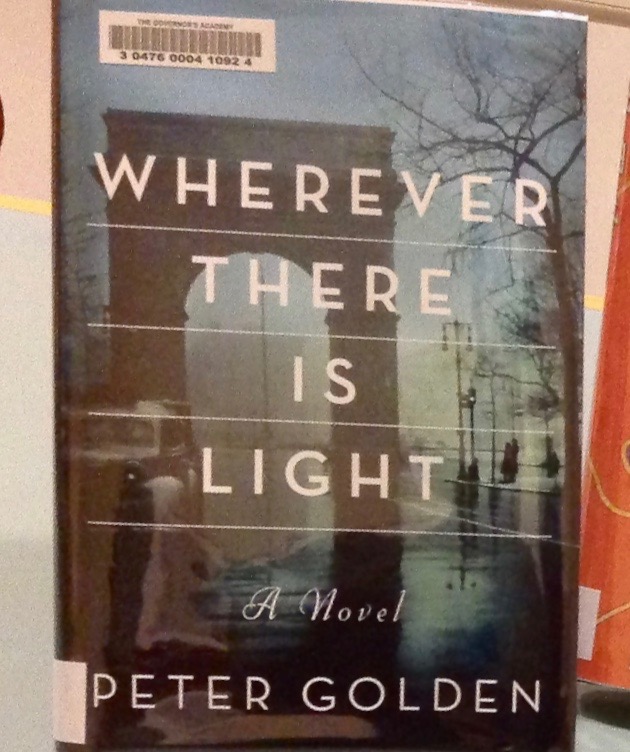
The lecture, titled “The Impact of World War II on Segregation,” aimed to promote his new novel, Wherever There is Light.
During his talk Golden spoke briefly on his new book, but focused on the historical topic.
The time period was turbulent for economics, politics, and society at large. The Nazi party had taken charge in Germany and was repressing or ejecting the Jewish people.
In the 1930s the Civil Rights Movement found its roots, concurrent with Adolph Hitler’s rise to power in Germany. During this time Black activists in America were seeking anti-kidnapping and lynching legislation, as white murderers could walk via jury.
American segregation was a hobbling aspect of the country beyond its unequal racial treatment.
When criticizing the German treatment of the Jews, the Nazi party had an easy counter; Germany pointed out the hypocrisy of American criticism, owing to White-Black segregation still in force.
African-American colleges in the years preceding WWII played a role in helping Jewish professors. Many hired them after they were fired from their positions in Germany. This ultimately saved a number of academics from persecution and death at the hands of the Nazi party.
Golden stressed the importance of the African-American press during this time.
Mainstream white papers rarely carried stories important to the black population, so underground publications stepped forward to fill that niche.
Among these was the Pittsburgh Courier, a paper vitally important in informing and organizing the early Civil Rights activists.
The Chicago Defender, an Illinois paper, was important in its region for promoting black voting in the city. By promoting housing they were able to get “blue” voters into their area and give the minority a voice in local politics.
One early story Golden detailed was Irene Morgan, a worker in a Baltimore plane plant. In 1944 she was arrested for refusing to give up her bus seat in Virginia when returning home (interstate buses were desegregated).
This proved to be an important development in Civil Rights.
New legislation was enacted to ban segregation on interstate buses, adding on to existing laws. Morgan’s story mirrors Rosa Parks’ in many respects, but Golden pointed out that Morgan acted without a larger movement to support her.
In his words, she was “someone who had bought her seat and wasn’t just going to give it up.”
The subsequent Journey of Reconciliation, a mass bus trip through the Southern States, tested this new law. Many were arrested for not moving, as police in the South ignored the new law. The Journey later inspired the 1961 Freedom Rides.
A major step forward was the deployment of nearly 1.9 million black soldiers. By January 1945 soldiers were running low, with many wounded or killed in the Pacific. Deploying the African-American men was the “logical” next step.
There was much hand wringing, and some commanders feared violence among their companies. These fears never materialized, with the black soldiers fighting just as hard, if not harder, as their white squad-mates.
An interesting parallel between black Americans and the Jewish people emerged post-war.
Many Jews fleeing from Nazi power landed in Russia and fought the Germans there. This was done in the hopes that they would be equally regarded once the war was done. Not so, as Stalin’s government targeted them in the years following Germany’s defeat.
A similar flow of events took place in America; black soldiers fought hard in the hopes that they would be recognized as equal upon the end of the war. Much the same as the Jews in Russia, they return home to encounter more persecution.
The treatment of black Americans pre-war was a sobering parallel to that of Jewish Germans. The treatment of one group as ‘others’ led to them being treated as sub-human, which in turn led to persecution and violence.
Golden largely conducted his research via books.
Most of the important figures of this time period had passed away, leaving mainly books and letters to draw from. His method for researching historical works: “read, interview, travel. Read to know what questions to ask, and travel to see what’s going on.”
Golden shared a story of tracking down someone for an interview at that time, all in a pre-internet time period. Upon arriving, he found that they had died three days prior.
Setting a novel that features a black protagonist in Paris during Segregation was an unusual, but calculated, move.
“By putting them in Paris I could look at them without cultural prejudice,” Golden said.
The most important takeaway from the lecture was that popular conceptions of history are often inaccurate or misconceived. Rarely is there just one factor at play. “Don’t assume you know the past,” Golden stated.
Peter Golden’s new book, Wherever There is Light, is on sale now in the UNCG Bookstore.
 THE CAROLINIAN
Nice job, Zach. Excellent reporting! If you decide to stick with it, I believe you will be a fine journalist!
LikeLike
Excellent job, Zach! Good reporting and writing! Stick with it and I believe you will be a fine journalist.
LikeLike