

Alexea Brown
Staff Writer
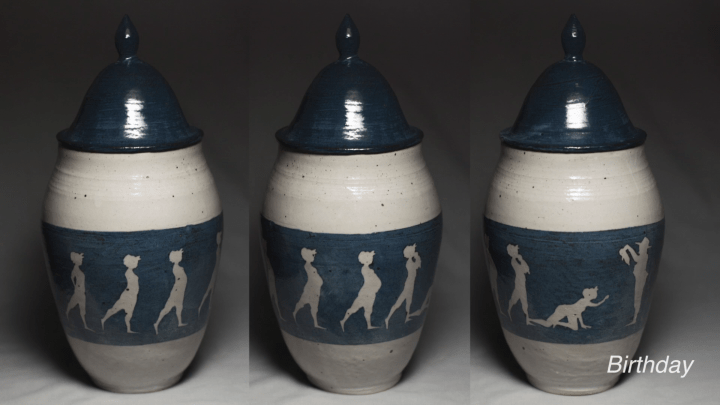
Quinn Hunter is a graduating senior at UNCG and a talented artist whose passion lies in her ability to use art — specifically ceramics — to tell stories about the experiences she’s had as a young black woman growing up in the South and the politics that inform her world.
Though she chooses to use ceramics as her mode of expression, Hunter’s first experience with the medium was less than favorable. At the age of 10, she received a toy pottery wheel, and after a day of working with it, she found herself so frustrated that she didn’t touch clay again for years. It wasn’t until her junior year at UNCG that she realized that she enjoyed the challenge presented to her by ceramics. Today, high fire stoneware makes up a large portion of her collection.
Most of Hunter’s pottery work speaks to what she calls her “inheritance.” On her website, she explains this inheritance is “not being of monetary or physical aspects, but the things that [she’s] inherited from [her] parents.”
Hunter says that her parents have passed onto her their race and religion — she was raised a Southern Baptist — and she chooses to focus on these two aspects of her identity because of the substantial effect they have had on the way she perceives the world around her, and, in turn, the way the world perceives her.
The images that Hunter uses for her pottery reflect the experiences that she’s had growing up in what she calls the “New Antebellum South,” as well as images that are relevant to the overall condition of black people today and in the past.
Hunter addresses through ceramic art — as well as through other forms of art such as collage and poetry — what it means to have grown up in the Christian Bible Belt as a black woman. Her pieces are an embodiment of her own experiences and the experiences of those before her, giving a voice to people who otherwise would have remained silenced.
“The reason I choose this subject matter is because I can speak to it from a personal standpoint. I feel that if I were to comment on something that doesn’t have anything to do with me, I would be taking away the voice of someone who could be speaking for themselves,” Hunter said.
However, Hunter views art as something more than just a means to communicate her experiences. She says art is inherently political, arguing its societal and cultural implications should never be disregarded.
“Because art becomes a historical record of the political strife that people felt, it becomes a representation of the people,” Hunter said. “Art is political — no matter how much people want to say that it’s not.”
Hunter says one need not look further than art movements such as Dadaism — a movement resulting from WWI that aimed to redefine the aesthetic of beauty — in order to observe the crucial role art plays in shaping society.
“The artists, horrified of all these images coming from WWI, distinctly pulled away from those cultures that were a part of WWI…That pulling away from culture is a political move,” Hunter said.
Hunter says even apolitical art cannot be severed from the politics that surround it. She concedes there is art that is more rooted in aesthetics, but she asserts even such work has motive.
“There is art that is essentially for its beauty — it’s so beautiful that it takes you to another place. But, then again, that’s sort of political motive as well. It’s art that helps you escape from the world,” Hunter said.
Hunter argues that art created with the purpose of elevating audiences implies there are issues above which people feel they need to transcend, which is something Hunter points at as demonstrating that even apolitical work is still steeped in political culture.
So far, Hunter has taken her work and her politics to be seen in a few galleries and art shows, including an animation that was presented at Middle Tennessee State University. She plans to participate in more of them in the future. One of her goals, though, is to eventually have her work exhibited in a museum.
Hunter is currently working on a quilting project. “It’s a series of three quilts and a wall of platters and plates,” she explained. “I’m doing a white quilt, then the second will be off-white and the third will be kind of dingy — and I’m going to do a video production on them.”
After she’s finished with her undergraduate studies, Hunter plans to pursue her MFA and build a career out of her love for making art.
“I mostly make my art for myself, but I can’t see myself dedicating so much time to something else. I’m applying to graduate schools, so we’ll see where that lands me,” she said.
At the end of the day, though, Hunter always comes back to what art can achieve in her community and society. A profession and continued graduate studies are only symptoms of a larger artistic agenda for Hunter.
“If you say your art’s not political, you’re lying,” Hunter concluded. “Or you’re not making good art.
Contributed reporting from Emily Bruzzo.
 THE CAROLINIAN