
Daniel Johnson
Sports Editor
It feels like when February comes around every year and people start talking about African American athletes, the same half a dozen names come up.
Names such as Jesse Owens, Jackie Robinson, Muhammad Ali, Bill Russell and Jim Brown and their accomplishments are all discussed every February, year after year. Yes, they are names that should be celebrated, but there are many other names that deserve recognition.
It is understandable for Jackie Robinson to be seen as the standard for African American athletes. His breaking of the color barrier and both the physical and psychological abuse in baseball is an illustration of courage and perseverance in the face of racism.
However, no one seems to mention the second African American baseball player in history.
Larry Doby had spent four years playing for the Newark Eagles in the Negro Leagues when Jackie Robinson broke the color barrier in April of 1947. About three months after Robinson’s inaugural game, Larry Doby became the second African American baseball player when he took the field for the Cleveland Indians.
Because interleague regular season play did not begin until 1997, like Robinson, Doby was playing against teams that had never taken the field with a black man.
And like Robinson, Doby shined like the star he was.
In twelve major league seasons (1947-1959) Doby was a seven time All-Star, two time Home Run champion and led the Indians to their second World Series title in 1948.
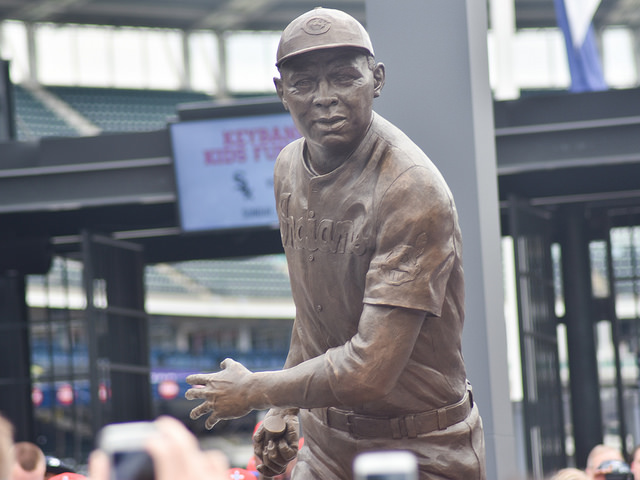
Doby’s #14 jersey is retired by the Indians, and he is a member of the Pro Baseball Hall of Fame and has a statue outside of Cleveland’s Jacobs Field. Also, in his tradition of being number two, he became the second African American manager in Pro Baseball after Frank Robinson.
Sticking with baseball, with black players being allowed in the Major Leagues, the Negro League had to do whatever it could to survive.
By 1953, when a 19-year-old Hank Aaron departed from the Indianapolis Clowns of the Negro League for Major League Baseball, the Clowns owner decided to generate excitement by replacing Aaron with Toni Stone, making her the first female player to participate in a men’s league. Though her career would last only two seasons because of age (she was 32) and loss of quickness from her youth, she was followed by two more women in the sport.
The same year that Stone was signed, the Clowns also signed the first female pitcher in the league’s history, Mamie “Peanut”Johnson.
Johnson would go 33-8 over a three year period and batted a solid .270 (2015 MLB batting average: 254).
Connie Morgan replaced Stone with the Clowns at second base in 1953 after spending five seasons with an All-Female baseball team. Though the league would collapse just a few years later, the legacy and importance of the three women players is eternal.
In the 1960s and 70s, during the reign of Muhammad Ali in the heavyweight division, he was seen as a the most polarizing athlete in the world.
Now imagine an Ali but more than 60 years earlier and you’ve got Jack Johnson. During the first decade of the 20th century, Johnson became the first black Heavyweight Champion of the world and ruled the division with all the pride and confidence that Ali had.
During Johnson’s peak, in the 1900s and 1910s, it was the worst time for African Americans post Civil War.
Jim Crow and other state laws limited progress for blacks, while the Federal government remained non-existent in their lives.
Now only did Johnson dominated the sport of boxing, he destroyed his white opponents, openly dated white women and lived like a king in a world that would see him as less than a man if not for his power.
Ken Burns had the perfect quote for Johnson during his documentary.
“For more than thirteen years, Jack Johnson was the most famous and most notorious African American on Earth,” Burns said.
Johnson ended his career with 85 victories, 45 knockouts and as the first great African American athlete in the country.
Why has time forgotten these important figures? Who knows.
But what needs to be remembered is that Jack Johnson was the original and inspiration for Muhammad Ali. Larry Doby was Jackie Robinson for the American League.
And three black women showed that they could play with anyone in front of them.
Time needs to start playing catch up.
 THE CAROLINIAN