
Maggie Young
News Editor
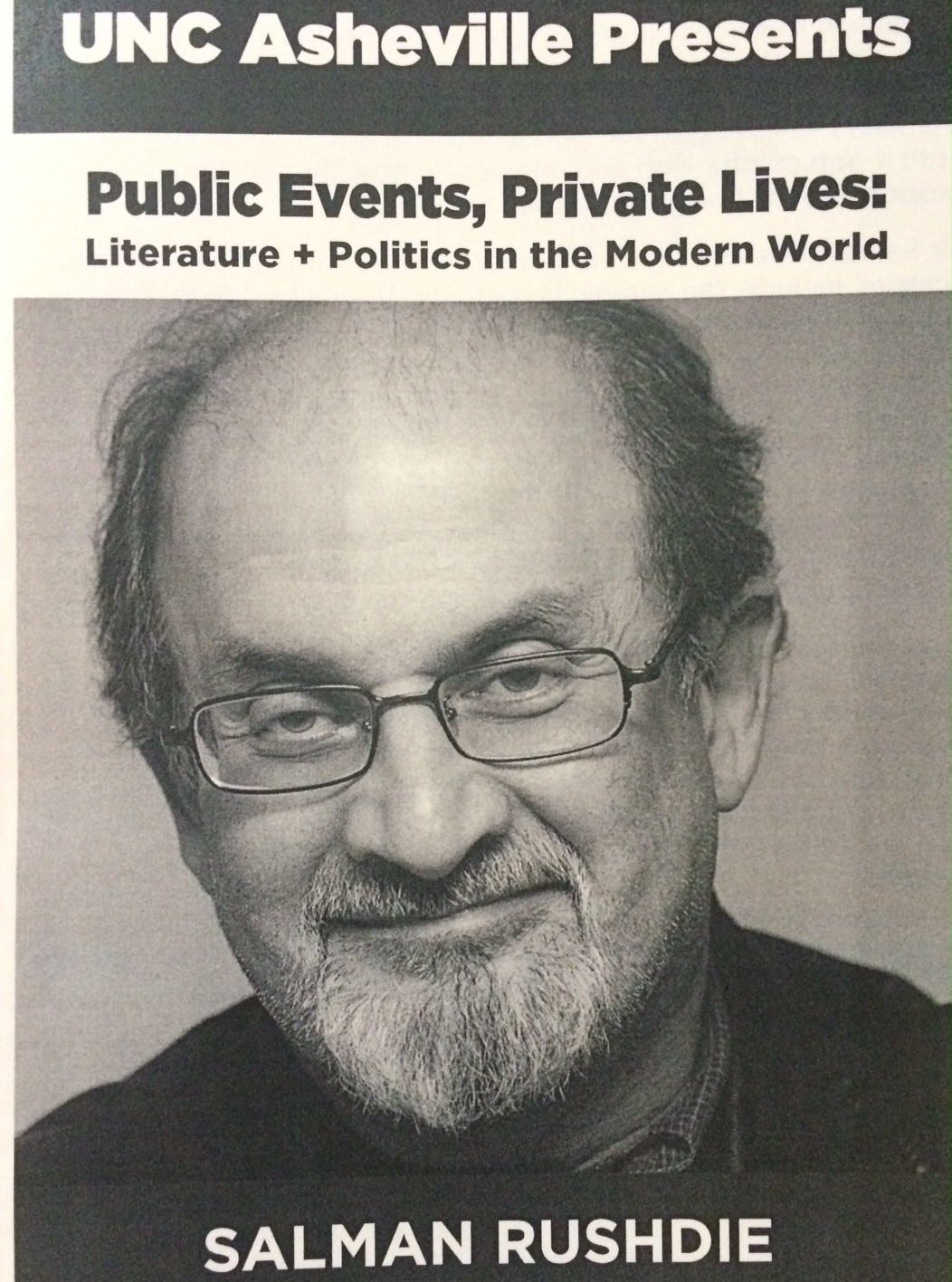
Sir Salman Rushdie spoke to an audience of over 3,000 attendees in the Kimmel Arena at the University of North Carolina at Asheville last Thursday night, Feb. 18.
The lecture, titled “Public Events, Private Lives: Literature + Politics in the Modern World,” addressed the ethics, the purpose and the necessity of the novel in a modern context.
The author is known for such novels as “The Moor’s Last Sigh,” “Fury” and most controversially, “Satanic Verses.”
His novel “Midnight’s Children,” which chronicles the lives of children born on the night that India gained its independence, earned the Booker Prize in 1981 and later was awarded the Best of the Booker in 2008.
Rushdie, a long-standing advocate of free speech and embracing controversy, held nothing back during his public lecture, reminding the college students in attendance “universities should be safe spaces for ideas, not safe from ideas.”
Rushdie criticized the exponentially restrictive and proliferative nature of “safe spaces” on university campuses and explained the irony of a student who attends university to expand his or her mind but who only listens to like-minded opinions.
“Of course students at university should live in a safe space in terms of their physical safety,” Rushdie said. “But the thought that they should be protected from ideas that they might find surprising or difficult is the opposite of the reason why people go to university.”
Rushdie, having dealt with criticism and threats from people who do not agree with his opinions or writings, expressed little tolerance for students who are complacent with silencing certain opinions.
He spoke to the audience about the issue of limited exposure to differing viewpoints.
“It is becoming a problem that young people think it’s okay to silence voices [they] don’t agree with,” Rushdie said.
UNC-Asheville Junior Math and Sociology major Sara Gerall explained to The Carolinian about the potential to ignore opposing viewpoints.
“On our campus, we talk about being very open and accepting,” Gerall said. “But it’s open and accepting as long as you agree with liberal views.”
To the idea that shutting down conflicting voices stems from “virtuous reasons” in politics, Rushdie vehemently stated, “You are wrong [to do so].”
He endorsed the act of colliding conflicting viewpoints by begging the question, “how else will you learn how to think?”
UNC-Asheville Junior Spanish and Education major Sari-Rose Brown told The Carolinian of her frustrations regarding the tricky dichotomy of safe spaces.
“When we’re trying to create a safe space [while] trying to educate but are also frustrated by ignorance, suddenly we’re talking over everyone else, then no one hears anyone,” Brown said.
She commented on the issue of “yelling out” over differing voices and went on to question the essence of the safe-space.
“It scares me because how can I let people talk about hate and not shut down any conversation that might be uncomfortable?” Brown said.
Rushdie argued that this is one of the questions the novel is able to answer.
In a world that is shrinking thanks to technology and connectivity, where people no longer rely on the physical newspaper for news, Rushdie claimed that the novel is a medium by which readers can learn about relevant events while simultaneously listening to perspectives they would not have had access to.
He claimed that the novel is a way in which to read about a culture and disagree with it while also relating to someone who lives within its bounds but who shares similar experiences with the reader.
This interconnectivity of conflicted areas of the world, he argued, is what makes it “inevitable that writers have to try to talk about the impact of public affairs on private life.”
He explained the butterfly effect as a classic example of this shrinking space between public and private life.
“If a butterfly flaps its wings in Beirut, we feel the breeze here,” Rushdie said.
He was adamant that our lives are increasingly informed by a global connectivity.
“So much of what shapes our life,” he said, “now happens in rooms we don’t know the existence of, decisions [are] being taken by people whose names and faces we don’t know.”
He cited September 11, 2001 as an example of how different lives, cultures and stories can “literally collide” with one another.
“It became impossible to understand what had happened in New York City without also understanding what was happening in the Arab world,” Rushdie said.
He continued to argue the novel as a means of bridging cultures and peoples and the writer as having an obligation to readers to at least try to bridge the gap.
Again, as an author who has had threats made on his life, he is no stranger to what it means to put one’s life on the line for ideas.
Rushdie spoke of a quote in Saul Bellow’s novel “The Dean’s December” where a dog barking is interpreted as the dog pleading “for god’s sake, open the universe a little more.”
He called students and writers to action, saying that even though someone will always be in place to hinder the progress towards opening up the universe, “[we] have to go to the edge and start pushing.”
He cited the poets Ovid, Mandelstam, and Lorca, all of whom were killed because of their writing.
At the end of the day, however, Rushdie noted that the works of each of these authors outlived their respective oppressors.
“The poetry of Ovid has outlasted the Roman empire,” Rushdie said. “The poetry of Mandelstam has outlived the Soviet Union. The poetry of Lorca has outlived the Franco dictatorship.” Rushdie finished by inspiring writers to avoid discouragement, saying that writing and expressing one’s idea has been and always will be dangerous. “It’s the job,” Rushdie said.
 THE CAROLINIAN