
Daniel Bayer
Staff Writer
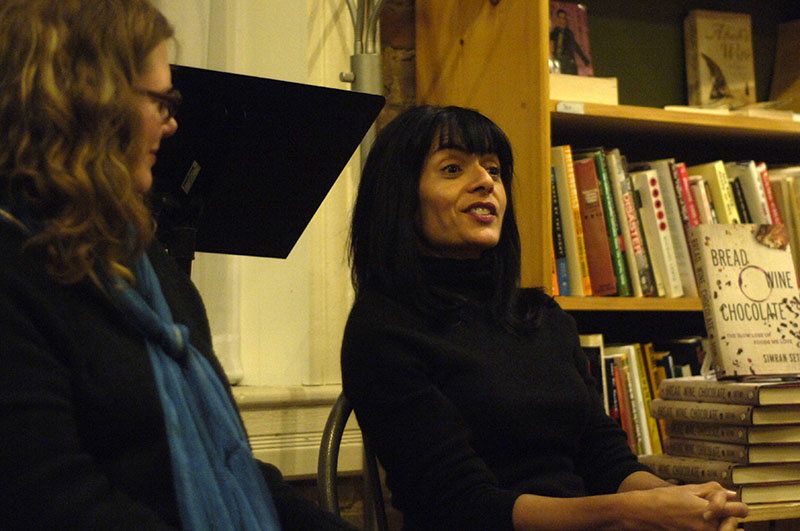
Simran Sethi, author of “Bread, Wine, Chocolate,” discussed the lack of diversity in our food sources last Friday at Scuppernong Books in Greensboro.
Approximately two dozen people were in attendance for the program, which also included a chocolate tasting.
Sethi explained the evolution of her book to her audience as being motivated by personal interest and experience.
“I wanted to write this book on the loss of diversity in food, and I think the best way to understand that loss in many ways is through experience,” Sethi said.
She chose to focus on chocolate after a chance meeting with a chocolate maker following her return from a trip to Italy.
She said that when she first began the book, “it was really about rice and potatoes and corn, and the loss of diversity in our staple foods,” but as the book developed, she found it was no longer as interesting as she first believed.
“I remember getting very bored. I was boring myself and I really didn’t know how I was going to handle that. I wanted to tell the story about the loss of biodiversity through the things that I love,” Sethi said.
According to Sethi, diversity is being lost in every component that makes food and agriculture possible, including the soil, seeds and the insects that pollinate the plants themselves.
“Bees, hummingbirds, bats — they pollinate one-third of our food, and moving right up the food chain, the loss of diversity in what we eat, including plants, animals or fish — it really compromises our food system,” Sethi said.
Sethi explained that despite the exponential explosion in the number of foods available on supermarket shelves, people really only consume a limited number of foods.
“We think that there’s diversity at the grocery store, but researchers who work on biodiversity have basically determined that we eat only five foods,” Sethi said. “It’s rice, corn, soybeans, palm oil and wheat. This is a tremendous concern. We’re growing everything in monoculture, we’re losing all of the diversity. It could all be wiped out by one disease or one pest.”
That danger is hidden by the seemingly endless variety of foods that we can choose from when we go shopping, she said.
“It’s an illusion in the sense that it’s a lot of diversity in flavor and brands. I think we all have seen that everything is becoming a monopoly and that includes brands as well,” Sethi said.
Sethi expounded on what she sees as the increasing problem of brands expanding while food diversity stagnates.
“Grocery stores are out of control now,” Sethi said. “I went to Walmart because it’s the biggest chain in America right now and counted these insane amounts of ice cream flavors and yogurts. Then you realize that 90 percent of them come from one breed of cow.”
Even seemingly innocuous fruits like apples have been reduced to just a handful of varieties, according to Sethi.
“You look at the five apples in the grocery store, one of which has no right to be there, which is the red delicious, because it’s horrible, and then you realize we could grow hundreds of varieties of apples in the United States,” Sethi said. “Why is this all we’re seeing?”
One solution is locally grown produce, she said.
“When you go to the local farmer’s market, you see that,” Sethi said, referring to the larger selection available. “We are in some ways fooled and deluded, because when you see that mango, you think, ‘Wow, I never had this when I was growing up.’ That’s because on a local level we’re seeing the results of globalization, but the global trend is towards sameness.
She spoke again on grocery stores expanding in size with a diversity of brands and processed foods, with little expansion in the fresh marketplace.
“Look at all the processed foods we have now,” Sethi said. “There are so many more aisles of that then we had when I was growing up, and I think that’s where the delusion comes in.”
Following the program, attendees tried three different varieties of natural chocolate manufactured in North Carolina, offering a small glimpse into the world of diverse and local goods one can purchase close to home.
“I’m excited to do the tasting,” said Sara Gladding, who had read Sethi’s book. “I love Scuppernong and come here every chance I get.”
Bob Marlowe became interested in the book after he saw Sethi on some TV shows.
“I ordered the book on Amazon; it was great,” Marlowe said. “I’m always up for learning something new and tasting great chocolate.”
 THE CAROLINIAN