

Maggie Young
News Editor
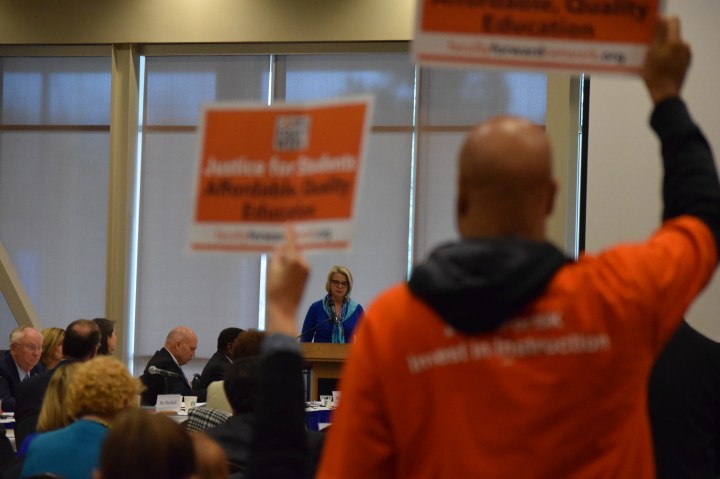
Margaret Spellings attended her first Board of Governors meetings as the new System president on Friday, March 4 at HBCU, Fayetteville State University.
Over the past year students and faculty have been seen expressing their increasing disappointment in the UNC-System and their distrust for the Board of Governors; the majority of last year’s Board of Governors meetings experienced some degree of protest.
The March 4 meeting, however, experienced minimal disruption only once, during which the meeting continued to run smoothly. This is in contrast to the number of meetings recently that have been disrupted to the point of periods of recess or relocation.
Security was higher than previous meetings, with metal detectors and officials doing bag-checks.
The only disruptance occurred during Spellings’ President’s Report, her first official report to the Board as president.
Five students stood amongst the audience with their backs turned to Spellings. Some wore shirts that read “people over money.”
In her report, Spellings listed five key aspects that she hopes to focus on as her time as president: “access, affordability, student success, economic impact, and excellence.”
She said that during her first 100 days as president she will be engaging in “a lot of listening and learning.”
It was announced during the last Board of Governors meeting that she will be visiting every UNC-System campus between March 1 and May with the hopes that Spellings will be able to get a broad idea of the needs of the differing constituent campuses.
She also stated that she wants to empower the chancellors as she will “rely on them for insights into the unique strengths of the universities they lead.”
A main critique Spellings has received since her appointment is that she is not an academic. Spellings has defended her work with academia arguing that having a political background gives her an advantage in creating a more efficient system.
She said in a press conference last October that “I think it’s a fantastic way to make policy is in a political setting because that’s the setting that we operate in.”
Some have voiced their confidence, or more basically, their conditional acceptance of a political leader.
Former chancellor of UNC Chapel Hill, James Moeser, said about Spellings’ appointment, “I can still imagine a successful outcome if she avoids the temptation to micromanage the campuses.”
While those accepting of a more political president, many agree that trying to run each, individual campus would be counterproductive.
In line with her political background, she also stated in her report that she plans to work closely with the legislature in order to “achieve some early legislative wins…”
She expressed a desire to attract “world-class talent” to the UNC-System, with “performance-based pay” as a high priority for legislature.
She finished her report by explaining her plans to utilize the talents available to her through the Board and the campuses, and her continued effort towards transparency, as she wants to “[develop] strong and productive relationships.”
At the end of Spellings’ address, one student shouted “Spell check,” and the students then filed out of the room quietly.
Members of Faculty Forward Network sat in the audience with signs and some protesters held signs that read things like “Invest in Instruction,” and “Justice for students,” but no one made any vocal disruptions.
In a show of good faith, Spellings introduced herself to some of the protestors.
Learning about the complaints and needs of groups frustrated with the UNC-System is all a part of her expressed desire to create a more open dialogue throughout the state.
She even thanked the protesters “for their decorum.”
The protesters she spoke with, however, were allowed to stay in the room because of their quiet presence, such was not the case with those who stood outside.
Protesters present mostly rallied outside of the meeting room with signs, and although vocal disruption did little to effect the meeting, chants could still be heard.
Increased security was the likely culprit for the lack of protesters in the meeting room. Many were barred from entrance and told the room was at full capacity.
The board has been vocal about its disappointment and frustration with the recent disruptive protests.
After the meeting Chairman Lou Bissette, who has voiced his personal disdain for the disruptions, said, “…the protesters were there. They got their point across but yet did not disrupt the meeting.”
The number of police officers attending meetings has been high for the past few meetings, and although all remained quiet during the most recent meeting, police presence did not go unnoticed.
The back wall was lined with over 20 officers who looked on quietly and did not have to escort anyone out.
Without the presence of protesters in the meeting, the meeting ran smoother than any in several months.
Before former president, Tom Ross, had even left the Board students could be seen protesting the increase in student fees and the cuts made to university centers across the state.
The increase in protests can be seen as an indication of the dissatisfaction within NC universities.
With the removal of Ross, conditions were ripe for an exponential increase in discontent.
Ross, a former judge and the chancellor for Davidson College, was a democratic president on a majority-republican board; many felt that his removal was an overt attempt by board members to find a republican leader who would better mesh with the Board’s goals and decisions.
Of the 32 members on the board 25 are registered republican and two are registered democrat; the remaining five are unaffiliated or unknown.
After retiring Ross told The News and Observer that prior to being removed he had been praised for his good work.
“Other than the fact that they want a different leader, I’m not sure I’ve ever been given a good reason for why we needed to make the change” he said.
The appointment of Spellings became so controversial, that although not many outside sources were involved in the selection process, the news spread quickly through the state.
When former chairman John Fennebresque called an emergency meeting to discuss one candidate for the presidency, House Speaker Tim Moore and President Pro Temp Phil Berger issued a letter that warned the Board about diminished trust that would result from a lack of transparency.
The letter stated, in part, “Our concern is not about any candidate for the presidency but rather the process by which at least a few members of the Board have utilized that appears to cut against the fundamental notion of transparency and due process…”
Though not yet law, a bill was passed in September that stated the Board must present three possible candidates for president before making a decision.
The lack of transparency and respect for guidelines set in place for a fair appointment process, led to Chairman Fennebresque’s loss of support within the board.
Fennebresque resigned just three days after Spellings’ appointment.
The rapid change-over left students and faculty wondering what the Board’s real motives were/are–many have speculated.
The UNC Faculty Assembly issued a statement articulating their frustration about the Board disregarding their input during the search process for a new president.
One part stated, “… the Board of Governors continues to act without the advice and counsel of the constituencies whose expertise they need to effectively govern the institution.”
Spellings has attempted to quell the fears of the state by continually making statements and sending emails since the start of her presidency that indicate her willingness and desire to work transparently within the System.
The next Board of Governors meeting is April 15 on the UNC-Asheville campus.
 THE CAROLINIAN