

Maggie Collins
Arts and Entertainment Editor
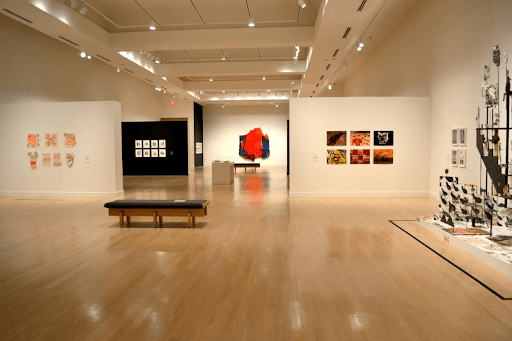
“How long do you think a person looks at a piece of art in a museum before moving on to the next piece?” asks Emily Stamey, who works on the staff at the Weatherspoon Art Museum, during our class trip. Students began giving seemingly reasonable answers like two, three, or five minutes. She gave us a peculiar smile as she continued to call on students. When she received a range of various answers, she said, “It’s actually only around 15 to 30 seconds.”
While this surprised most of us, the sad reality was that it was true. Stamey had previously asked us to look at a piece of art as we sat down for this conversation, and we hardly even spent those 15 seconds looking at it before taking a seat. Why is this? It could partly be due to how our society has become so used to immediate gratification. We can look up anything we want to know in seconds on our phones, and we scroll past a video on TikTok if it’s longer than 30 seconds because it’s boring.
For our class trip, we spent most of our time examining one piece of art. I will admit that I found it hard to sit, observe, and engage with this piece of art deeply. After a few minutes, I began getting antsy and found myself looking at other works of art from my chair, looking at my classmates, and even my phone to look at the time. It’s not that I wasn’t enjoying it or bored; instead, I was not used to sitting in one place looking at one piece of art. It was a new process for which I had to be patient and still. These qualities seem to be lacking in our society.
After sitting and observing this piece of art, I began to see things I couldn’t have seen while quickly passing by it. Stamey began to ask about all the aspects of the art: what lines were present, what colors were used, what shapes were being made, and what mood the art invoked—the kinds of questions that a person couldn’t answer by only spending 15 or 30 seconds looking at the piece. The most fascinating and counterintuitive thing we did was look at the art and discuss it for about an hour before we read the title or the description of what the artist had in mind when creating the piece.
This was important for the observation process because we all have different interpretations of art. What I might see and appreciate the most about the piece might be something my neighbor didn’t even consider. While it is informative to read about the artist’s intent, your interpretation is also valid if it differs from that. That is the beauty of art: it’s in the eyes of the beholder.
Weatherspoon Art Museum is a beautiful place full of captivating art. Although I am in my last year at UNCG, this was my first visit to the museum because I never thought much about going. Now that I have been as part of a class and seen its beauty, I wish I had taken more time to visit. Not many universities have the opportunity to have an art museum on campus, so I encourage everyone to spend a day or evening observing and appreciating the art. You can go alone, with friends, or even on a date.
Instead of glancing at each piece, take a step back, look at it from different angles, and observe qualities like the colors, shapes, and objects used for a few minutes. Find your interpretation and then read the author’s intention. Ask yourself, Are the interpretations similar? Different? Why do you think that is?
Their current exhibitions displayed are Making Room: Familiar Art, New Stories; Art on Paper 2023: The 47th Exhibition; A Golden Age: Original Animation Art from the Walt Disney Studios, 1937-42; and Sheena Rose: Pause and Breathe, We Got This.
Weatherspoon Art Museum is open 10 a.m. to 5 p.m. on Tuesdays, Wednesdays, Fridays, and Saturdays and 10 a.m. to 8 p.m. on Thursdays. You can find more information on their website: Weatherspoon Art Museum.
 THE CAROLINIAN