

Virginia Weaver, Senior Staff Writer
Microwaved Beef is a column by Virginia Weaver that reflects on flashpoints from the last few years in the culture wars. The rapid pace of contemporary discourse makes it easy to forget critical moments and trends that have defined our social and academic lives. Microwaved Beef brings those moments back into the spotlight.
In mid-2025, the lesbian pop world allegedly lost three stars: Billie Eilish, Fletcher, and JoJo Siwa. All three of these pop stars started dating men, in quick succession. Siwa re-identified away from lesbianism in April. In early June, Fletcher released a single, “Boy,” that reflected her own new relationship with a man and expressed anxiety about public reaction. Billie Eilish publicly confirmed her relationship with actor and musician Nat Wolff just a few days later.
That three women singers who were known as being attracted to women had all found male beaux at roughly the same time was chum for the “vibe shift” genre of discourse. At Metro, Brooke Ivey Johnson wrote of this constellation of couplings:
Now, as summer 2025 looms, barely 10% into Donald Trump’s second presidency and amid a global surge in far-right ideology, the queer pop girlies seem to be suddenly dating men, with JoJo Siwa and Billie Eilish as two much-talked-about examples.
Johnson’s piece, which connects the three pop stars’ new relationships to a broader rightward shift in American culture, resonates with myriad other public responses.
While pop fans were less interested in the political context of early-mid 2025 than journalists tended to be, they expressed intense disappointment, particularly concerning Fletcher’s new relationship and her single, “Boy.” In an essay on her Substack newsletter, Trish Bendix summed up what seemed like a common sentiment among fans:
Fletcher’s ode to her boyfriend… felt particularly egregious considering that, unlike Jojo, fans took her seriously and, unlike Billie, Fletcher was more directly involved with and invested in her Sapphic fandom.
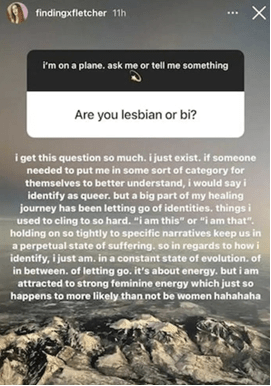
But Fletcher was not lesbian, and like Billie Eilish, she had never claimed to be. Fletcher has always avoided labelling her sexuality. In 2021, having been asked by a fan whether she’s lesbian or bisexual, Fletcher replied that she dislikes putting precise labels on her sexuality. However, she did describe what makes her attracted to someone: “It’s about energy. But I am attracted to strong feminine energy which just so happens to more likely than not be women hahahahaha.”
Billie Eilish came out as “queer” in a 2023 interview, saying, “I’m physically attracted to [women]. But I’m also so intimidated by them and their beauty and their presence.” She did not say or imply that she is not attracted to men. Neither she nor Fletcher had ever identified as lesbian.
The case of JoJo Siwa, however, is different – and more complex. Siwa came out as “gay” or “queer” in 2021, at which time she was dating another young woman and felt ambivalent about labelling her sexuality.
In a notorious 2022 interview, Siwa stated that although she’s lesbian, she dislikes the term. “I don’t like the word itself, it’s just like, lesbian, it’s just like a lot. But I mean, at the end of the day, that’s what I am… It’s like the word moist.” Later, taking to TikTok, Siwa tried to cool off the resultant backlash, elaborating on her awkward statement about the word “lesbian.” She clarified that she does not think “lesbian” is “a slur,” but that “it’s not the word that flows off the tongue for me.”
In 2024, Siwa infamously claimed that she wanted to “start a new genre of music… called gay pop.” This too received backlash, after which Siwa clarified that she did not think she had invented gay pop, but wanted to make gay pop “bigger than it already is.” Siwa had already gained notoriety, rather than popularity, with most onlookers prior to her latest revelation earlier this year.
In April, Siwa announced publicly that she is not lesbian: “Fuck the L, I’m going to the Q! That’s what I love about sexuality.” Siwa then began dating a man.
Siwa has alleged that she was lesbian at one point, but that her sexuality has changed. “Sexuality is fluid, gender identity is fluid,” she explained in an interview. However, she has also claimed that she had felt “pressure” to identify as lesbian, suggesting she was not in fact lesbian prior to April.
Some onlookers seemed under the impression that Eilish, Fletcher, and Siwa were all avowed lesbians until mid-2025, which is simply not the case (even if confusion over Siwa’s sexuality is understandable). But the trio of new relationships became fuel for this summer’s vibe shift discourse, nonetheless. Sexuality had been troubled, in the minds of readers and listeners who were not quite clued in.
Many explanations could be proffered to explain the media’s and fandoms’ responses to these singers’ new relationships. Perhaps critics continue to stretch–in this case, to a breaking point–for incidents to exemplify the now four-year-old vibe shift. Or perhaps critics writing on the trio failed to understand the complexity of sexuality. Fleurine Tideman, assessing the discourse at Glamour, argued that “society still struggles to grasp that bisexuality exists.”
This article is modified from an essay originally published in Virginia Weaver’s newsletter.
 THE CAROLINIAN