
Jenay Moncrieffe
Over the past couple of years, loyalty tests have become a popular genre on YouTube. These loyalty tests involve testing whether one’s partner is cheating. Many people enjoy the content for the elaborate scenarios that tempt one’s partner to cheat, without realizing it is all a test. These elaborate scenarios provide viewers with an easy way to unwind after a long day.
One of the most prevalent loyalty test YouTube channels is known as UDY (Underrated, Distinct & Young). They average 2 million views per video. In every video, they repeat the phrase, “You better grab a bag of Takis because you already know, this video is going to be good.” This phrase invites viewers to relax and enjoy the content without worrying about outside responsibilities.
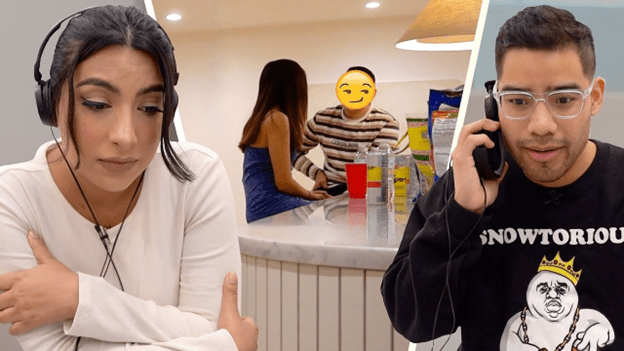
In most loyalty test channels, the roles do not change. These videos usually feature a couple: one is the client, who wants to secretly test their partner, and the other is the client’s partner, who is set up for the test. A decoy will test the client’s partner. A decoy is an actor involved behind-the-scenes of the loyalty test to tempt the client’s partner into cheating with looks or money.
It can be comforting for viewers to know that the setup and roles will remain the same across different locations and storylines. It is so fun to watch these videos because they are action-packed and unpredictable. The suspenseful buildup of the music throughout the entire video is very entertaining. Building each intro to include an in-depth storyline of the client’s point of view on why they want to test their partner, how long they have been cheating, and other background information makes it easy to connect with the client while watching.
Some audiences who watch loyalty tests love to analyze everyone in the video to reach a definitive conclusion. The confirmed outcome determines whether the client’s partner will cheat at the end of the video or remain loyal. These assumed outcomes are based on the client’s, their partner’s, and even the decoy’s personality types. Some comments are pretty blunt when viewers feel the decoy doesn’t have the charisma needed to make an individual cheat. Others may feel the client is the problem because of the lack of sufficient evidence as to why they want to test their partner, especially if they’ve been dating for more than a year. Among everyone, the client’s partner is most likely to yield a sufficient outcome. Viewers share their opinions in the comments if they think an individual would cheat because of their lack of boundaries, word choice, and, most of all, their engagement in the conversation. Their engagement in the conversation makes it fairly easy to determine if an individual will cheat on their partner.
There is a great difference between participating in an intentional conversation and a forced conversation. Given how these tests are set up, the couple is usually in a room with a couple of other individuals, and during the first ten to fifteen minutes, all other individuals leave, leaving only the decoy and the client’s partner. Because they are alone, pressure is taken off the client’s partner to act a certain way, since the partner and the other individuals are no longer around. This scenario makes it extremely easy to tell whether the client’s partner is interested.
If you feel this form of content seems more hurtful than helpful, think again: the majority of these tests appear to be fake and may involve all actors to maintain control over every part of these videos. In general, actors are needed for these tests. However, if the content is real, the client and the client’s partner should be the only real individuals (including the host and camera crew, of course). Whether the content is real or fake, the storylines are dramatized to keep viewers hooked and invested. To do this, actors, the client, the decoy (and the client’s partner if the content is fake) are given a loose script that outlines what should be said and the blocking, also known as the movements and places the actors should stand when it all takes place.
All that being said, no relationships are truly being ruined, as the entire environment is completely controlled. If any relationship is ruined, maybe it’s for the best, because let’s be real: the client chose to hire YouTubers and an entire camera crew rather than talk one-on-one with their partner. On the flip side, we won’t honestly know if a loyalty test is real or fake, as it is all speculation.
I grew up watching loyalty tests, and I find them comforting and nostalgic. Loyalty tests on YouTube are very entertaining, a perfect mindless activity when you want to relax, especially for students who are stressed and have finals coming up. All scenarios may or may not be real, making the wild storyline and elaborate plan that much more interesting for the audience to enjoy. If you watch those videos for yourself, you will see how easy it is to get hooked and have fun.
Headline image from Is He USING HER To Pay His Rent & Bills? | UDY Loyalty Test.
 THE CAROLINIAN