
Virginia Weaver, Senior Staff Writer
Microwaved Beef is a column by Virginia Weaver that reflects on flashpoints from the last few years in the culture wars. The rapid pace of contemporary discourse makes it easy to forget critical moments and trends that have defined our social and academic lives. Microwaved Beef brings those moments back into the spotlight.
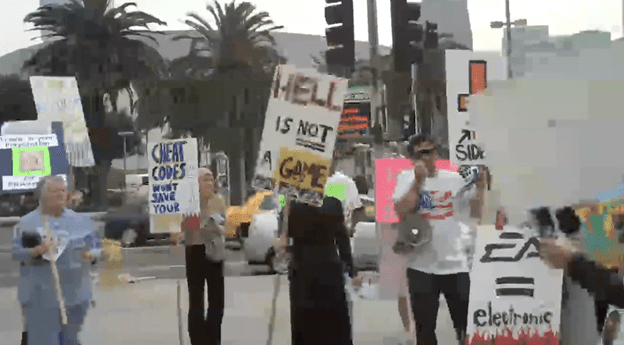
In June 2009, around 20 protesters gathered outside the Los Angeles Convention Center, which was hosting that year’s Electronic Entertainment Expo (E3), to voice their complaints about the upcoming action video game Dante’s Inferno, produced by industry juggernaut Electronic Arts (EA). The protestors held signs with slogans such as “HELL IS NOT A GAME,” “Trade in your PlayStation for a PrayStation,” and “Just say Infer-NO.” According to the protesters, Dante’s Inferno disrespected the poem on which it was loosely based and trivialized Hell.
The protesters—or at least the orchestrators of their appearance—picked the right place to maximize their visibility. In its years-long heyday, E3 was the video game industry’s premiere yearly event, serving as the optimal setting in which to announce and show off new games. With 41,000 attendees, E3 2009 vastly surpassed the previous year’s attendance, reversing a downward trend in the exposition’s popularity. E3 2009 featured the announcement of several massively popular and critically esteemed games, including Halo: Reach. Despite attendance concerns, in 2009, E3 remained the industry’s flagship annual show-and-tell, watched eagerly by fans and reporters alike. E3 2009 was thus the perfect time and place for a protest.
The protesters’ timing was impeccable in other ways, too, aligning with the early 2000s’ broader cultural tensions. Dante’s Inferno is a violent action game, and debates about the influence of violent video games on real-world violence hit a fever pitch in the early 2000s. Four years prior, in 2005, then-Senator Hillary Clinton made headlines by leading the charge to regulate minors’ access to violent and sexually explicit video games. “We need to treat violent video games the way we treat tobacco, alcohol, and pornography,” Clinton urged. Onlookers noted at the time that in her failed attempt to pass stricter regulatory laws concerning video game sales, Clinton had formed alliances with conservative Christians, formerly the video game industry’s most prominent naysayers. Her key role in the backlash against violence in video games remains infamous, although her conservative allies were and remain the industry’s primary political and moral detractors. In 2009, then, it would not have been all that surprising to see protests against a violent game, given the ongoing bipartisan—if largely conservative—political backlash against them. At the time, too, extremist Christian protest groups, foremost among them Westboro Baptist Church, were rising in notoriety, and were widely mocked across the internet. The signs waved by the protestors against Dante’s Inferno were clearly based on signs made by such groups.
The protestors at E3 2009 were guaranteed significant visibility, perhaps even infamy. But most of the Internet seemed to detect something suspicious, even insincere about them, as video footage became widely available. To some viewers, it even felt like the protest was entirely fabricated.
E3 2009 was held from June 2-4, and on June 5, EA vindicated doubtful viewers’ hunches. The corporate behemoth confirmed that they had hired “a guerrilla marketing agency” to stage the alleged protest against Dante’s Inferno. Although the marketing stunt EA put on remains notorious, the game they sought to promote with it is largely forgotten.
When it was released in 2010, reviews of Dante’s Inferno were tepid at best, and often scathing, with a critic at IGN listing it as one of his “Top 10 Biggest Gaming Disappointments of 2010.” Generally, Dante’s Inferno was received as an inferior imitator of the popular God of War series, and its mediocre sales have been attributed in part to its release a mere month before that of its much more highly anticipated competitor, God of War 3.
Today, EA’s fake protest blunder serves as a window into a lost cultural moment. In 2023, the Entertainment Software Association announced the end of E3. One insider told IGN reporters: “As consumers began to adopt digital formats, the need for a retail show for distributors declined… [E3] was ultimately left behind as major labels adopted a straight-to-consumer digital showcase event that saved them a ton of money. COVID was just the final nail in the coffin, but from what I could see and what I heard from colleagues it had already struggled for years to find its footing.” When EA protested its own game in 2009, the media landscape still centered around physical sales, the cultural climate surrounding video games was more heated than ever, and the Internet loved to jeer at extremist Christian protestors, a phenomenon that seems to have lost some of its steam. Even in 2009, EA’s hoax was an obvious miscalculation, but it was densely interwoven with the cultural context of its time.
 THE CAROLINIAN