
Ailey O’Toole
Staff Writer
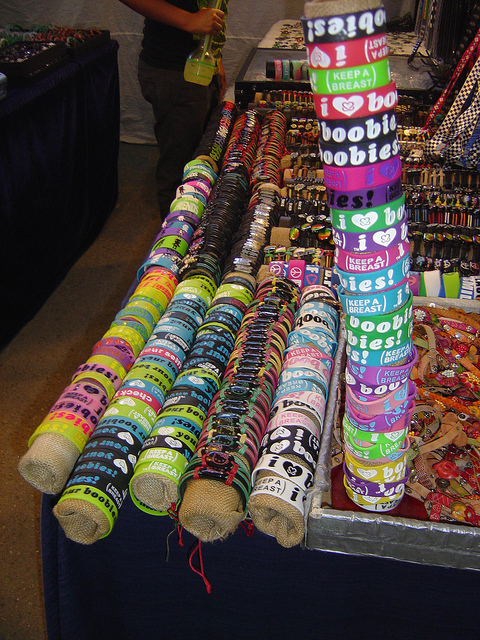
“I like boobies.” The phrase is everywhere: t-shirts, bracelets, bumper stickers, you name it. And as catchy and witty as it seems, I do not like it and I do not think it is appropriate.
Using the phrase, “I like boobies,” or “save the ta-ta’s” to promote breast cancer awareness reduces the person suffering from the disease to his or her “ta-ta’s,” and sexualizes a very complex and life-shattering illness. I find it inappropriate and somewhat callous. It is as if we are saying that it is the “boobies” that need to be saved and not the person who is suffering from the illness.
Using that phrase also involves the nudge-nudge, wink-wink assumption that men should care about breast cancer awareness and early detection because men love boobs. Shouldn’t they care because they value human life, regardless of whether the person has boobs or not?
What about the fact that men can get breast cancer as well? It is insensitive and frankly does not even make sense to reduce the struggle of those men to their breasts.
This campaign also ignores and even casts shame on people who choose to or are forced to undergo mastectomies to save their lives. Those people should not feel ashamed for choosing their lives over their breasts, but the “I like boobies” campaign seems to encourage the opposite.
To clarify, sexualization is when a person, usually a woman, is represented in such a way that arouses viewers or otherwise connotes sex when the actual purpose of representation has nothing to do with sex at all. Pornography does not sexualize women because the purpose of porn is to be arousing. However, when an advertisement for alcohol or cars — or one soliciting donations for breast cancer research — portrays women in a sexual manner to convince people to buy into what the advertisement is selling, that is sexualization.
While I think this kind of ad campaign is inappropriate and almost vulgar, I do think it is effective; something that is a good indicator of the misanthropy that is rampant in our culture. The marketing people who created this campaign know what they are doing; they knew that people would be into the “I like boobies” motto because it is so easy to sexualize women and to devalue them into only being good for their boobs.
Other good examples of this problem are porn sites that use breast cancer donations to increase their web traffic. This has happened many times: porn sites offer to donate 1 cent to Susan G. Komen for the Cure for every 30 views on videos. However, the intended recipient for the donation rejected the offer.
Unfortunately, many women have been dragged into this marketing scheme. For example, in 2009, there was a great deal of controversy over a highly erotic breast cancer awareness video called “Save the Boobs,” released by Canadian TV Host Aliya-Jasmine Sovani.
Sovani’s statement on the matter was, “[The video] was designed to promote a local charity, called the Boobyball for young people under the age of 30 to get aware about a serious subject that affects women my age (but is often thought of as a “grandma’s disease”)… I was not hired by a company to show my assets; this was completely my concept, and after finding out my cousin will be losing one of her breasts to cancer THIS month, I agreed to lend my face to the cause.”
However, the focus of the video was not on her face. The video featured Sovani, a buxom women in a scantily clad bikini, whose breasts are being thoroughly admired by men and women alike. The video’s tagline is: “You know you like them. Now it’s time to save the boobs.”
Can you not see why this is a problem?
If you have seen the video, Aliya-Jasmine Sovani is a beautiful and healthy-looking woman who does not at all adequately represent what it is like to have cancer. The purpose of these campaigns is not “how much awareness can we spread,” or “how many lives can we save?” The purpose is “how much money can we get people to donate when they see this sexy woman flaunting her breasts?” It is disgusting.
We should be creating campaigns that validate, empower, and embody the struggle breast cancer patients fight every day, not vaguely pornographic commercials that pull in money based on how well they can sexually objectify women.
 THE CAROLINIAN