
Alison McKane
Staff Writer
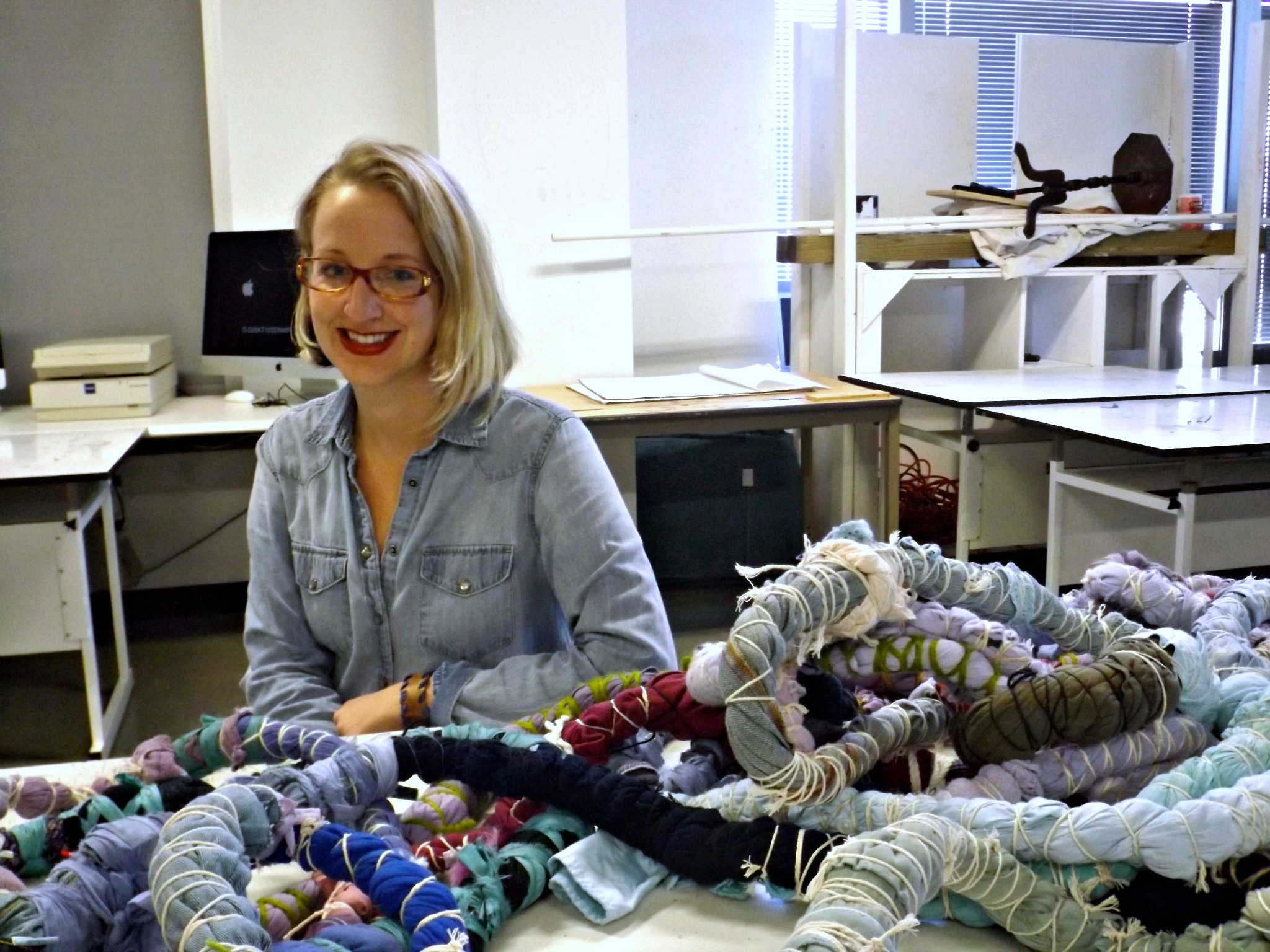
For Jennifer Bonner, UNC-Greensboro alumna, making rope out of donated clothing began as a necessity.
At first, she attempted using sheets, but it left something to be desired aesthetically.
After having already made one teepee-like structure, Bonner was asked if she would be interested in gearing her project towards this year’s capstone common reading, “Where am I Wearing?” by Kelsey Timmerman. Bonner’s sole tee-pee fort was on its way to becoming the project “Wear.”
Bonner’s fort project is now tailored to “Where am I wearing,” in that it involves the textile industry, but its original intent looked much different.
Initially, she began the project after thinking about how children will use just about anything they can get their hands on to make a fort. This inspired the idea of using donated clothing rather than sheets.
However, as Bonner’s intended audience changed, her thought process underwent a transformation as well.
Instead of forming her project in a way relating to children, Bonner began to shift its focus to the textile industry, the implication to highlight the livelihoods of both consumers and workers.
Many Americans think, “Can’t wait to get rid of clothes to get new ones,” said Bonner.
She went on to explain that people don’t always consider where the money used to pay for their clothes go: namely to poor, underpaid workers surviving dangerous conditions overseas in order to make a living.
What these workers face are real issues that Americans, and others benefitting from the products of this labor, don’t like to think about, and will, more often than not, turn a blind eye to.
Timmerman’s book and Bonner’s project force people to see the truth in the textile industry — the good and the bad.
While Bonner’s project could easily solely focus on the negative, she explained that the project had positive aspects as well.
Bonner created the fort structures to represent the shelters of workers in the industry, and the teepee structures as village clothing made into rope. According to Bonner, the rope itself represents the products consumers buy, which give workers the means to put a roof over their heads.
The first thing that catches the eye when walking into the room Bonner set up for her project, were two long tables covered with clothing.
Half of one table held an example of rope that Bonner had brought, a template for those who would work during the four-hour workshop.
The smell of pizza, a staple in bribery tactics to get college students to any event, was detectable from the hallway. And while the program was mostly for honors students, people popped their heads in every once in awhile, most likely following their noses.
As it was a four-hour workshop, showing up early meant that many people had not arrived yet.
Two dance majors were there, asking Bonner questions.
They were excited to hear that they would be receiving extra credit from the professor for attending, and assisting for Bonner with her project.
After short introductions, photographs and conversation on the project, four people, including Bonner, sat down at a table to begin working.
Actually making the clothing into rope proved to be more difficult for the participants than the finished project suggested, but after getting the hang of it, conversation followed suit.
The four spoke about their lives over the makeshift rope, like old women speak over their knitting.
Bonner’s final project will be on exhibit Saturday, Nov. 14 in Moran 109.
 THE CAROLINIAN