
Shaquille Blackstock
Staff Writer
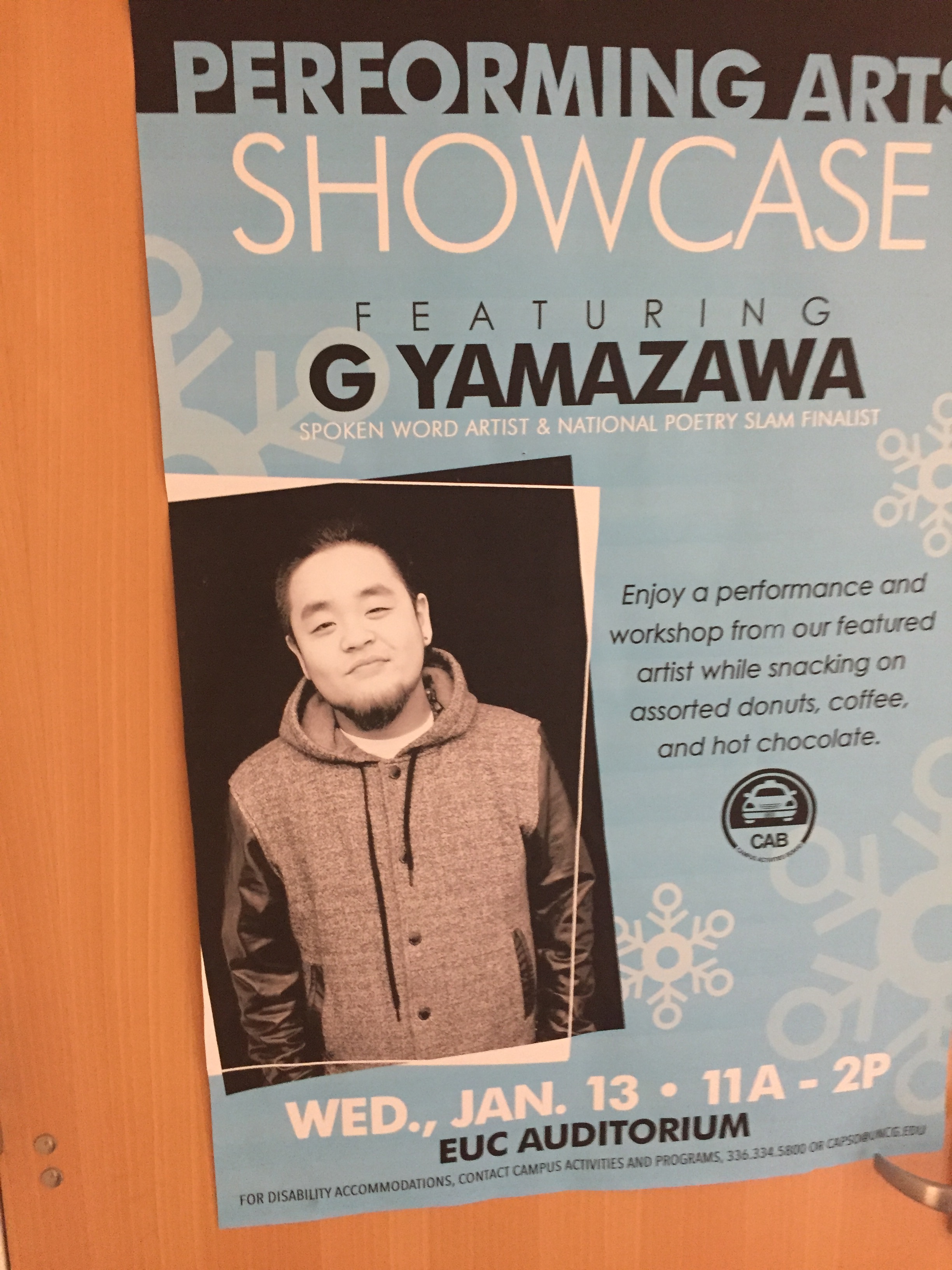
The spoken word and hip hop artist George Yamazawa paid a UNCG a visit on Jan. 13, and for those who attended, it was quite a treat.
In the workshop, he discussed everything from how to turn writing as a hobby and passion into a career, to some of the challenges he has faced as an Asian American poet born in the south. Originally from the Durham area, Yamazawa shared how he found success as an artist from a small town.
“I always wanted to be an artist, and accepted myself as such. I wanted to rap, and it really was like a monkey on my back. I went to my first poetry slam in Chapel Hill at the age of 14. It was a really small event, and I met my first crew after that.” Yamazawa explained, regarding his early interest that would eventually become his dream.
Yamazawa went to describe the difficult journey he endured through his teens to find a place for his interests to flourish, as well as develop his identity as an artist.
“I eventually even met someone known as the Godfather of the triangle, and found out that there is a really big poetry center around here; you just have to find it. From the time that I was 14 to around 17 I rapped heavily. I got kicked out of school and had to find an alternative source of income, and that was the age that I found out who my real friends were. [At] about 15 and 16 years old, I was really hunting for my identity.
“There are so may amazing MC’s and poets in NC with crazy energy, and that’s where I found myself. At one point I wasn’t worried about making money, I just wanted to win every poetry slam. Chasing the dream becomes more important than what you catch. In fact, as an artist, there is a different sense to making money. You become proud of that ‘starving artist’ badge…at one point I sold CD’s to eat. I was never taught by my family to make money. I would describe it as karmic, almost. Money helps you to become more creative…Kanye West couldn’t do these crazy creative, innovative things that he does without his ridiculous budget,” said Yamazawa.
The art of travelling was one of the themes of the workshop, as Yamazawa detailed how his experiences travelling helped him grow as an artist.
“I left in 2011 on a four month tour….it was just a backpack tour, travelling to places like Denver and New York. Some might imagine a bus or a jet, and it’s not always glamorous, but living your dream is most important. I didn’t do the conventional track in life. I turned 21, I learned to travel, which is like an art all its own. By the end of a nine month stint, I had no home and moved to DC, learned to host workshops, and just live in a new place on my own. I had side jobs, selling CD’s and writing.
“I was approached to book college shows in 2012, at 22 and didn’t feel ready to get paid that much. I didn’t think I was good enough. I evaluated myself in the scope of what art should be, waited until I got my first showcase. In the third year of doing the college showcase, I’ve just been writing hip hop,” said Yamazawa.
The workshop had a very informal and personal vibe to it, as audience members were able to speak with Yamazawa personally, and ask questions.
Yamazawa presented two spoken word pieces that were humorous and poked fun at stereotypes: (“I’m not worried about you fools; I eat cats like you for dinner.”/ “If they ask you how you like your chicken, say teriyaki and fried.”/ “When it comes to black and white, never pick a side.”)
He also presented spoken word pieces that were more elevated and inspiring, conjuring images of golden thrones and the lethal choreography of his ancestors, the samurai.
It was like being in the presence of a poetic guru.
Yamazawa also addressed his feelings about success and its challenges. “Sometimes there’s this guilt that comes with getting what you want, while others that you know didn’t. You’ll read occasionally of a celebrity whose life seems to be on a downward spiral, and I think that it’s often because of a fear of success (or failure) or because of guilt. You cannot be afraid.”
He elaborated on success and the pursuit of dreams: “When chasing something, there might be a moment where you lose the rationality of how a life is supposed to be lived, and you think about your personal life. You might say to yourself ‘I don’t care about a degree; all I care about is chasing this dream.
“You leave your hometown, relationship and school. When you follow a strong determination, you gain more speed and resistance, like a car jetting down the highway. Something’s gonna happen throughout that pursuit—physical illness, someone might leave—and you have to see those things as omens,” said Yamazawa.
Many other poets were present in the audience from our own school.
Jane White, who is a part of the poetic collective “Black Box Project,” spoke about the importance of being in a group.
“For things that many would deem challenging, like writing a big set, it just comes in handy to be in a group. You can pull from each other, and it’s easier. It’s like a set that me and my group did… It’s four guys and two girls, and we all wrote letters to our unborn children… detailing our wishes for them and the future,” said White.
On the difference between areas like Durham and Charlotte versus bigger areas like Los Angeles and New York, Yamazawa said, “There’s a family feel between Durham and Charlotte and that stretch of the interstate, and there’s not a huge underground scene, which is the opposite of how it is in larger places. Here, you have a local spirit, but less opportunities of gathering artists. Nationally no one may have ever heard of your team.
“Artists in big cities have a competing factor, which isn’t always great because you are trying to become better than someone else when you should be trying to become better than who you were yesterday.
“Being from a small town allowed me to compete nationally and then come home and hibernate, to develop better. You’re from where you’re from, and there’s a special concept of home that you should always be proud of,” Yamazawa said.
 THE CAROLINIAN