
Daniel Bayer
Staff Writer
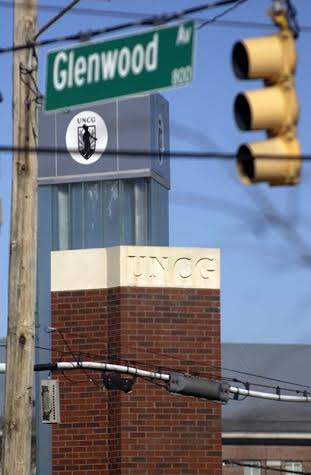
Residents of the Glenwood neighborhood are increasingly troubled over the expansion plans of UNC-Greensboro, as the Greater Glenwood Neighborhood Association (GGNA) has called for mediation with the university to solve disagreements over the new Spartan Village II development and other issues.
“It feels like we’re an afterthought in this new development,” Glenwood resident Scott Trent said. “I live right on the same street as the new rec center, where they blocked off Neal Street without informing us, and I still don’t know if it will be permanently blocked.”
Relations between the university and the neighborhood reached an impasse last July after a meeting between neighborhood representatives and the UNCG design team.
Minutes of the meeting obtained from both sides show a drastically different interpretation of the relationship, with residents complaining that the development would not serve the needs of both students and residents as had originally been promised.
“GGNA representatives expressed concern and dismay that the mixed-use development that UNCG had promised would serve the needs of Glenwood neighbors as well as students is not shaping up as we had been led to expect,” read an addendum to the minutes compiled by Nancy Lenk, secretary of the GGNA, and Burt Smith, leader of the GGNA design delegation.
The addendum was written to express the views of neighborhood representatives that were omitted from the official minutes compiled by Eric Schoenagel, the project manager.
Complaints by the GGNA center on the decision made to move retail stores from Gate City Boulevard to an area off of Glenwood Avenue and a ban on the sale of alcoholic beverages on development property, according to the addendum.
“UNCG’s promises of ‘mixed-use,’ ‘retail,’ ‘five restaurants’ and ‘a grocery store’ have been called into question by the recent disclosure that alcohol sales of any kind will be prohibited within the boundaries of the RVP,” or the Revised Vision Plan, adopted by Glenwood and UNCG in 2011 after extensive input from residents.
The official minutes of the meeting paint a more optimistic portrait of the relationship.
“Little’s and EDC’s retail experts helped locate the retail so that access, visibility and flexibility could be provided for the retail partners. Retail fronts portions of Gate City Boulevard and Glenwood Avenue with the primary focus of development at the corner of Gate City Boulevard and Glenwood Avenue.” The official minutes note, simply, that it was “impractical” to place storefronts along Gate City Boulevard without mentioning the resident’s concerns or complaints.
There is no mention in the official minutes of the alcohol issue, though the addendum reveals that residents regard restaurants that serve alcohol as a major factor in making the development appealing to those in the neighborhood.
“GGNA representatives expressed frustration and resentment that we were promised restaurants where neighbors could go to have a beer or glass of wine with dinner. And GGNA contends that one could reasonably expect to find beer and wine in a full-service ‘grocery store’ intended to serve the Glenwood community,” reads the addendum.
The GGNA alleges that the disagreements add up to a violation of item 23 of the Memorandum of Understanding (MOU) reached between the neighborhood and university in 2012, leading the GGNA to unanimously invoke the mediation provision of the MOU at a meeting on Jan. 7, according to a letter sent out to Glenwood residents by GGNA president Elizabeth Keathley.
On Jan. 29, Glenwood residents were invited to attend a “meet-and-greet” with UNCG Chancellor Frank Gilliam at the Glenwood Community Center.
“I am also looking forward to receiving your feedback, as we continue to work together to enhance the engagement and collaborative efforts between the University and the Greater Glenwood community,” Gilliam said in an email, without addressing the demand for mediation.
The GGNA and residents have made real efforts to keep the neighborhood vital, according to Lenk.
“We have a community garden and a sculpture garden with art by UNCG students,” Lenk said. “Last year, we had a October festival with music and vendors and a home ownership class.”
Lenk says that UNCG has made some contributions to neighborhood revitalization but questions UNCG’s long-term commitment.
“Their self-interest and our self-interest are not the same,” Lenk said.
Students from UNCG have planted flowers in one of the neighborhood parks, but Lenk isn’t sure if it’s “just for students to learn, or part of a continuous effort.”
“They spend a lot of money on consultants, but I’m not sure if they listen to what they have to say,” Lenk said, referring to the company that organized the meetings that led to the development of the Revised Vision Plan. “It just seems like it’s more campus-oriented.”
 THE CAROLINIAN