
Katerina Mansour
Staff Writer
No matter who you are, you have privileges as well as oppressions.
Oftentimes, we like to focus a lot on the ways in which we are oppressed, the struggles we face. However, it is critical for us to acknowledge our privilege.
Based on factors, such as your race, gender, class, nationality, sexuality, religion, education and more, you will face a different set of advantages and disadvantages in society.
You might be privileged due to your race but face incredible strains due to your class and education. You could be oppressed due to your sexual orientation but incredibly privileged in terms of your race and gender.
There is an intersectional approach that must be taken when analyzing privilege and oppression. This can be seen in the writings of Kimberle Crenshaw, a scholar within the field of race.
In this article, I would like to focus on white privilege, since it is the most problematic form of privilege we face throughout the world. However, I do encourage everyone who reads this to take a second and think of the ways in which you are privileged.
While I was studying in South Africa, my professor studied this very issue; and, fortunately, my class was able to participate in a sociological experiment relating to the issue.
At first, there was the obvious expectation from everyone that white people would have a lot to write down about their privilege, but then things became tense when our Afro-Indian female professor insisted that the black students should be writing things down as well.
The fact that they were attending the University of Cape Town in itself was a sign of privilege. This was a difficult pill to swallow for many students, but by the end of that class period, we all learned a lot about each other and ourselves.
A major reason white people don’t tend to accept the idea of white privilege is because they think that by admitting white privilege exists, they’re calling themselves racists. This is, of course, not the case.
Accepting the fact that you are privileged due to your race does not mean you are being racist or that you are guilty of anything.
The way society has been shaped to view white people as the dominant, superior race is the problem.
The elite classes continuing to uphold stereotypical beliefs about black people and their perceived inferiority is the problem.
The structural violence against black people within the law, the workforce or the housing system, is the problem. The refusal to admit that black people still face racism and discrimination is the problem.
Admitting you are advantaged due to your race brings you closer to the solution.
Yet, many people flat-out refuse to admit white privilege exists. We need to get over whatever notions hold us back from accepting this fact.
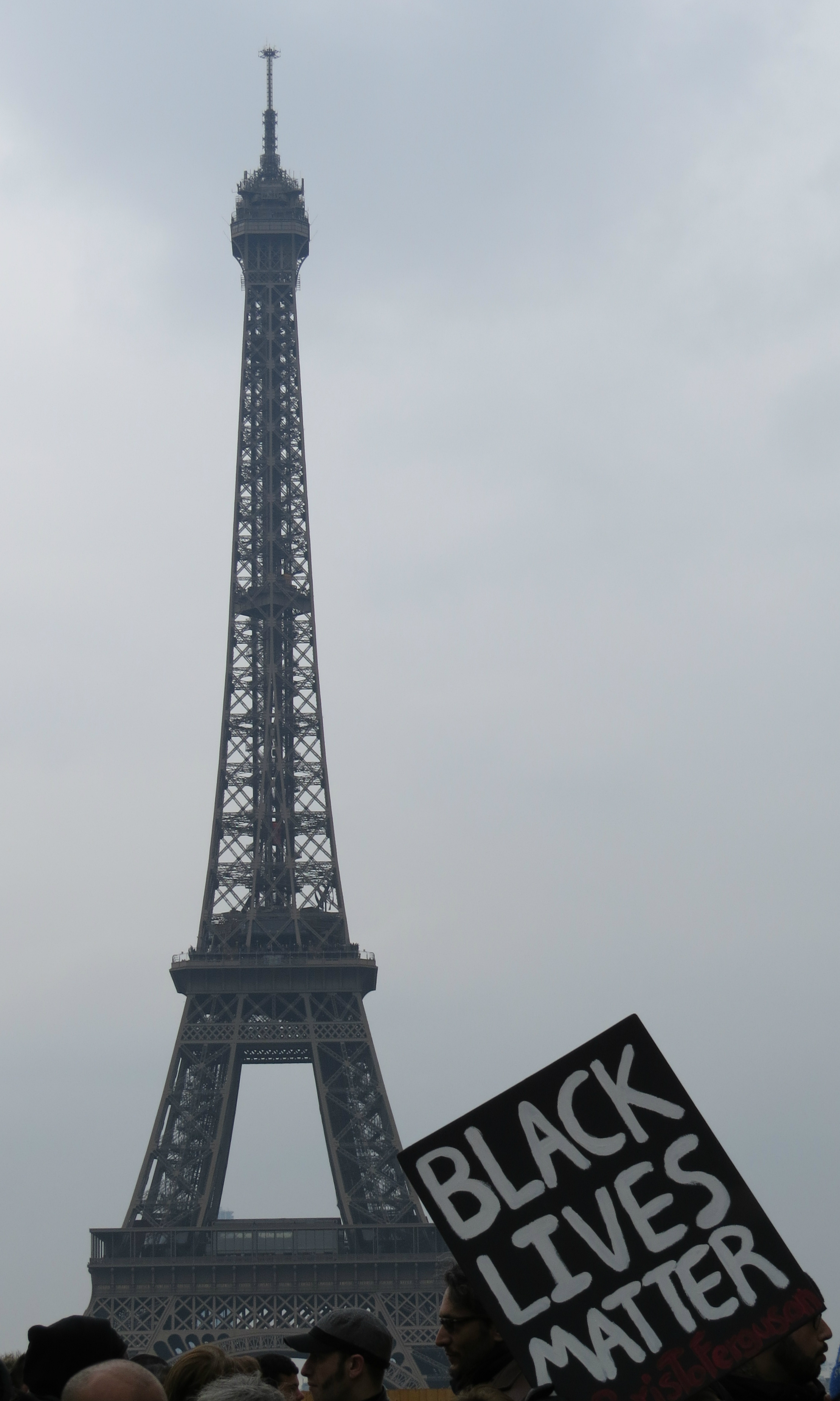
You might not realize it, but by insisting that there is no privilege to being white, or that being black doesn’t mean you face any struggles anymore, you are further oppressing people of color. A recent example of this was the response to #BlackLivesMatter.
Outraged by the idea that black people could be in the spotlight and fight for their humanity, white people couldn’t help but bring back all the attention to themselves by creating responses such as #AllLivesMatter or #BlueLivesMatter.
Yes, we all know that all lives matter. The point is that blacks have continuously been stripped of their humanity, and they deserve to be recognized as equal human beings that matter in this world.
#AllLiveMatters in effect silenced the voices of black individuals just like our colonial ancestors did.
But now, let’s do a little international comparison in terms of racial privilege.
I’ve lived in the U.S., France and South Africa, so I’ll speak a little bit more about these three countries.
In South Africa, black people are the majority, yet they are not treated equally. Naomi Klein, a prominent writer on the subject, explains that as of 2006, 70% of South African land was still owned by white people, despite the African National Congress’ (ANC) promises to redistribute the land.
The redistribution has yet to occur to this day as it is continuously being postponed. Unemployment for black South Africans has increased from 23 percent in 1991 to 29 percent in 2012, according to The Economist. And due to South Africa’s struggling economy, this figure is showing no signs of decline.
Official state statistics estimate that roughly 58 percent of white South Africans enter some type of higher education, while only 12 percent of blacks do.
These statistics are not the result of black South Africans lacking a desire or motivation; it is because they are not offered the same resources as those available to the white population.
In this case, privilege due to race extends to class as one’s race in South Africa largely determines to what class you are placed.
In France, the issue of race extends mostly to Arabs, more specifically to Muslim Arabs. Some might attribute this issue to recent terrorist attacks, but these events have only exacerbated a problem that has existed in France for decades, long before even 9/11 happened.
Due to its colonial history with Northern Africa, France continuously struggles with Arab immigration.
The majority of the population views Arabs as troublemakers, criminals, uneducated and even a religious and cultural threat to the country. Because of this, a great deal of social discrimination occurs, which also pours into the economic and political arenas.
Many employers refuse to hire Arab candidates and are especially discriminating when it comes to hiring Christians versus Muslims.
It has gotten so bad that Arabs feel like pariahs within France, even when they are lawful residents of the country.
Almost every political party in France debates the topic of Arab immigration and the spread of Islam throughout the country, further stigmatizing Arabs, treating them like a threat to be eliminated.
In this case, privilege extends to the advantage you have by belonging to a religious community that is favored by the majority of the world.
The U.S. is a case most of you are familiar with. Unless you’ve been living in a cave, you’re aware of the struggles African-American individuals face.
As a white person, people don’t question how you got into a school or got a job. They just figure you’re smart or skilled.
As a white person, you’re less likely to be arrested, and this isn’t because white people commit fewer crimes; it’s because black people have a target on their backs and are expected to commit crimes.
As a white person, being well spoken is expected, unlike for blacks who are told they “sound white” if they speak in an educated manner.
As a white person, you are portrayed in the media in a diverse way, whereas blacks are almost always portrayed as over-sexualized, violent, savage, as thugs or criminals.
The list could go on forever, so please, can we just say it?
Can we just finally all accept that yes, white privilege exists?
Because once we do, we can start working on ways to diminish the way we oppress others and increase the privileges others are bestowed.
 THE CAROLINIAN