

Catie Byrne
Features Editor
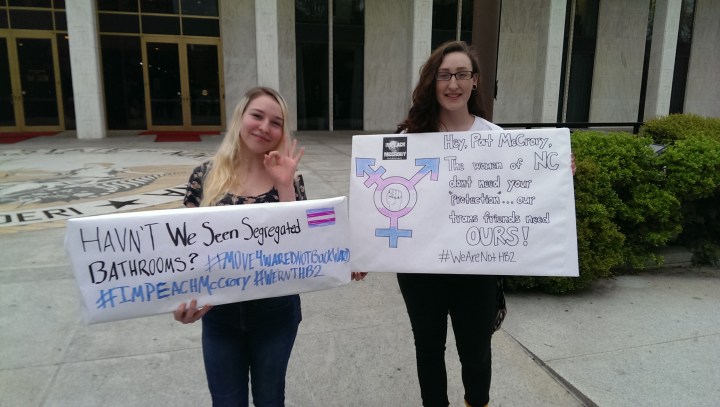
Upon arrival to the transgender rally against House Bill 2 on Friday, April 1, the air was fraught with the chants of 40 protesters, three chatting policemen and tension; as protesters circled the North Carolina Legislative Building with an array of colorful signs, flags and posters in hand.
Wearing a blue, pink and white trans pride flag as a cape, which featured the trans woman emblem on it, 31-year-old trans woman and rally organizer, Laura Nazario, opened the rally up with a bullhorn in hand, and recounted the significance of what it means for transgender people to be gathered at the North Carolina Legislative Building protesting for their rights the day after March 31, the national trans day of visibility.
Nazario, the only trans woman of color at the rally, noted that it was important to remember why so many trans people — predominantly trans women of color like herself — chose not to be visible in order to protect themselves from the violence which disproportionately affects them, more than any other group of trans individuals.
She also described the ways in which her experience as trans is also impacted by her other marginalized identities. Nazario said, “I’m transgender, I’m hispanic and I’m part Jewish, so, all those things put together, put me at a very low place in the matrix of domination. So, with that being my reality, all of this attention makes it even harder; and being so visible just adds to that. It’s not an easy place to be… We’re just human beings, we’re flawed just like everyone else, and we’re just trying to live our lives.”
As the rally progressed, the various stories of transgender people of all ages and genders, reflected Nazario’s sentiment to wish to be able to live in peace, and free of the constraints which HB2 puts on their agency as trans people.
Thirty-year-old trans woman, Vivian Taylor, described the struggles and fear she experienced going to the bathroom, before she was able to be recognized as a woman.
“For a while, I didn’t pass, and that’s a terrifying thing, because you just never know when you’re going to get hurt. Even for myself, as a more privileged, white trans woman, there are still very real dangers I face, all the time. I want better for the State,” said Taylor.
This is a concern that 29-year-old trans woman, Hadassah Chapman, echoed.
“I’m actually more afraid to be out than normal. I already have anxiety as it is, and now my anxiety is much worse. So, where do I go with that? I’m going to keep using the women’s restroom, I’ve done that for six years… For the most part, I pass, but there are sometimes people, in like smaller areas that ask me, ‘Are you female?’ and I always have something funny to say in response, like, ‘Today I am.’”
Three high school trans people, who wished to only be referred to by their first names, raised issue with political rhetoric which perpetuates a narrative that characterizes trans people as predatory bathroom invaders.
Quinn, a 15-year-old trans man said, “We all hear the stories politicians tell about trans people going into the bathroom and assaulting people, but why is the focus only on trans people? What about the cis men and cis women who are hurting kids?”
Sixteen-year-old agender person, Louis, expanded on Quinn’s question, and argued that the focus is put on trans people in order to sensationalize their everyday practices, such as going to the bathroom, and dehumanizing them as a group, by painting them as predatory monsters.
“If there are groups of people they [politicians] can oppress, they’re going to oppress them. They use fear-mongering, they say, ‘Oh, trans people are going to assault people in bathrooms, [but] people are going to be assaulted everywhere, like, bathrooms are not special in that [problem],” said Louis.
Eighteen-year-old trans girl, Zoe, concurred, and said that she felt othered and alienated by the bill, as it reinforces the kind of transmisogyny she experiences that disallows her from using the women’s restroom at her high school.
“I think one of the most frightening things about HB2 is not the affects, but the message that it sends. It’s basically the government saying, ‘We’re not on your side, and we’re actively encourage you to discriminate against people.’”
As the rally came to a close, Nazario recounted her prior experience at the North Carolina Legislative Building, and encouraged protesters to continue to fight against legislation that takes away trans peoples’ rights.
“The last time I was here, I was in that building, watching the senators debate on my life and my rights. I spoke to the senate, and told them about how this bill would affect me, and I spoke from my heart. After I spoke, one of the senators came up to me and shook my hand, and he said, ‘Thank you for speaking, you did so great, I’ll never vote your way, but thank you for coming.’ He walked off with a smirk and went about his business. I heard you all today to make it your goal to get these people out of office, because they don’t belong here, and they don’t deserve to run our lives and determine how our lives will be,” said Nazario.
 THE CAROLINIAN