

Olivia King
English MA Student
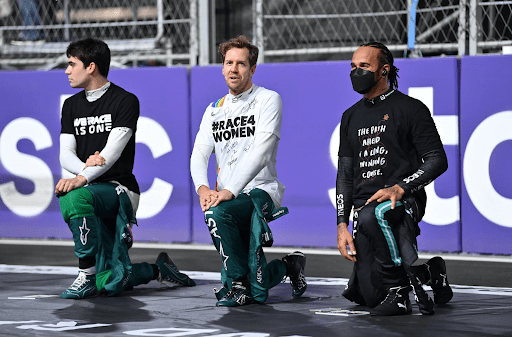
Formula One (also called Formula 1 or F1) is the highest level of international motorsport. Currently, it consists of 10 teams (each led by a Team Principal) and 20 drivers (two drivers per team). The race season consists of 23 races spanning five continents, with a 24th race added to next year’s calendar. The series’ expansion is partly because of new people joining the sport’s upper levels of administration. By the end of the 2021 racing season, there had been a leadership change within F1’s governing body, the Federation Internationale de L’Automobile (FIA). The new FIA president, Mohammed Ben Sulayem, immediately began making changes and strived to push the sport into the American market.
The sport has seen a surge in viewership since 2017, some of which derives from Netflix’s dramatized documentary series Drive to Survive. The streaming service added the show in 2018 but did not garner a massive following until the pandemic. The show follows the 10 teams and their drivers throughout the racing season while giving audiences a behind-the-scenes look at the sport’s business and politics. Every few years, the Motorsport Network, in partnership with F1, collects and analyzes a survey about the sport’s viewership. According to motorsport.com, the most recent survey in 2021 polled 167,000 fans across 187 countries. The results indicated that female viewership (as the survey quantified) had doubled, the average age of viewers had lowered to 32, and overall viewership had increased in the U.S., India, China, and Mexico.
Given the fanbase changes to the fanbase, new F1 president and CEO Stefano Domenicali, in conjunction with Sulayem and the FIA, began expanding the race calendar from the 21 races on the 2021 schedule. There has traditionally been only one race in the U.S., at Circuit of the Americas in Austin, Texas. However, there is now a suitable F1 track in Miami, Florida, and a street circuit around the Las Vegas strip in Nevada. These internal and external changes (the pandemic, global politics, and social movements) have presented F1 with an interesting predicament. How do they navigate the changing and conflicted global landscape while growing their audience?

In February of this year, the FIA introduced a new regulation to the International Sporting Code: article 12.2.1.n, commonly known as “Guidance on the Principle of Neutrality.” This article restricts drivers and teams from speaking out or showing their support for organizations or social issues during the racing event. The official policy reason behind this is “To ensure respect for this diversity, it is fundamental that motor sport remains neutral and thus separate from and free of political, religious, or personal interference.” While to some, this policy seems extreme (and it has created vitriolic discourse online), the sport has agreements with many countries––each with their own laws, beliefs, and cultures.
Each track has a contract with the sporting organization that both parties must renew for F1 to race there. However, the new policy extends to a driver’s or employee’s personal social media, and the governing body has not explicitly stated what they consider to be the racing event. Is it the three-day weekend filled with practices, qualifying, and the race? Or is it the whole race week?
Many drivers, including Sir Lewis Hamilton, Lando Norris, and Alex Albon, have expressed confusion and frustration at this new policy. At the beginning of this year, Finnish driver Valtteri Bottas stated in an article for The Independent, “I don’t understand why they want to control us. I think we should have the right to talk about what we want.” Article 12.2.1.n will also impact the teams’ activism, including for the many that have recently joined Racing Pride, an organization created in 2019 to support LGBTQ+ drivers and employees within motorsport. Issues related to racism, sexism, antisemitism, and further discrimination persist within different facets of the sport. Many drivers used their platform to show their support for causes related to these issues. While it is undetermined if this policy change will be long-lasting, the effects are already starting to appear. Given the sport’s growing popularity in the U.S., especially with the younger demographic, the policy will continue to influence the perception of the sport and the individuals within it.
 THE CAROLINIAN