
Megan Guzman, Opinions Editor
A little over three weeks ago, signs popped up around Center City Park in downtown Greensboro with the following message:
“Food and resource distributions are no longer allowed, in or adjacent to the downtown parks including along Friendly Avenue or Elm Street, due to ongoing pedestrian safety and waste management concerns. Distributions may now be offered and reserved at two alternate locations, by contacting the parties below:”
The sign includes contact information for City Hall Plaza and Tiny House Community Development, the latter being over a mile away from Center City. This policy is the latest in a series of decisions by the Greensboro City Council that have made being unhoused in Greensboro increasingly impossible.
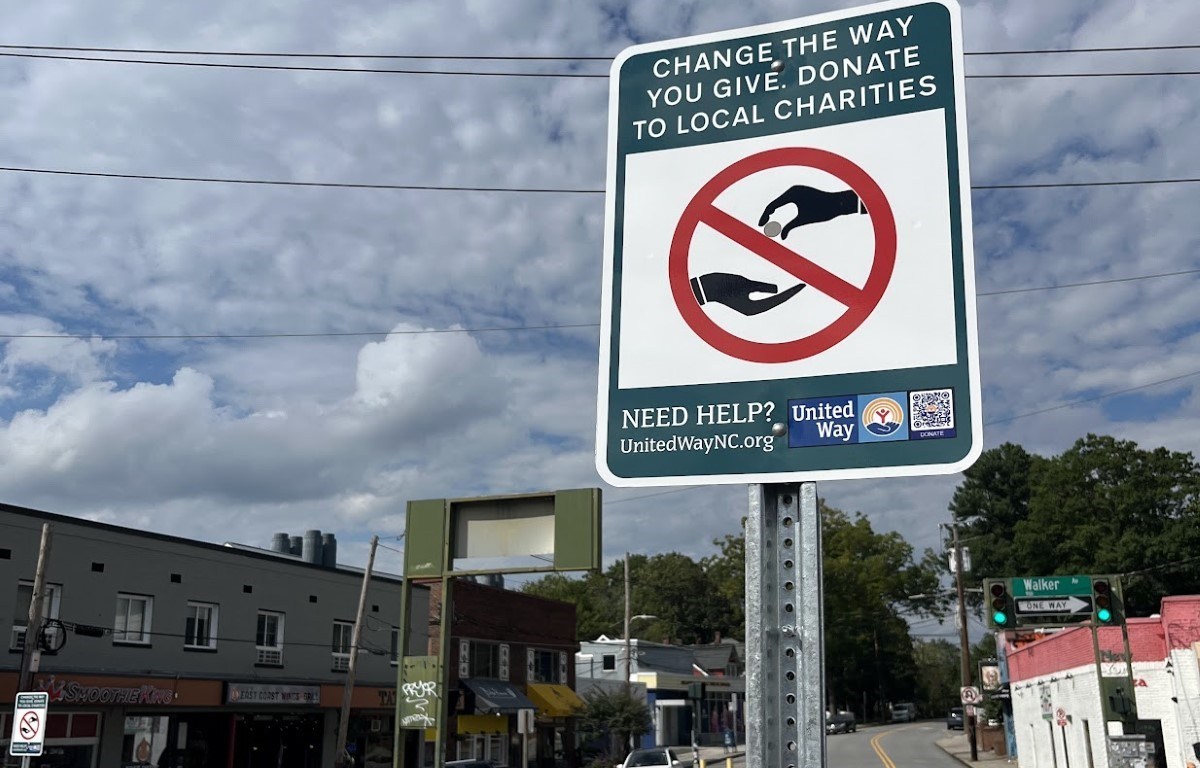
I began to notice this phenomenon when different, yet equally troubling, signs appeared across the city encouraging people to donate to large nonprofits like the United Way, rather than give directly to people asking for money on the side of the road. These “anti-panhandling” signs emerge across the state, with local jurisdictions arguing that panhandling threatens public safety. The signs say that giving money to people directly will not solve their problems and imply that unhoused people are irresponsible with their money. Rhetoric like this supports the belief that homelessness is the result of individual failings and can only be solved by state-sanctioned or corporate-funded organizations, like large nonprofits.
What these signs leave out is that many large nonprofits have barriers to entry with their programming, requiring unhoused people to refrain from drugs and alcohol, attend church services, or limit their interaction with other people. High barrier shelters exclude those most struggling and often require unhoused clients to be searched, surveilled, and policed.
In Greensboro, one of the most important resources for people experiencing homelessness, the Interactive Resource Center, is a “barrier free” center, with no requirements for the people they serve. This center has recently transitioned away from the 24/7 operation schedule it began at the beginning of the year and, instead, to an 8 am to 3 pm, Monday through Friday schedule. This came after months of complaints from local businesses about the IRC’s supposed threat to property values and from the City Council’s insistence that the IRC limit those who enter the center and employ armed security. The IRC, thus, chose to stay true to its mission of being a no barrier center and shortened its hours of operation.
The Greensboro City Council’s answer to homelessness is increased policing, surveillance, and arbitrary rules and regulations of the unhoused population, rather than focusing on solutions to save people’s lives. The City Council consistently inserts itself as the arbiter of care between the unhoused population of Greensboro and the rest of the community, without committing itself to tackling the root causes of homelessness. By policing mutual aid and food distributions through signage that discourages the housed community from connecting with their unhoused neighbors, the City Council continues to contribute to a culture that treats people experiencing homelessness as subhuman.
Local organizations, like GSO WHOA (Working-class and Houseless Organizing Alliance), combat this disconnection through direct action and mutual aid between working-class and unhoused residents in Greensboro. Members of WHOA attend city council meetings and distribute food and water to unhoused residents, advocating for housing, food, and healthcare as a human right and opposing the criminalization of homelessness.
The Greensboro City Council shows no signs of slowing down their anti-homeless tirade, with anti-homeless signage, architecture, and policies increasing by the day. Obviously, the city council cares more about maintaining property values than protecting people’s lives. Therefore, as organizations like WHOA illustrate, community members, both housed and unhoused, must continue to work together to distribute resources amongst each other and participate in direct action against oppressive institutions that seek to police, surveille, and eliminate members of society deemed “not productive” enough. I encourage readers to talk to your neighbors, classmates, coworkers, and/or community members about ways to support each other through these increasingly burdensome times. Our liberation is bound together.
As Lilla Watson famously said in a presentation from 2004, “If you have come here to help me you are wasting your time, but if you have come because your liberation is bound up with mine, then let us work together.”


Very insightful! Thank you for this
LikeLike