
Virginia Weaver, Senior Staff Writer
Microwaved Beef is a column by Virginia Weaver that reflects on flashpoints from the last few years in the culture wars. The rapid pace of contemporary discourse makes it easy to forget critical moments that have defined our social and academic lives for the last few years. Microwaved Beef brings those moments back into the spotlight.
According to an epochal Time Magazine cover from June 2014, America’s civil rights activists were ready to brave a new frontier. Few magazine covers loom so large in our zeitgeist’s short memory, because few have had such an impact in creating the zeitgeist.
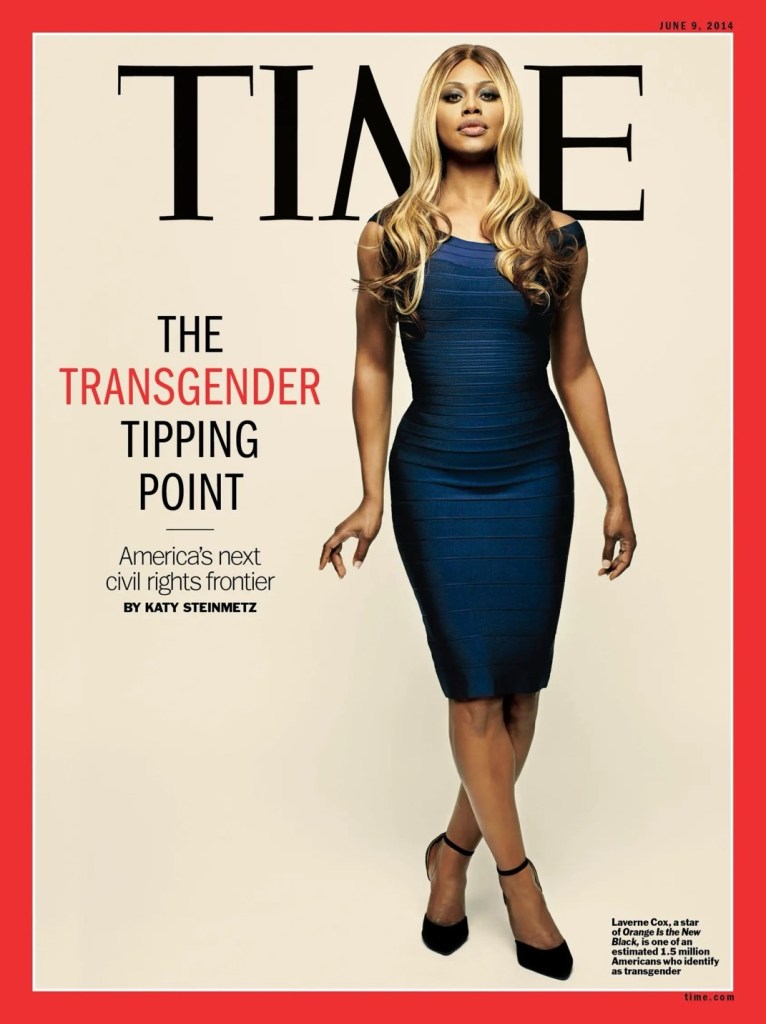
On Time’s most memorable cover, actress Laverne Cox strikes a confident and elegant pose in a form-fitting, navy blue dress, her head and shoulders blocking part of the TIME logo. In 2014, Cox was the most prominent trans actress in the business, having received acclaim for her role in Netflix’s hit series Orange is the New Black (2013-2019). The cover story’s title and subtitle stand out to Cox’s right: “THE TRANGENDER TIPPING POINT: America’s next civil rights frontier.”
While many readers recall the issue’s cover, few recall the cover story itself, in which Katy Steinmetz provides a useful sketch of the culture war’s gender front. It’s worth revisiting the article as a time capsule, since it allows us to trace the trajectory of hot button issues in the gender wars across their most furious decade. Each of the activist pressure points Steinmetz surveys would go on to become a crucial battleground in the gender wars over the next few years.
Earlier bouts of the gender wars are visible in the article, too. For instance, Steinmetz takes for granted the idea that sexual orientation has no bearing on transgender identification. This idea had been a microcosmic battlefield of the gender wars over a decade prior. From Steinmetz’s matter-of-fact statement that sexuality and gender identity have no connection, it’s clear that the battle over that distinction was no longer even worth referencing.
Schematizing the gender wars
Although all the topics in her tipping point article remain relevant, a few of Steinmetz’s main focal points, especially conflicts regarding sex-segregated spaces and non-binary gender identities, stand out as having played central roles in the gender wars since 2014.
Of the 27,715 respondents to the 2015 U.S. Transgender Survey, 35% identified with non-binary gender identities, 33% identified as trans women, 29% identified as trans men, and 3% identified as crossdressers. According to its early insights, the 2022 U.S. Trans Survey’s findings differ little from those of the 2015 survey. At the time of Steinmetz’s writing, statistics on the scale of the U.S. Transgender Survey were unavailable.
To Steinmetz, then, the topic of non-binary gender identification seems new, despite its prevalence as revealed by the massive survey only a year later. She informs the reader that “some trans people reject all labels, seeing gender as a spectrum rather than a two-option multiple-choice question.” In the following paragraph, Steinmetz notes understandingly that even people who are supportive of trans rights can become confused by the idea of a gender spectrum.
Steinmetz dedicates significant and detailed attention to the intensifying conflict over whether sports teams and bathrooms should be segregated according to sex or according to gender identity. She bundles these conflicts together with the largely unstated conflict regarding transgender identification among children and adolescents. That these three issues would become one unified cluster in Steinmetz’s prescient piece is telling, even if she does not elaborate on their common grounds. In fact, Steinmetz could have bundled all her topics together, because they all revolve around the idea of gender identity, and what it means—or should mean—for society.
The core question of the contemporary gender wars was already becoming clear. Should society and law start prioritizing gender identity alongside—or perhaps instead of—sex? The issue at hand was no longer how to treat patients with a rare psychiatric condition called gender dysphoria. At stake was a much larger, society-wide conceptual shift.
Steinmetz compares the goals and travails of transgender activism to gay rights activism numerous times. Perhaps in 2014, the comparison seemed obvious. Now, it’s become clear that not all trans people’s concerns map so tidily onto LGB people’s concerns or beliefs. The assumption that transgender activism entailed nothing more than applying the same methods to the next letter in the initialism was reductive at best.
Executive orders
In 2021, President Biden signed Executive Order 14021, which added gender identity to the purview of Title IX. Seven years on from the tipping point, gender identity had joined sex as a basis for anti-discrimination law.
In January 2025, President Trump signed Executive Order 14168, reversing former President Biden’s insertion of gender identity into law and laying out legal definitions of sex.
Writing for Time Magazine at the end of February 2023, Moises Mendez II followed up on Steinmetz’s seismic transgender tipping point article from nine years prior. He quotes Laverne Cox’s own reflections on the trajectory of trans acceptance in the intervening years. Cox remarked, “In 2023, we are at the height of the backlash against trans visibility.” Much had changed between 2014 and 2023. But the new transgender tipping point had yet to begin.
 THE CAROLINIAN