
Virginia Weaver, Senior Staff Writer
Microwaved Beef is a column by Virginia Weaver that reflects on flashpoints from the last few years in the culture wars. The rapid pace of contemporary discourse makes it easy to forget critical moments that have defined our social and academic lives for the last few years. Microwaved Beef brings those moments back into the spotlight.
Although Aristasia began as a branch of Madrianism, one of the many goddess-worship religions of the 1970s, what it became is difficult to classify. Was it a religion, a fandom, a roleplaying game, or something unclassifiable?
The Aristasian movement developed as a distinct community in the 1980s under the thumbs of Mary Martindale, who has used many names, and Priscilla Langridge, also pseudonymous and many-named. At this point, Aristasian practices centered on a lesbian, BDSM lifestyle, an early stage in the development of what the community referred to as “life theatre.”
The central tenet of Aristasia, if there could be just one, is that we are living in the Void. According to their doctrines, in the 1960s, the sexual revolution destroyed our civilization. Aristasia referred to this cultural decline as the Eclipse. We now live in the Void, and the Void’s cultural degeneracy is the Pit, in Aristasian jargon. Aristasia’s participation in the Filianist goddess-worship religion took a backseat, relative to the ideas of the Pit and the Void.
Early Aristasian communes took the form of period-themed households. St. Bride’s School for Girls, a Victorian-themed commune, remains the most notorious Aristasian commune in part because of an assault case against its founder in the 1980s.
Despite St. Bride’s School for Girls’s Victorian theme, at least one member of the movement produced several video games from the commune. Given its reactionary ideology, it may be surprising that Aristasia was so adaptable to the technological (technic, in their terms) moment. When the Internet became widespread, Aristasia made the leap into the digital realm on message boards, which it referred to as Elektraspace, as opposed to Telluria, or earth.
Aristasia required a space to itself, separate form worldly concerns, so that its adherents could participate in the fantasy of living in an alternate, utopian world known as Aristasia Pura, an extraterrestrial empire that did not undergo the Eclipse. Also known as the Feminine Empire, Aristasia Pura was an imaginary domain ruled by one Empress, and divided into seven lands ruled by queens, each themed after a pre-Eclipse decade or era with one exception. The lands are as follows. Quirinelle, the most popular land, is fixed in the 1950s. Kadoria: 1940s. Trent or Trintitia: 1930s. Vintesse: 1920s. Arcadia: Victorian and Edwardian. Amazonia: Ancient. Novaria: At least the 2020s; the utopian future.
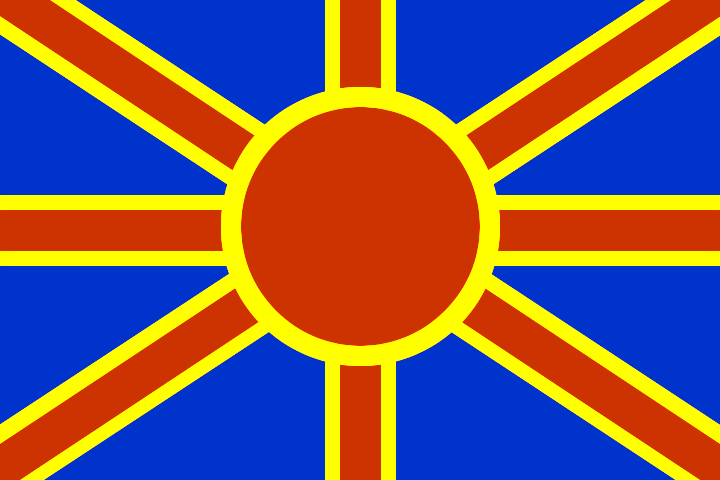
The flag of Aristasia Pura.
The alleged denizens of Aristasia Pura were not human, but aliens known as intermorphs. Aristasian intermorphs are all what humans would think of as anatomically female, with a few distinctive twists. There are two sexes of intermorphs: blonde, or chelani, and brunette, or melini. Intermorphs are oviparous, as in, they lay eggs. They live to around 200 years old and can regrow lost limbs.
Functionally, the intermorphs served as an opportunity for online role-playing. An Aristasian-in-Telluria, as in a human who lives on Telluria (earth) but participates in the Aristasian community, could have multiple online Aristasian personae at once. They could live out an Aristasian life on forums and, eventually, Second Life (Virtualia, in Aristasian terms), while maintaining their humdrum life in Telluria.
Aristasia was never a large community or religious group, but in 2005, a decisive sectarian split doomed the movement. Operation Bridgehead was a coordinated effort by a sect of disgruntled community members to reshape Aristasia according to their values, in the past and the present, by deleting old resources and dictating the movement’s direction going forward.
Two primary doctrinal differences separated Operation Bridgehead proponents and operatives from the run-of-the-mill Aristasian-in-Telluria. Firstly, they wanted to eradicate any memory of Aristasia’s kinky lesbian origins in favor of an extreme focus on their values of innocence and cuteness. Secondly, they believed in the literal existence of Aristasia Pura. For them, it was not a roleplaying game or a fanfiction setting.
With the community in disarray in the wake of the highly successful Operation Bridgehead, post-2005 Aristasia experienced what biologists call survival without recovery. Operation Bridgehead did not destroy Aristasia in a moment, but it guaranteed its extinction.
By the very early 2010s, what little remained of Aristasia was more or less run to the ground by the Bridgehead-aligned sect, Chelouranya. But Aristasia was functionally over before Chelouranya began. All that remain are hollowed-out websites and odd jargon one stumbles across from time to time in depopulated forums.
What may once have been niche, obscure moments in religious history now receive disproportionate degrees of media coverage. The Love Has Won movement, which spread through online outreach and became the subject of an HBO docuseries, has few members and little cultural impact. A video essay on the creator of an obscure Christian operating system known as TempleOS has 7.3 million views at the time of writing. Aristasia itself has yet to receive the same treatment, but the current pop cultural fascination with the intersection of religion and the Internet shows no signs of abating. The Internet may seem spiritless to some of its users, but many religious communities, new and old, beg to differ.
 THE CAROLINIAN