
Virginia Weaver, Senior Staff Writer
Microwaved Beef is a column by Virginia Weaver that reflects on flashpoints from the last few years in the culture wars. The rapid pace of contemporary discourse makes it easy to forget critical moments and trends that have defined our social and academic lives. Microwaved Beef brings those moments back into the spotlight.
For almost a year, discourse in the US regarding transgender rights has been dominated by President Trump’s executive orders and the Supreme Court decision in United States v. Skrmetti, which upheld the constitutionality of Tennessee’s restriction of access to youth gender medicine. However, just before this wave of legislation in the US began, the feminist commentariat were raptly observing the development of a discrimination case that had made its way to Australian federal court. That case was Tickle v. Giggle. This case forced the Australian legal system to answer, more clearly than ever, a key question: Who can be excluded from single-sex spaces? Onlookers saw Tickle v. Giggle as a crucial showdown in the “gender war,” and even, as Petra Bueskens wrote, “a disagreement about the nature of reality itself.”
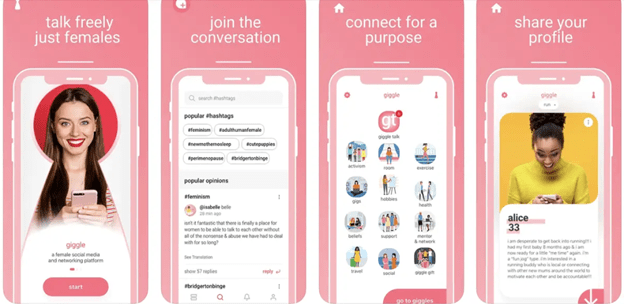
In 2020, Australian businesswoman Sall Grover launched a social media app, “Giggle for Girls,” commonly known as “Giggle,” that only allowed women to join. As reported by Business Insider, shortly after its launch, Giggle was subject to controversy for its use of flawed AI software to detect whether prospective users were male or female. Critics also swiftly found fault with Grover’s intention to exclude trans women from her social platform. However, Grover later clarified that she had intended to allow trans women to use the app but changed the policy after receiving threats and harassment from trans women online. Business Insider reported that Grover took Giggle off Google’s app store in December 2021 to hamper trolling efforts by some of the app’s most vociferous critics.
Giggle also faced serious technical challenges behind the scenes, beginning shortly after it went online. In a November 2022 interview with journalist Meghan Murphy, Grover explained that she had never been able to launch Giggle properly and that, having learned from her experiences in the three years since she began to work on the app, she had decided that the time had come to take Giggle fully offline and relaunch it after substantial maintenance and alterations. “We’re renovating [Giggle] and updating it, so don’t download it right now. It’s about a month and a half from relaunching,” she told Murphy. Giggle has not yet relaunched at the time of writing. Grover has made it clear that she will only bring Giggle back online if it becomes lawful to exclude transgender women who try to join, which is currently illegal in Australia, as made clear by Grover’s loss in the climactic Tickle v. Giggle.
In February 2021, an Australian trans woman named Roxane Tickle downloaded Giggle. The app’s face detection software allowed her to create an account, but, in September 2021, she was banned from Giggle, in accordance with the app’s policies. She privately attempted to contact Grover about the issue. Grover found this experience unnerving, as Tickle allegedly contacted her via phone, which was not an ordinary way for Giggle users to get in touch with her. In December 2021, Tickle filed suit against Giggle for discrimination, setting in motion the case that would become Tickle v. Giggle.
Tickle v. Giggle received significant international attention. The peculiar draw of the case rarely lay in the precedent that it might set for discrimination law in other United Nations member states. Nor did the mistaken notion that Australia would be ruling on the definition of “woman” draw this far-flung interest for the most part.
At stake in Tickle v. Giggle was discrimination law, not the definition of womanhood. A 2013 revision to Australia’s 1984 Sex Discrimination Act had made it illegal to discriminate on the basis of gender identity, yet this law remained largely untested. As the BBC reported, Tickle v. Giggle “is the first time alleged gender identity discrimination has been heard by the federal court in Australia.” The controversy at hand was whether single-sex spaces that discriminate on the basis of natal sex–always a heated topic in the gender wars–could still be legal in a nation exemplary for its progressive legislation concerning gender.
Although Australian law against gender identity discrimination had never been tested in federal court, few onlookers were surprised that Tickle won the case, which reached its conclusion in August 2024. Grover’s supporters saw her loss in Tickle v. Giggle not merely as a legal blow to their cause, but as a defeat in a much bigger cultural struggle. After both Grover and Tickle had appealed the decision at the end of 2024, author JK Rowling expressed support for Grover and the two planned to meet early in 2025. Grover has yet to cede her argument.
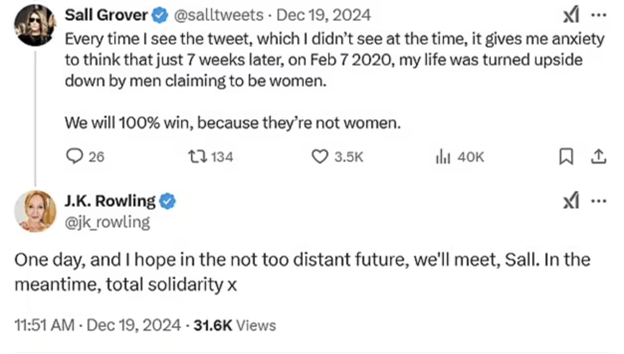
Media attention had almost entirely shifted away from Tickle v. Giggle and its outcome by December 2024, when Rowling and Grover exchanged posts on X. Nevertheless, the case continues to resonate with intensifying cultural battles over sex and gender across multiple nations. After all, what mattered to onlookers about Tickle v. Giggle was not the letter of Australian law, but its context within the culture wars.
 THE CAROLINIAN