
Virginia Weaver, Senior Staff Writer
Microwaved Beef is a column by Virginia Weaver that reflects on flashpoints from the last few years in the culture wars. The rapid pace of contemporary discourse makes it easy to forget critical moments and trends that have defined our social and academic lives. Microwaved Beef brings those moments back into the spotlight. Today’s edition is a Halloween special.
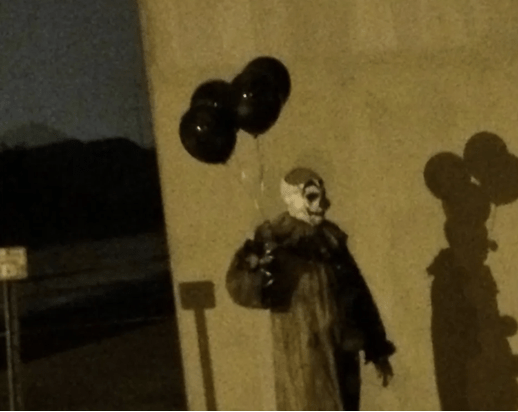
This October, Spirit Halloween seems close to bursting with creepy clown costumes and merchandise. Pennywise, the evil clown of Stephen King’s 1986 novel It and its popular film adaptations, and Art the Clown, the primary antagonist of Damien Leone’s Terrifier films have become prominent icons of the macabre. But a decade ago, residents in the US and parts of Europe were petrified by alleged–and sometimes verified–encounters with real-life monstrous clowns.
Creepy clown incidents began at least as early as 2013 when a college student in England dressed up as Pennywise from It as part of a performance art project. A few months later, a copycat was spotted several times in New York. Stephen King tweeted in response to these sightings, “Pennywise spotted on Staten Island. Do I get royalties?”

Just before Halloween 2014, the mayor of Vendargues, France, banned clown costumes in his town. This decision came in response to a series of incidents in which individuals dressed as clowns had scared or even assaulted unwitting victims.
Creepy clown sightings peaked two years later, in 2016, culminating in a mass social panic. Although a creepy clown spotted in Wisconsin had received national coverage a few weeks prior, the first major incident in the new wave of alleged sightings came in August 2016 in South Carolina.
According to a Greenville County sheriff’s report and reporting by the New York Times, several local children had alleged that individuals dressed as clowns had tried to lure them into a nearby patch of woods, and other residents of the area had reported creepy clown sightings too. These incidents remain unconfirmed. Nevertheless, they provoked a reaction from concerned locals, and the story received widespread coverage.
Following the wave of alleged sightings in South Carolina, the clown panic spread across the US. In many cases, the sightings were hoaxes or pranks. In response to a few incidents, however, individuals associated with creepy clown activity were arrested on charges of serious criminal activity, including terrorism. In Connecticut, the Director of Security for New Haven Public Schools asked that principals ban clown costumes in their schools as “symbols of terror.”
In early October 2016, a journalist asked White House Press Secretary Josh Earnest whether President Obama knew of the clown panic. Earnest responded that he was unaware of whether the president had been briefed on the creepy clowns but stated that he was familiar with the situation and supported thorough investigations of alleged incidents by local law enforcement. While Earnest seemed bemused by the question, and the journalist appeared to giggle while posing it, the Press Secretary’s response received grimly serious news coverage. ABC, for instance, framed the exchange as indicative of how dire the clown threat had become: “The problem has become so widespread that even the White House weighed in today…”
Although the 2016 clown panic began in the US, it spread quickly to the UK, starting in September—only a month after the panic’s origins in South Carolina. British law enforcement officials warned against participation in clown-related pranks. According to CNN, police in Thames Valley received 14 reports of clown sightings in a single 24-hour span at the height of the craze in October 2016. Durham’s police investigated an alleged incident in which a person dressed as a clown had followed several schoolchildren while holding a knife. The New York Times reported a sinister episode in Essex in which men dressed as clowns invited two schoolgirls into their van for a “birthday party.” The clown incidents became too frequent to ignore, and especially in the UK, numerous alleged clown sightings in 2016 involved threatening elements such as weapons and implicit attempts at kidnapping.
Stephen King responded to the sightings and incidents as they began frightening far more people than had the Staten Island clown of two years prior: “Hey, guys, time to cool the clown hysteria–most of em are good, cheer up the kiddies, make people laugh.”

Beginning in late October 2016, critical perspectives on the clown epidemic began to emerge, cooling off tensions. In a piece for The Guardian on Halloween 2016, culture critic Steven Poole argued that the clown panic was “a volatile mix of fear and contagion,” and that “[t]he creepy clown… embodies wider cultural faultlines of the present day.”
Even at the height of the 2016 creepy clown epidemic, critics had begun connecting the wave of fear to broader cultural phenomena, such as folklore. Indeed, many alleged incidents resemble classic instances of urban legends, our modern folklore equivalent. Urban legends, argues popular history podcaster Chelsey Weber-Smith, can damage the fabric of society, discouraging community-building and raising suspicion of our neighbors for fear of “unimaginable vengeance by… nameless and faceless hordes of sociopathic boogeymen.” In some towns, the creepy clown epidemic led to increased police surveillance and restriction of kids’ outdoor activities, such as recess, at a time of year associated with outdoor festivals and the once-yearly joy of trick-or-treating. After all, as Weber-Smith reminds us, social panics fueled by urban legends can lead to the propagation of “sensational falsehoods that have material consequences.”
 THE CAROLINIAN