
Carole-Anne Morris, Editor-in-Chief
I love that old Buffalo Springfield song. You know the one: “I think it’s time we stop/ Children, what’s that sound?/ Everybody look what’s going down.” One of the best protest anthems ever penned. It’s a gentle, almost tender admonition of apathy that stirs me every time I hear it.
Most people, including myself until the writing of this article, assume “For What It’s Worth” is a response to the calamities of the Vietnam War. But it turns out that Stephen Stills wrote it after the Sunset Strip Riots of 1966, a set of violent clashes between LA cops and citizens protesting the demolition of a beloved nightclub doomed to be replaced by strip joints.
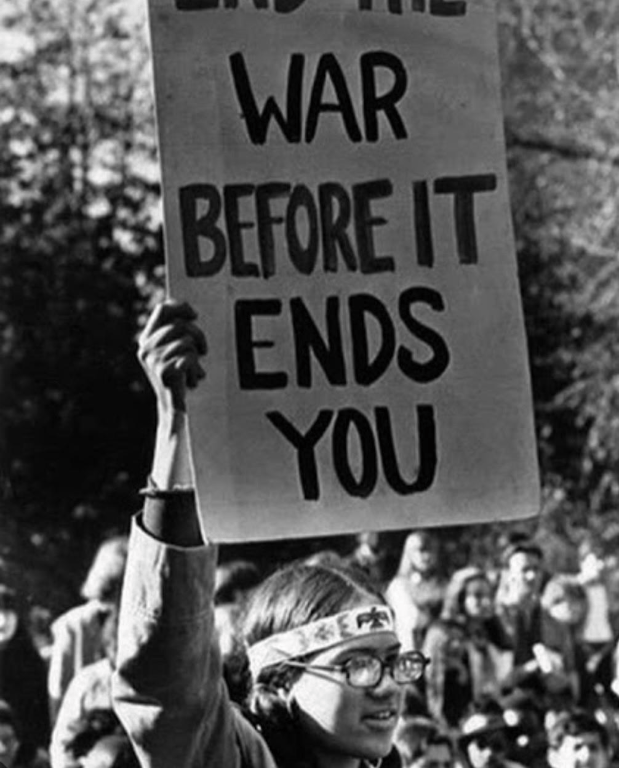
It’s the age-old tableau of power dynamics: authority versus the subjugated, oppressors versus the oppressed. That’s why “For What It’s Worth” really does conjure the vibey late-60’s counterculture that rejected the Vietnam War, helping shape Dan Ellsberg and his brave disclosure of the Pentagon Papers in 1971. The fallout led to the war’s end and New York Times v. United States, a landmark win for freedom of the press. In it, the Court delivered a proverbial haymaker to the government by outlawing prior restraint. Without the ability to suppress reporting, the government’s ambition to control media narratives while also perpetrating war crimes was, if not utterly shattered, at least curtailed.
There’s a reason journalists have a special obligation to serve as “watchdogs over public affairs and government.” Those in power have an unfortunate tendency to abuse it, and we need journalists to keep shining a bright, sanitizing light on deeds done under the cover of secrecy and darkness. That’s why the Pentagon’s new press policy is so suspect.
Sean Parnell, Department of Defense chief spokesperson, says that the new policy is merely an “overdue update” to the Pentagon’s “credentialing process.” What is this but the basest wordplay? The policy is a clear attempt to strong-arm journalists by requiring them to refrain from seeking out information. Incidentally, journalism functions via the seeking out of information, so the question begs to be asked: why? Why else, but to gain control over media narratives and public perception? The Pentagon is also imposing restrictions on communications between its staff members and Congress for presumably the same reason. Secretary of Defense Pete Hegseth’s own memo confirms this, stating that “[u]nauthorized engagements with Congress…may undermine Department-wide priorities critical to achieving our legislative objectives.”
Yeah, we wouldn’t want a silly thing like the truth to get in the way of that $1 trillion budget, even though the Pentagon has a long and storied history of wasteful spending. Did you know, for example, that since 2016, we’ve paid the Vietnamese government over $86 million for its cooperation in efforts to resolve the cases of 1,500 MIA service members? The itemized charges are laughable ($10,000 for a single-page document), and only 25 of those cases have been resolved to date.
Wasteful spending is likely just the tip of the iceberg; or, if you like, a smoky specter evidencing a wildly burning fire somewhere out of sight. Now that the Pentagon’s press corps has been purposefully reconstituted, made up of alt-right and foreign outlets who’ve agreed to the policy, one can’t help but wonder about the dirty deeds done in secrecy, in the name of the American people who are forced to fund them.
As a former lawyer and current journalism professor, I tend to perk up when I hear about the government’s ongoing attempts to suppress information and speech, especially when it comes to the military complex. But the Pentagon’s new press policy is just one of a hundred stories that will get buried in the crushing weight of all the others that make up the 24-hour news cycle. Reporting on it has already slowed, with the most recent update being a marginal story about conservative activist Lara Loomer joining the Pentagon’s press corps and some speculation that she may have already run afoul of the new press policy.
We can’t forget about this one. Parnell would have us believe that access to the Pentagon is a “privilege, not a right.” And sure, information that would identify and locate troop deployments or supply shipments should be privileged. But that’s not what we’re talking about here. We’re talking about a growing hostility toward accountability and transparency, and when any regime walks this dangerous path, we need to stand with our journalists and hold power accountable.
Don’t keep your head buried in the sand.
Everybody look what’s going down.
Headline image from Art-Sheep.

