
Lindsay Webb
A House of Dynamite drops us into a world where one mistake in a global system can change everything in minutes. No villains, no easy answers, no reliable rescue; just the uncomfortable reminder that nuclear risks aren’t history. They’re now.
The Nuclear Treaty Between the U.S. and Russia
The New START Treaty is the last nuclear arms control agreement between the U.S. and Russia, and it expires on February 5, 2026. After that, there will be no legally binding limits on the world’s two largest nuclear arsenals.
No caps. No inspections. No enforceable transparency.
Russia already suspended its participation in the treaty in 2023, halting on-site inspections and most transparency measures, leaving us operating with even fewer of the verification tools that kept both sides honest. If the treaty disappears, so do the guardrails that have prevented worst-case scenario planning for over fifty years. Add China’s rapid nuclear buildup, and we’re staring down the possibility of a three-way arms race.1
Why This Matters to Us
New START isn’t just a treaty; it’s a stability system. Without it, we’re all flying blind. This moment demands pressure from the public, from us as students, and from anyone who doesn’t want to inherit a world where nuclear danger is the default setting.
North Carolina’s Nuclear History
Had one of the two nuclear warheads that dropped outside of Goldsboro, NC, detonated; it could have vaporized everything within a nearly 1.5-mile radius. In January 1961, a B-52 bomber carrying two Mark 39 thermonuclear bombs broke apart midair over eastern NC fields and dropped two nuclear bombs on American soil.
The bomber was part of a Cold War operation that kept nuclear bombs airborne just in case. When the plane broke apart, one bomb dropped without its parachute. It completed several of the steps needed for detonation before crashing into the fields and swamp at high speed. Most of the wreckage was recovered, but some pieces remain buried underground.
The other bomb parachute opened, but that was arguably worse. The parachute gave the bomb enough time to nearly complete its detonation process. When it touched the ground, the bomb’s internal detonation sequence had engaged three out of the four arming mechanisms.
The final fail-safe was a simple electrical switch that prevented the bomb from firing. Still, we lucked out because that safety switch had been known to fail in previous tests and accidents.
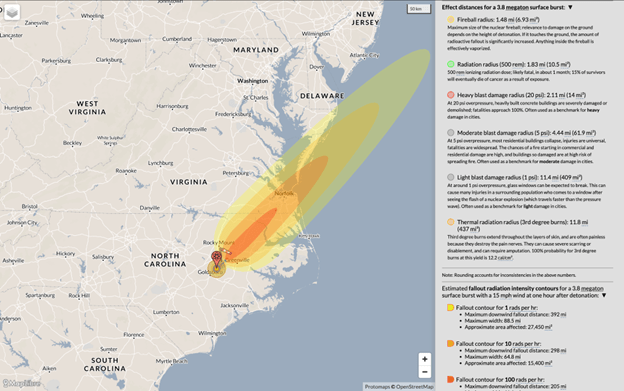
This simulation represents the blast of one of the two Mark 39 thermonuclear bombs that nearly detonated near Goldsboro, NC in January 1961. (permanent link to settings)
The Reality of the Situation
There are over 12,000 nuclear warheads in global stockpiles. The nuclear fallout in Hiroshima was atrocious and affected the population through trauma, radiation exposure, and societal collapse. Nuclear testing spews radiation into the atmosphere, contaminating the food chain, and literally restructuring our DNA.
Some radioactive elements mimic calcium in the body, so when we consume contaminated food, our bodies use them as building blocks for our bones and teeth. U.S. officials knew about these effects and acknowledged that potentially thousands of people would develop cancer in America as a result. They saw that as a necessary cost to stay competitive in the nuclear arms race with Russia.
Even many of the scientists who built the bomb quickly became some of its loudest critics, publishing letters and testimony urging the public and policymakers to rethink the path we were on. Albert Einstein, J. Robert Oppenheimer, and others later contributed to the Bulletin of the Atomic Scientists and joined forces with journalists to amplify their message.
A “viral” article from the time, “Modern Man is Obsolete,” describes an era where we risk our own eradication. For the generations who lived before and after the invention of the atomic bomb, the severity of our advancement struck a chord. It is estimated that tens of millions of people read the article2 (not an easy stat to achieve in 1945) and learned that nuclear warfare was not the next natural step in weapons technology. It was a science experiment gone wrong.
What You Can Do in 60 Seconds
1. Call for renewed nuclear diplomacy. Urge your representatives to push for a successor to New START before the deadline.
2. Demand better decision-making. Right now, one person (the U.S. President) can legally order a nuclear strike alone. That needs reform.
3. Strengthen system safeguards. Support policies that prevent accidents, miscalculations, or unauthorized launches.
UNCG Peace Action
Our new UNCG Peace Action chapter will be hosting events and peaceful demonstrations to build awareness and momentum around these issues. All majors are welcome to join.
While the situation is urgent, the point isn’t to be scared—it’s to be informed. And information is power when put into action.
 THE CAROLINIAN
A really interesting read. Well researched and cited.
LikeLike