
Ezra Franchi
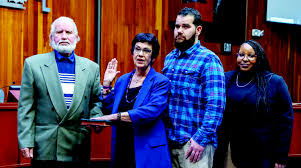
This Tuesday, December 2nd, the newly elected city council members and mayor will be sworn in—this is Greensboro’s first majority-Black council, making this a historic win, as described by Carolinian editor, Nora Webb.
Voters from Greensboro say that “property taxes, affordable housing and bringing business to Greensboro” are most important to them. People are in desperate need of a change, and they’ve turned to the Mayor Pro Tempore, Marikay Abuzuaiter, and former Administrator of the U.S. General Services Administration, Denise Roth, for help.
Both city council member Roth and Mayor Abuzuaiter accepted a short interview (Roth in person and Abuzuaiter by email), during which they discussed their plans to improve our city. Would you think I’m too honest if I were to admit that, frustratingly, I’m left with more questions than answers?
Abuzuaiter focused her campaign page on infrastructure, economic development, “more & attainable housing,” and several other key areas. Roth, too, briefly discussed infrastructure, housing, and opportunity on her campaign page.
Unsurprisingly, these goals align with newly elected NYC Mayor Mamdani’s promises on affordability: I’m not saying anyone is piggybacking political pledges to gain a seat in office, but I’d be remiss if I didn’t point out that these aligned goals highlight the severity of the average citizen’s financial struggles. From New York City to Greensboro (and far beyond), grocery prices are soaring, shoddy apartments are unaffordable for the average person, and healthcare is inaccessible. I can barely describe the excitement I felt before reading about Mayor Abuzuaiter’s long-term goals for “attainable housing,” and now I get to express my immense disappointment with the word “attainable.”
For brevity’s sake, Roth and Abuzuaiter were asked the same questions in slightly different wording. After all, their goals line up—to inspire economic growth in Greensboro and make necessities more affordable. Oops, sorry! I keep saying that pesky little word. What I mean to say is “attainable.” But, um, what does that mean? “Attainable” itself means reasonably achievable, but in this case, it simply means that housing exists, regardless of how affordable it may or may not be.
On her website, Abuzuaiter expressed her and the city council’s commitment to adding 10,000 more housing units in the coming years, on top of the 18,000 that were approved from ‘21 to ‘24. If their goal is to provide attainable housing, I wondered how many units would be Section 8 housing.
Section 8 housing is a voucher program provided by the Department of Housing and Urban Development. The program helps low-income families, the elderly, and the disabled afford housing by subsidizing a portion of the rent.
According to the Affordable Housing Hub, there are only 486 Section 8 rental houses and only 237 low-income housing properties in Greensboro. You might wonder, among the new units being introduced in Greensboro, how many will be Section 8 housing?
None.
Abuzuaiter explained that the city cannot mandate any number of Section 8 housing properties but can assist other developers in building lower-income housing by occasionally offering grants or loans.
So, forget about Section 8 housing. What about just affordable housing for low-income residents?
Abuzuaiter offered some information about Yanceyville Place, a housing development “that is a collaboration between a faith entity, a development company, the City of Greensboro and a tax credit program provider,” describing it as “the epitome of what lower-income housing collaborations can be.”
Why is the epitome, the perfect example, of affordable housing a collaboration between a religious institution and a development company? But, if our city won’t provide affordable housing, at least someone can…right?
I’ll comment briefly on the disregard for people of other faiths in these communities—I wonder how comfortable housing can be when located directly next to a religious institution whose views may directly oppose your identity and faith.
And honestly, I’m not a fan of the “it’s better than nothing” argument. Citizens deserve a government that cares more about the housing available to them: housing is a human right and should be comfortable for people of all faiths (or lack thereof), not just the faith of the church it’s conveniently located next to. No one should have to compromise on their faith to stay housed.
I asked Roth about this same predicament, but instead of inquiring about the lack of Section 8 houses, I questioned: How are we going to ensure that these 10,000 additional units are affordable for the average worker?
“Adding 10,000 more [units] is not about affordable housing,” Roth said. “Their goal is really just units to the market.”
Greensboro is nothing like New York City, and we certainly don’t have any Mamdanis on our city council, but we could all take a page from his book on affordability solutions. For example, I asked whether Greensboro would ever consider something like Mamdani’s rent freeze. I didn’t expect a yes—what I wanted was an actionable plan for avoiding rent hikes in the coming years.
On the topic of a rent freeze, Roth said, “I’m not even sure that solves the problem that we’re seeing. Frankly, I am not one to say that we should control the market by policing it.”
Additionally, Roth clarified that she’s “not sure we’ve said we’re going to prioritize creating housing that people can afford. We said, ‘We’re going to create units, just units.’ Those are different for sure.”
So, did we vote for people who want citizens to have housing, or people who just want houses on the market? Why have homes on the market when the average person can’t afford them?
North Carolina was dubbed the “worst for workers” among all 50 states in a 2025 study by Oxfam. North Carolina has poor wage policies, few worker protections, and little to no right-to-organize policies. According to an estimate by the Massachusetts Institute of Technology, an adult working full-time with no children would need to earn $22.54 an hour to live; yet, our minimum wage is $7.25 an hour, and the poverty wage for a single adult with no children is estimated to be $7.52 an hour. 10,000 new units might be 10,000 too many if something isn’t done about our wages.
Abuzuaiter clarified that neither she nor the council can “mandate any salaries for private corporations or companies,” but they do “encourage businesses of all sizes to follow our lead in making sure employees receive living wages.”
I’m sure that pleading “pretty please” to corporations will really motivate them to end worker exploitation, just as sure as I am that people will be able to afford the average rent of $1,500 a month while earning $7.25/hour.
What is attainability, then? Apparently not affordability. As usual, we’ll just have to stand by and watch our new council and Mayor as they attempt to uphold their promises to the community. You know, what I find most interesting about recent elections across the country is that citizens—especially students and Gen Z—are holding their elected officials accountable for the promises they’ve made. Our new mayor and city council members should expect the same from us.
 THE CAROLINIAN