
Virginia Weaver, Senior Staff Writer
Microwaved Beef is a column by Virginia Weaver that reflects on flashpoints from the last few years in the culture wars. The rapid pace of contemporary discourse makes it easy to forget critical moments and trends that have defined our social and academic lives. Microwaved Beef brings those moments back into the spotlight.
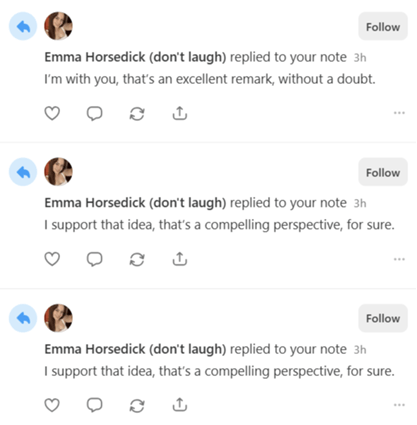
In the Spring of 2025, Substack’s first notorious bot account left tens of thousands of comments on users’ content before its hasty deletion by the platform’s moderation team, gaining instant notoriety. Emma Horsedick (don’t laugh) – “(don’t laugh)” was part of the account’s username – strewed positive comments across Substack, offering vague affirmations of users’ posts and notes. However, Emma Horsedick’s notoriety would quickly be surpassed in early 2026 by the sudden rise of a Substack power user known as President Plump.
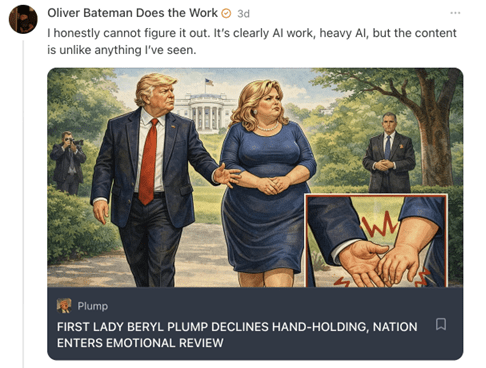
A new satire account on the burgeoning social media platform started making waves when it joined in the Fall of 2025, quickly topping the site’s bestseller charts with a massive surge in paid subscribers. Soon, President Plump–as the account was called–reached hundreds, then thousands of paid subscribers. Although the account gained attention for rising so swiftly on the bestseller charts, other users rarely engaged with its content. If President Plump was mentioned at all, it was brought up as a confusing phenomenon, its content inscrutable and its popularity inexplicable.
President Plump’s newsletter invited readers to enter the “Plumiverse,” where President Donald Trump was satirically portrayed as President Plump, and other political figures and countries received in-universe nicknames too, like “Banada” for Canada. “President Plump” had already risen to popularity as a derogatory nickname for Trump as far back as 2020, and the President Plump account made use of other long-running jokes among Trump’s critics, such as mockery of his staring at an eclipse without sunglasses in August 2017. President Plump’s short-form content satirized President Trump’s past style of posting on X.
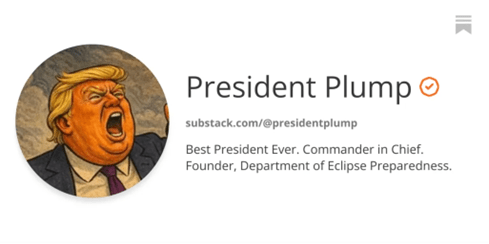
President Plump’s content relied heavily on AI-generated images, including for its profile picture, seen in the above screenshot, captured on 1/6/2026. Curious readers also generally believed the account’s written material to be AI-generated.
None of President Plump’s content received much visible engagement in the form of likes or shares, meaning that despite the account’s ostensible hundreds and eventually thousands of paid subscribers, few of them were interacting with its posts. Onlookers began to grow suspicious that the account was a bot and wondered if its subscribership was authentic or also consisted of bots.
By mid-January 2026, President Plump had amassed thousands of paid subscribers, an achievement made visible by the solid orange checkmark by its name. Onlookers’ interest and confusion grew.
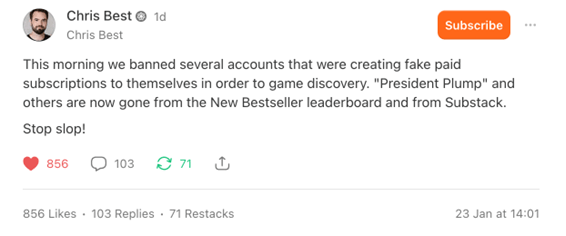
Almost as soon as speculation about President Plump became a viral topic on Substack, on 1/23, the platform’s CEO and co-founder, Christ Best, announced that moderators had banned the account and other accounts found to be using “fake paid subscribers in order to game discovery” – in other words, using bots to artificially inflate their subscribership and attain high visibility by showing up on pages like Substack’s bestsellers lists without earning real paid subscribers organically.
Unfortunately for curious Substack users, President Plump’s sudden banishment made it hard to learn more about who or what was behind the account. Substack writer KNIFEPOINT was in the midst of investigating the issue when President Plump was banned, but had managed to track down some key clues beforehand. For instance, the few users who interacted with President Plump’s content in publicly visible ways (e.g., by “liking” its posts) were likely bots and tended to follow only President Plump and a few other, specific accounts, such as a dating advice newsletter and a gay erotica writer, both pseudonymous. One name in particular, Rowan Thornwell, seems central to this network of accounts; as KNIFEPOINT writes, “my very first Google search led me to Rowan Thornwell’s other substack, The Vault, which served as an aggregator of all his various pseudonymous Substacks, Plump included, talking openly if ambiguously about each of them as loosely related projects.” While the case has not exactly been closed, it has at least been settled that President Plump and his Plumiverse were nothing but a sham.
Chris Best’s note announcing the ban on President Plump and other scam accounts ends with the short sentence, “Stop slop!” Across social media, but especially on the writing-heavy platform Substack, concerns have risen about the sheer amount of AI-created content, often referred to as “slop.” So ubiquitous now are complaints about slop that Merriam-Webster made slop its 2025 Word of the Year.
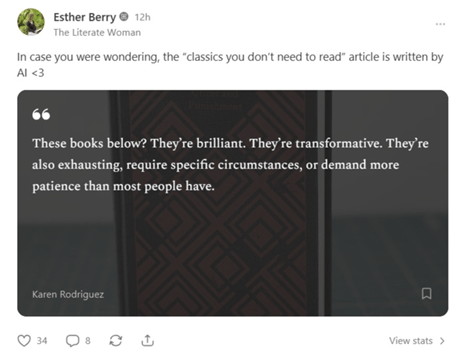
Although Emma Horsedick may have been an annoying or charming curiosity–depending which Substack user one asks–President Plump revealed Substack’s vulnerability when faced with savvy and unscrupulous bot-users. With Substack poised to gain a wave of new users in the wake of widely decried developments on X, and amidst a slew of celebrities joining the platform, it remains to be seen how well the platform’s moderation policies and enforcers tackle the risk of AI slop driving users away.
 THE CAROLINIAN