
Virginia Weaver, Senior Staff Writer
Microwaved Beef is a column by Virginia Weaver that reflects on flashpoints from the last few years in the culture wars. The rapid pace of contemporary discourse makes it easy to forget critical moments and trends that have defined our social and academic lives. Microwaved Beef brings those moments back into the spotlight.
In 1990, Naomi Wolf published The Beauty Myth: How Images of Beauty are Used to Harm Women, an impassioned polemic against the beauty industry that brought formerly obscure feminist arguments to a wide readership. To this day, The Beauty Myth remains a hit; it’s still in print and available at most bookstores. In a 2019 interview, Wolf defined “the beauty myth” as “the premise that there is a literal—albeit inhumane—state of physical perfection that doesn’t actually correspond to any human qualities but that nonetheless, as women, we’re all supposed to commit ourselves to.” In her breakout book, she argues that the beauty myth is upheld by a “cultural conspiracy.”
Today, Naomi Wolf is famous as a conspiracy theorist, her feminist days long behind her.
In May 2019, Matthew Sweet interviewed Wolf on BBC radio about her new book, Outrages: Sex, Censorship, and the Criminalization of Love. In a few seconds of the interview that swiftly went viral, Sweet disproved the whole thesis of Wolf’s book. Wolf believed that she had discovered that dozens of gay men had been executed under Victorian anti-sodomy laws, which was a striking claim and cut against scholarly consensus. While reading Outrages, Sweet had noticed that Wolf’s apparent discovery hinged on her misunderstanding of the legal term “death recorded.” Wolf had taken the term at face value, as if it referred to the subject being executed. However, as Sweet clarified, death recorded “was a category that was created in 1823 that allowed judges to abstain from pronouncing a sentence of death on any capital convict whom they considered to be a fit subject for pardon.” He followed this revelation with the verdict: “I don’t think any of the executions you’ve identified here actually happened.” Wolf had no counterargument and sounded stunned.
On social media, Wolf seemed to imply her chief source for her thesis in Outrages was a 1978 paper by A.D. Harvey, a scholar primarily known for creating infamous hoaxes and engaging in academic fraud.
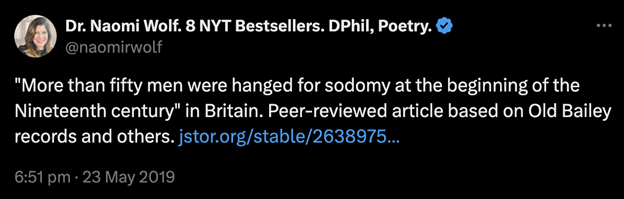
In the immediate aftermath of this devastating interview, critics expressed sympathy for Wolf and praised her calm reaction; at The Cut, Yelena Dzhanova wrote: “To her absolute credit, Wolf is taking this on the chin.”
Later critics have noted that Wolf’s transformation into a popular conspiracy theorist on the political Right accelerated in the wake of this humiliating moment on air. However, other writers who have explored the trajectory of Wolf’s career have traced her conspiracy theorizing tendencies back still farther.
Naomi Klein, in her 2023 book Doppelganger: A Trip into the Mirror World, details the ways that Wolf’s right-wing shift began as early as the 1990s. Wolf’s reputation as the definitive feminist soared with the 1990 publication of The Beauty Myth, but sank almost immediately. By decade’s end, the public’s reception of her work had soured. In June 2019, weeks after Wolf’s live debunking, Parul Sehgal slammed Wolf’s decades-long “career of blunders” in a takedown at The New York Times. Sehgal resurfaces Wolf’s long-running reputation for playing fast and loose with her data, which dates back to early reviews of The Beauty Myth. In her magnum opus, Wolf had so massively misrepresented statistics concerning yearly deaths from anorexia that one academic paper Sehgal references coined the concept “WOLF” – “Wolf’s Overdo and Lie Factor” —while unpacking her exaggerations. Klein recalls that Wolf received widespread mockery when, in 2000, presidential hopeful Al Gore brought her onto his campaign to advise him on drawing in women voters. Her advice that Gore try to look more like an “alpha male” drew derision from the press. Wolf was already growing fonder of traditional ideals of masculine power. According to Klein, Wolf had abandoned her identification with feminism by the early 2000s. In 2007, she published the book End of America, which Klein describes as “patriotically paranoiac.”
Still, nothing was so devastating to Wolf’s career—at least, so it seemed at the time—as the public shaming she suffered in 2019 over Outrages. The book’s publication in the U.S. was halted. Wolf’s mainstream publication opportunities dried up. Klein points out that some professors soon “started using excerpts of Outrages as a cautionary tale” to “instill in students a healthy fear of sloppy research[.]”
Within a few months of the BBC interview, Wolf smelled a conspiracy against her. By January 2020, she suspected that the massive wave of criticism she had faced was part of an intentional effort to take her out of the public eye. Soon, the COVID-19 pandemic fueled Wolf’s conspiracy theorizing. Her career caught a second wind as she began to appear on Fox News and other popular right-wing shows, quickly becoming a star anti-vaccine influencer.

In 2024, Naomi Wolf co-edited two books, The Moderna Papers: Moderna’s Crimes Against Humanity and The Pfizer Papers: Pfizer’s Crimes Against Humanity, for Stephen K. Bannon’s War Room Books, an imprint of the controversial publisher Skyhorse Publishing. Wolf now writes and makes videos about various topics, including politics and the Geneva Bible, on her Substack newsletters. In her Substack bio, Wolf describes herself as, “Cancelled five times, still right.”
 THE CAROLINIAN