
Virginia Weaver, Senior Staff Writer
Microwaved Beef is a column by Virginia Weaver that reflects on flashpoints from the last few years in the culture wars. The rapid pace of contemporary discourse makes it easy to forget critical moments and trends that have defined our social and academic lives. Microwaved Beef brings those moments back into the spotlight.
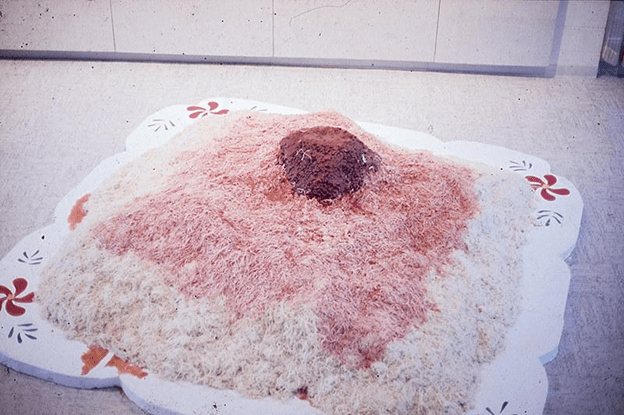
Records hosted by UNCG’s libraries recall a memorable curio in our university’s long history: the “spaghetti incident” of January 1971. Although it led to the expulsion of its perpetrators, the spaghetti incident gained UNCG nationwide attention for a moment as news of the stunt’s scandalous and bizarre nature circulated widely through the airwaves. UNCG’s Special Collections & University Archives’ digital timeline of UNCG history describes the spaghetti incident thusly:
As an art project, two nude art students dove into eighty pounds of cooked spaghetti on a giant platter fashioned out of a child’s plastic swimming pool. The spaghetti was topped with a giant meatball made of dog food and eight gallons of ketchup. The students were initially arrested for disturbing the peace, though the charges were later dropped.
According to Chris Lowrance’s largely lost research from around 2008, the incident took place “in the outer gallery of the Weatherspoon Art Museum,” and was “a scheduled ‘happening[.]’” However, not every recollection of the incident aligns with regard to its details. According to Miriam Corn Barkley’s eyewitness account, recorded in 1991 as part of the UNCG Centennial Oral History Project, the spaghetti incident may have begun as part of an art class assignment, in which students were tasked with making replicas of food. Barkley also recalled, albeit tentatively, that the material in the plate was not real spaghetti but rather some kind of fibrous strands like “string or rope.” Barkley says, regardless, that the spaghetti incident became “part of the mythology of our day.”
The two students who took a dive into the spaghetti dish were Robin Lehrer and Patricia O’Shea, at least the latter of whom was a senior. Per Lowrance, “O’Shea became the more famous of the two, perhaps because of her history of setting off firecrackers, staging fake weddings, and distributing feminist literature.” Other sources imply that O’Shea was the more infamous of the pair, too. One eyewitness, Brenda Cooper, could easily remember O’Shea’s name but struggled to recall Lehrer’s in a 1991 interview for the UNCG Centennial Oral History Project. Nevertheless, although the legal charges against them were dropped, both students faced the same fate: expulsion, per Cooper’s memories and other archival sources. It appears that the duo’s expulsion was only decided upon months after the incident, however, given O’Shea’s ongoing activity on campus throughout February 1971.
O’Shea’s activist tactics may have been jarring, but she was not alone on campus in taking a keen interest in feminism. Women’s liberation was on many UNCG students’ minds in 1971 as the second wave of feminism came roaring to prominence across the Anglosphere. According to Nelda French, writing in 1971 in her column Taming of the Shrew at The Carolinian, UNCG’s own organized women’s liberation movement had begun in 1968 and thrived since. In March 1971, The Carolinian announced that a “Women’s Liberation literature table” would be available weekly outside Elliot Hall, at which “[t]he prices will be low and a wide range of pamphlets, women’s underground newspapers, magazines, etc. will be available.” Whether O’Shea was involved in this tabling effort is unclear, given the hazy timeline of her expulsion, but it is probable.
O’Shea was having a busy year, either way – and not just because of her spaghetti skinny-dip in January. Also in January, publication of Coraddi, the student art magazine, was halted due to alleged budget overreach. O’Shea edited the magazine, and Lehrer served as its arts editor at the time. Considering its timing, the halting of the magazine’s publication may have some relevance to O’Shea’s and Lehrer’s otherwise unexplained spaghetti stunt, but any connection must remain conjecture. Per The Carolinian’s reporting, in February 1971, O’Shea lost the seemingly tense case to receive additional funding for Coraddi. O’Shea contributed a letter to the editor shortly afterward clarifying what had happened in Coraddi’s budget meetings and announce her departure from its editor’s desk. In the months immediately following O’Shea’s dramatic, perhaps mandated resignation, Coraddi began to solicit student submissions and announced that it would return to print “for the first time in two years” in October, “since editorial difficulties prevented it from being published last year.”
Soon, however, O’Shea and Lehrer were expelled and may have intended to move to California. The duo took out a satirical ad in The Carolinian’s April 21, 1971 issue, acknowledging their celebrity and infamy for both the spaghetti incident and the brief cancellation of Coraddi, and using dark humor to hint at their financial straits while preparing to depart from UNCG.
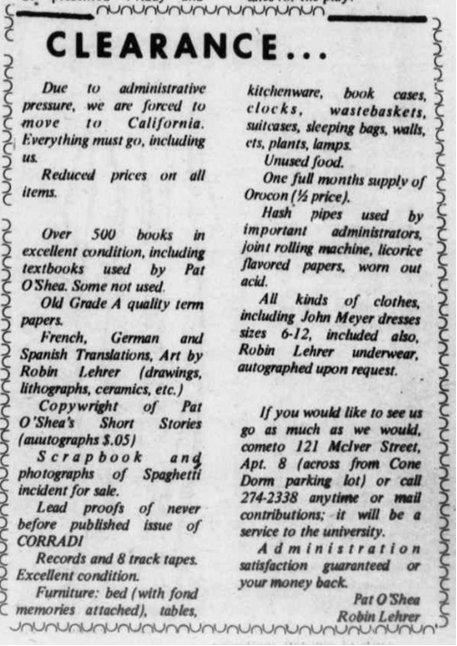
Celebrities, O’Shea and Lehrer had indeed become. Purportedly, Johnny Carson featured a bit about O’Shea’s and Lehrer’s nude spaghetti stunt on The Tonight Show, although The Carolinian has been unable to locate the relevant episode.
While the spaghetti incident’s notoriety has faded, remembered primarily in dim archival scans, its legacy and scandalous charm live on. The efforts of second-wave feminist activists at UNCG like Patricia O’Shea and The Carolinian’s own Nelda French constitute a crucial, oft-overlooked facet of Greensboro’s rich history of social justice activism.
Perhaps their legacy may yet live on.
In a 1971 issue celebrating The Carolinian’s first five decades in print, one student journalist remarks: “In looking back over fifty years of CAROLINIAN issues, the most striking point is that in spite of the differences in traditions, people, morals and numbers of people that have developed over the years, the issues have remained very much the same. The complaints in the 1920 article on woman sufferage [sic] would be applicable to the Sisterhood of today, and could well be a Nelda French column.”
 THE CAROLINIAN