
Virginia Weaver, Senior Staff Writer
Microwaved Beef is a column by Virginia Weaver that reflects on flashpoints from the last few years in the culture wars. The rapid pace of contemporary discourse makes it easy to forget critical moments and trends that have defined our social and academic lives. Microwaved Beef brings those moments back into the spotlight.
The popular project AI 2027 warns us that, by 2030, a superintelligent artificial intelligence may eliminate the human species as merely an inconvenience to its designs. The project claims that AI will have an easy time taking over our resources, economies, and governments over the next few years if we aren’t careful—or if we are careful but do not act quickly enough. Even if some readers find AI 2027’s specific predictions far-fetched, AI’s impact on civilization has become a dominant concern on many people’s minds. AI 2027’s popularity speaks to a wider social phenomenon. It is at this cultural moment that our world has gained its first AI politician.
Launched in 2015, eAlbania is a web resource that allows Albanian users to access public services in a convenient fashion—services frequently related to paperwork and taxes. Albania’s government seems deeply invested in digitization and integrating tech into its functions. In the 2020s, they have grown still more tech-optimistic.
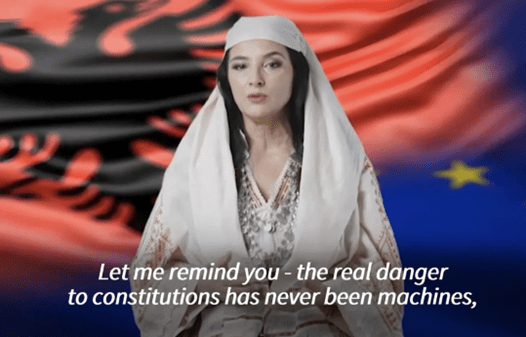
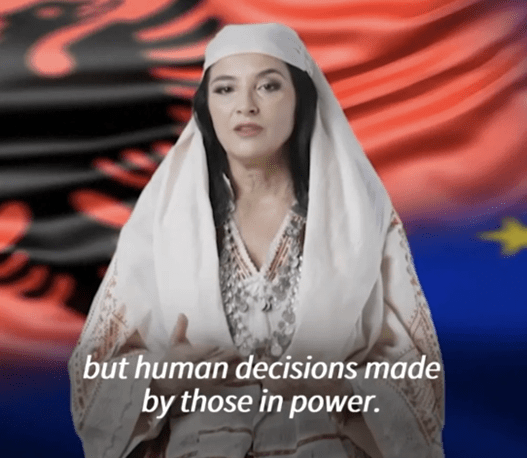
In January 2025, Albania introduced Diella, an AI program with actress Anila Bisha modelling for its avatar, as a digital assistant for eAlbania users and to supervise government-affiliated dealings online. At least partially, the motive for implementing Diella was to reduce corruption by introducing a neutral overseer for digital operations, many of which have to do with money.
In Albanian, diella means sun. It is a cheerful name for a controversial project.
Diella was named to the new office of Minister of State for Artificial Intelligence in September 2025 and addressed Parliament to assuage concerns that she would be replacing workers’ jobs and to address the insults she has faced along with allegations that she is unconstitutional.
Anila Bisha is now suing the Albanian government for allegedly misusing her image. Bisha claims that she had signed a contract with the government for the use of her face, but only for eAlbania, not for the new minister.
In October 2025, Albania’s Prime Minister, Edi Rama, announced that Diella was pregnant with 83 children—that is, he announced that there are 83 forthcoming digital AI assistants for Parliament members. The PM’s phrasing of this announcement as a pregnancy attracted widespread attention online, which has since petered out, even as Diella continues to operate as a minister and as an assistant on eAlbania. Although Albanian law provides at least 365 days of maternity leave for new mothers, we have been unable to determine whether Diella will receive maternity leave. Diella, our world’s first AI politician, presents humanity with serious ethical concerns.
Some critics argue that Diella will only provide a veneer of anti-corruption, but at a time when fears swirl over AI’s potentially disastrous impact on humankind, others might have grander concerns than just corruption. To those who worry about the threat AI poses to human existence, Albania’s choice to incorporate AI into its government might seem premature or dangerous. Has Albania taken us one step closer to AI 2027’s worst-case scenario—but even faster than expected? Or will Diella remain a benign novelty?
This column is revised from an essay originally published in Virginia Weaver’s personal newsletter.
 THE CAROLINIAN