
Kaylee Roberts
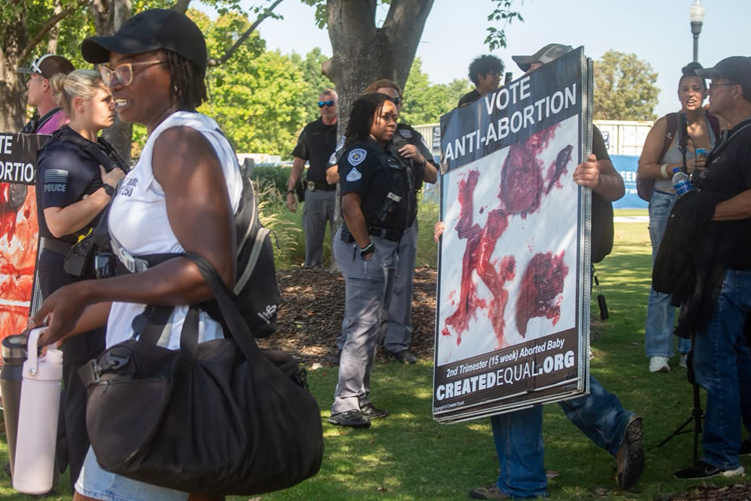
A demonstration involving an anti-abortionist group took place at UNCG on October 1. These demonstrators were seen in front of Moran Commons, as well as on Stirling Street across from the Bryan School of Business and Economics. The demonstration drew attention from students on campus and prompted varied reactions, raising questions about how demonstrations are approved and how the university responded to this controversial use of free speech on campus.
According to a UNCG Police Department report obtained by The Carolinian, the demonstration had been approved in advance by the university. The event involved several people (both male and female) who carried signs and devices to record their interactions with whomever they encountered on campus.
Alexa Howard, a senior at UNCG, was near the Bryan School when she saw people gathered along the sidewalks. “I observed a lot of arguing and passionate students,” Howard says, “All I could do was shake my head in disbelief.” Howard also observed people handing out flyers.
When asked about UNCG’s approval of the demonstrators, she said that she did not want these demonstrators on campus. “Regardless of [UNCG] being a public campus, they were obviously causing distress to the overall well-being of the students.”
Sofi De La Jara, a freshman, was in front of Moron Commons when she observed a man and woman in the center of a group of students. “When I walked up, the man and woman were being incredibly dismissive,” De La Jara said. “[They] gave no platform for other students to have a proper debate.” She also mentioned that this group was threatening to use pepper spray on the students as the crowd grew larger. “This isn’t free speech and this isn’t healthy to have on campus,” De La Jara said.
Dr. Cathy Akens, representing UNCG’s Division of Student Affairs, said that UNCG is “obligated to protect freedom and expression.” The public is allowed to “engage in expression” on campus and has access to campus spaces no matter the content or perspective. The group would have talked to the Reservations Office to coordinate the use of the campus space. UNCG’s free-speech policy can be read more thoroughly in the University Policy Manual, which highlights the values and restrictions UNCG has regarding public expression and demonstrations.
Regarding this particular demonstration, Dr. Akens noted that the UNCG Police Department and Student Affairs staff were present. “The University is reviewing reports that students vandalized property belonging to the external group and engaged in conduct that disrupted the event,” Dr. Akens stated. “Our commitment to free expression does not extend to conduct that damages property, intimidates others, or materially disrupts campus activities.”
At this time, the University is reviewing policies and will have to determine the next appropriate steps. While students have heavily opposed the demonstration, other students say the demonstration was important, but could have been conducted better.
Sebastian Del Campo, a senior at UNCG, observed heavy debates going on outside of the EUC building. “I saw [aggressiveness] both from the protesters and the pro-life advocates,” Del Campo states, “the crowd got in the way and thus no general common ground could be met.”
Del Campo mentioned that he is pro-life himself and was interested in discussing the ‘third way’ with the demonstrators. The third way advocates for protecting the right to have an abortion, while providing resources that reduce the need to have one. He observed that the anti-abortionist group was not interested in “collaborating on solutions rather than compromise,” but instead told him that he “had to choose a side, them or us.” Del Campo acknowledges that the pro-life advocacy was not done well, and that it “just diminishes actual good faith effort to preserve life and provide resources for women.”
The official incident report, case number 2610-008095, states that there was a group being “disorderly” due to the anti-abortionist group on campus. The report was made on October 1, at 12:40 p.m. and involved one of the female demonstrators who reported significant property damage including the destruction of camera footage and signs.
The offenses highlighted in the report included personal injury to property, larceny (less than $1000) and disorderly conduct by abusive language. Two individuals were listed as suspects, though there is no confirmation that either was a current UNCG student. The case was closed by arrest.
The group returned to campus on October 15 and were seen in front of Moran Commons. UNCG’s crime log also lists an arrest on that date at Moran Commons under case number 2610-008570. The available information does not establish whether the arrest was connected to the group’s presence on campus.
As UNCG continues to navigate demonstrations and other forms of campus expression, the university’s approval process and response to such events remain important aspects of campus life. For students who witnessed the demonstration, reactions varied not only in response to the message being presented, but also in response to the way it was communicated. Their perspectives reflect the different ways members of the UNCG community interpret demonstrations on campus and the impact such events can have on students.
Headline photo taken by Isabel B. Thompson

