
Nora Webb
In 2024, 6,800 people cast early ballots at UNC Greensboro. Another 6,487 voted early at NC A&T. If you went looking for either site this year, you didn’t find them.
On July 21, the Guilford County Board of Elections voted 4–1 for a 2026 early voting plan with seventeen sites and not one on a college campus, despite students coming to meeting after meeting to ask for them. Because the vote wasn’t unanimous, the final decision went to the State Board of Elections, which approved the plan in August.
I’ll give them this: seventeen is the most sites Guilford County has ever offered in a midterm year, and members argued that the new Union Square location downtown, a building UNCG shares with A&T, GTCC, and Cone Health, would meet students’ needs.
But look at what the board chose to add. Stokesdale Town Hall drew fewer early voters than any other site in the county in 2024, just 2,857, and yet it made the cut. The campus sites, each with more than twice that turnout, did not. And Union Square is not on campus. It’s 1.3 miles from the Elliott University Center, which Google Maps estimates is about a 30-minute walk, and there is no direct bus.
Board chair Eugene Lester called the downtown sites “uniquely suited” to students. No, Mr. Lester. A campus site is uniquely suited to students. It means you can vote between a morning lecture and an afternoon lab. A downtown site means carving time out of your day, which is a lot to ask of students who work, commute, or don’t have a car. Access is often the difference between getting your “I Voted” sticker and saying, “Well, I wanted to go, but…”
UNC Greensboro’s Office of Leadership and Civic Engagement stepped in with free shuttles and deserves real credit for it. But do the math: two days, seven trips a day, 14 seats a trip. That’s 196 seats for a campus where 6,800 people voted early two years ago. A shuttle sign-up sheet is not a polling place.
Carolyn Bunker, the board’s lone vote against the plan, pointed out that roughly one in four voters ages 18 to 25 who voted in 2024 did so at those two campus sites. Those are the voters this plan asks to travel the farthest.
This isn’t the first time this year, either. On Jan. 13, the State Board of Elections rejected proposed early voting sites at both NC A&T and UNCG for the March primary, on 3–2 votes. Students said they had offered to staff a campus site for free. NC Newsline reports that the State Board has pushed to limit campus polling places this year, and site fights have played out in counties across the state. Each decision comes with a logistical explanation. But after the January vote, one board member accused the State Board of waging a war on students. State Board chair Francis De Luca said it wasn’t. When Jeff Carmon, another board member, asked what it was, then, to tell students they couldn’t have a site, De Luca replied, in what WRAL described as a mocking tone: “I want a site, I want a site.”
I’ll answer Carmon’s question: It’s suppression.
People say the South is inherently red. I’d argue that much of it isn’t red so much as suppressed. North Carolina has been here before: in 2016, a federal appeals court struck down the state’s 2013 election law after finding that lawmakers had targeted Black voters “with almost surgical precision.” The tactics change, but the pattern holds. Across the state, the voters are there; casting a ballot just keeps getting harder for the people with the least time, money, and transportation to spare, and right now, that includes a lot of students. And in the spirit of good faith, I’ll say sure, maybe North Carolina is red! But if it is, I’d like to see that label earned ethically, at ballot boxes everyone can reach, not manufactured by deciding who gets an easy trip to the polls. I’ll lose gracefully, but only if they play fair.
Which brings me to the “why bother” crowd. Nobody argues this hard over polling places nobody uses. Those campus sites drew more than 13,000 early voters in 2024, and margins in this state can be razor-thin. In 2024, a state Senate race in Wake County was decided by 128 votes, fewer people than OLCE’s shuttles can carry this year. Every extra mile between you and the ballot box is a bet that you won’t make the trip.
And if you’re tempted to sit this one out because the polls make the outcome look settled, then stand by as I crack open a cold can of 2016-flavored angst. Tastes pretty bitter. I remember how certain everything looked, and how little that certainty turned out to mean. Polls don’t cast ballots. People do.
This ballot has real stakes: city bonds for housing and transportation, three amendments to the state constitution (one of them about voter ID), and a seat on the N.C. Supreme Court.
Some students are already treating the setback as motivation. After the State Board’s decision, NC A&T student Omari Johnson told WFDD he thought it was “going to push more and more students now to go and vote anyway.”
Let’s prove him right. Make the trip. Follow the path of the UNCG and A&T students who walked to the polls on the first day of early voting.
OLCE’s free shuttles leave the front of the EUC every hour from 9 a.m. to 4 p.m. on Oct. 21 and Oct. 27; sign up here. On other days, take Route 9 from the W. Market Street stop at Gray Drive to the Board of Elections office downtown; the whole trip from the EUC takes about 15 minutes, and it’s free with your Spartan ID, via a free UMO code you can request in advance. Same-day registration, one of the things that 2013 law tried to take away, is still here: you can register and vote in the same visit until 3 p.m. on Saturday, Oct. 31. Our early voting guide has everything else you need.
Somebody is betting you won’t bother. Prove them wrong.
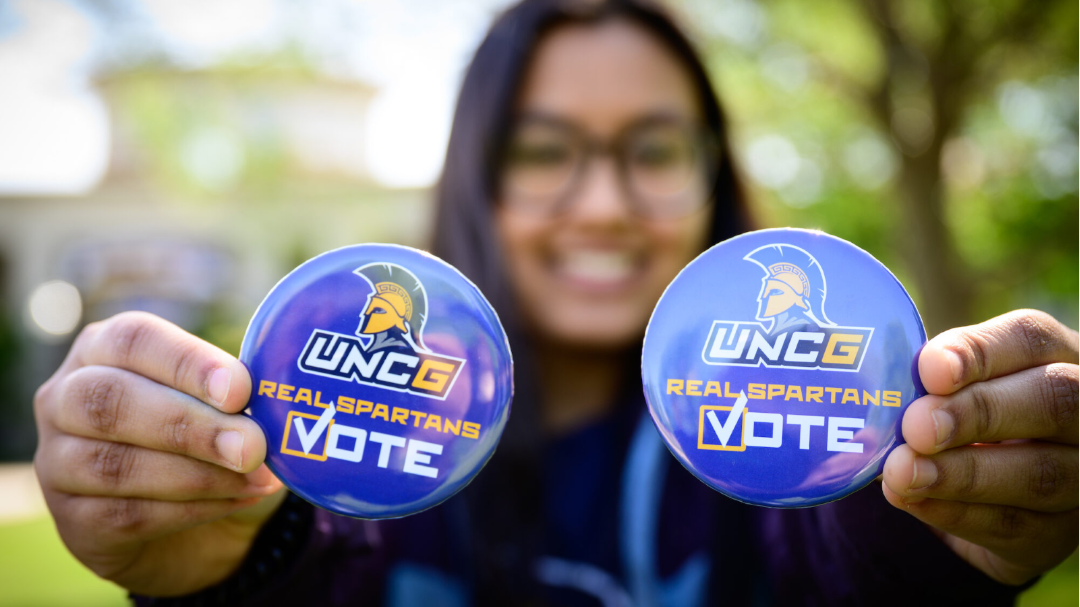
Headline image Courtesy of UNCG’s Office of Leadership & Civic Engagement.

