
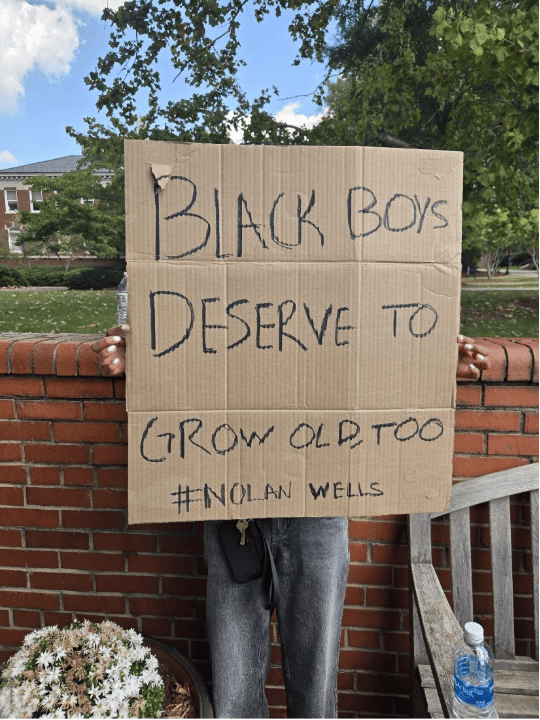

On Oct. 15, at the Minerva statue located behind the Elliott University Center, students gathered for an organized walkout and protest in response to the death of Nolan Wells. Wells, an 18-year-old football player attending community college in Mississippi, went on a trip to Horn Island with friends on the Fourth of July. He did not return home with them. A search began for him, ending on July 6, when his body was found by the shoreline of the island. On Sept. 21, a grand jury found no evidence of wrongdoing, with District Attorney Angel Myers McIlrath saying in a video statement, “There is absolutely no evidence to support the allegations that Nolan’s death and disappearance were racially motivated.” District Attorney McIlrath also said in her statement that, along with holding the guilty accountable, the grand jury had a duty to “exonerate those who have been falsely accused.”
The death of Nolan Wells rocked many across the United States, leading to protests across the country beginning at Jackson State University in Mississippi. In North Carolina, 12 universities, including: the University of North Carolina at Greensboro (UNCG), North Carolina Central University (NCCU), North Carolina State University (NCSU), and North Carolina Agricultural and Technical University (NC A&T) held protests. Several groups helped organize the protest at UNCG including: the Party for Socialism and Liberation (PSL), No Labels, Young Communist League (YCL) and the NAACP chapter at UNCG.
Prince Williams, a member of PSL, said his hope for the protest was for students to join organizations, while emphasizing the importance of not falling into old systems. He explained how organizations have been essential to fighting for justice for years, providing a unified platform to address issues. When discussing feelings of frustration with the slow progression towards change, Williams referred to the How Long? Not Long speech given by Dr. Martin Luther King Jr. He used this speech as an example of how protest and advocacy work, and to encourage students to not lose hope. He explained that “we are the detonator,” referring to students and this younger generation as the catalyst needed to create change. He also explained how change “resonates up,” starting with protests like the one held at UNCG and traveling beyond campus.
Other students I spoke to shared a desire for the protest to lead to conversations on campus. Tiyana, a member of No Labels, gave an impactful quote, saying they hoped the protest would, “spread across campus, start conversations, inspire people to act and create results.” Susie, the president of the Young Communist League, shared that they were frustrated and angry with the slow progress. They expressed how after multiple generations of similar issues, we’ve managed to take “baby steps” toward progress and that they don’t want people to “be content with society and slow change.” They expressed a desire for “unity and a shared desire for change.” They said that they hoped the protest would help students at UNCG feel strongly about the need for progress and recognize how far we still have to go.
Cerenity, a vice president with the NAACP at UNCG, gave an inspiring and empowering speech at the end of the protest. She challenged students not to respond only when a tragedy occurs and to “challenge the challenger.” When asked to define “the challenger,” she explained that it’s not limited to being a person but can refer to any form of microaggression and injustice. The idea is to face these forms of microaggression and actively combat them. She also argued against the idea that our generation is too young to lead and advocate actively, not just when it’s convenient.
The heartbreaking death of Nolan Wells is among many tragedies this year. On June 14, one-year-old Kohen Wiley was killed by Officer Hunter Foster in Senatobia, Mississippi. The Attorney General ruled the shooting justified on Oct 19. Foster resigned on Friday, Oct 23, with the former police chief being fired after texts containing racial slurs came to light on Oct. 20. There have also been reports of several African American people found hanging, including in North Carolina. With the public questioning and disapproving of how authorities have handled these cases, some have expressed strong belief that these were racially motivated attacks. The protests at UNCG and other campuses across the country are part of essential dialogues on race and the systems that are supposed to ensure safety and justice. As the protests here at UNCG and across the country highlighted, the desire for change, answers and accountability is strong, and students are determined to achieve all three.

