
Virginia Weaver, Senior Staff Writer
Microwaved Beef is a column by Virginia Weaver that reflects on flashpoints from the last few years in the culture wars. The rapid pace of contemporary discourse makes it easy to forget critical moments and trends that have defined our social and academic lives. Microwaved Beef brings those moments back into the spotlight.
On October 22, a journalist asked President Donald Trump, “Is there anything in a campaign ad that should be off limits?” The President responded: “I know one thing. If my mother said that about me, it would be– you would have hit gold.” Implicitly, the answer was no. Nothing is off limits. Making the right attack ad is “hit[ting] gold.”
The journalist’s question came in the wake of an instantly notorious attack advertisement targeting Amy Acton, Director of the Ohio Department of Health and Vivek Ramaswamy’s Democratic rival in the ongoing Ohio gubernatorial race. Ramaswamy, an entrepreneur turned Republican political hopeful, attempted a presidential campaign in 2024 before backing out of the primary race and endorsing President Trump. He soon became co-leader of the then hypothetical Department of Government Efficiency (DOGE) alongside Elon Musk. Before DOGE became an active initiative, Ramaswamy dropped out of the fledgling program to focus on his political ambitions in Ohio. Needless to say, Ramaswamy is deeply enmeshed in the Republican Party, although his own political endeavors have been marked by repeated failure. Becoming governor of Ohio would be a massive leap forward in his political career.
On October 18, an advertisement began circulating on television that featured Amy Acton’s mother, Donna Arthur. “She is a liar. She lies about her past,” Arthur alleges of Acton in the ad. Ramaswamy’s campaign soon confirmed that they had produced the commercial.
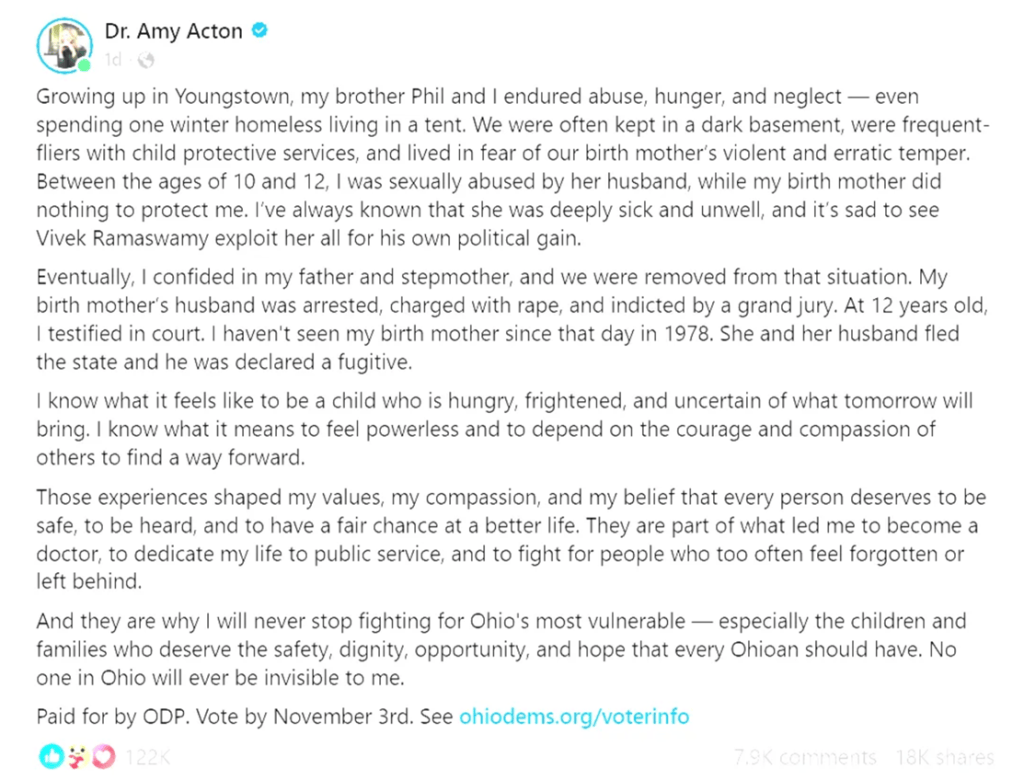
What rankled many critics was not just the unusual decision to bring somebody’s mother into a campaign ad, but also the fact that Arthur was long estranged from her daughter after a history of abuse. According to verified accounts, Arthur lost custody of Acton after Acton’s allegedly sexually abusive stepfather was indicted on the charge of the rape of a twelve-year-old girl; at the time, in 1978, Acton was twelve years old, although the identity of her stepfather’s alleged victim has not been publicized. Acton’s mother and stepfather were also convicted of theft by deception in 1996. Her stepfather was, as far as available reporting has established, never arrested after failing to show up at court, despite being declared a fugitive and the issuance of a second arrest warrant. He died in 2004. According to all the factchecking undertaken to date, it appears that Donna Arthur remained married to him until his death.
The attack advertisement was thus unusual not only for its viciousness but also for choosing to rely on the perspective of an estranged, allegedly abusive mother, who remained married to the man who allegedly raped a child. In response to the ad, Acton posted her side of the story to social media:
It bears emphasizing that it is difficult to trace some of the information necessary to verify all of Acton’s claims about her mother and stepfather, as some details are impossible to reliably research nearly 50 years later.
Attack ads have a long history in U.S. politics, with some historians tracing the tactic back to Lyndon Johnson’s 1964 presidential campaign. Johnson’s campaign created the notorious “Daisy” commercial, in which a young girl stripped the petals off a daisy until being annihilated in a nuclear blast. The commercial’s contents, although they may seem ambiguous today, fed into the Johnson campaign’s central allegation against Johnson’s opponent, Barry Goldwater: that he would place the world at greater risk of nuclear war. Attack ads can focus on facts about an opponent, but they primarily rely on pathos, appealing to viewers’ hearts and guts. While there have been famous and successful attack advertisements, such ads can backfire, and the emotional charge they bear can intensify the backlash they generate.
Despite the vociferous support of President Trump and Vice President J.D. Vance, the Ramaswamy campaign’s attack ad against Acton backfired immediately. Polling rapidly swung farther in Acton’s favor, according to GOP polling. On October 30, Ramaswamy confirmed that his campaign was pulling the ad, stating that it had “run to completion.” It would seem that for some people, attack ads featuring a candidate’s estranged mother are still not a way to “hit gold.”

