
Catie Byrne
Features Editor
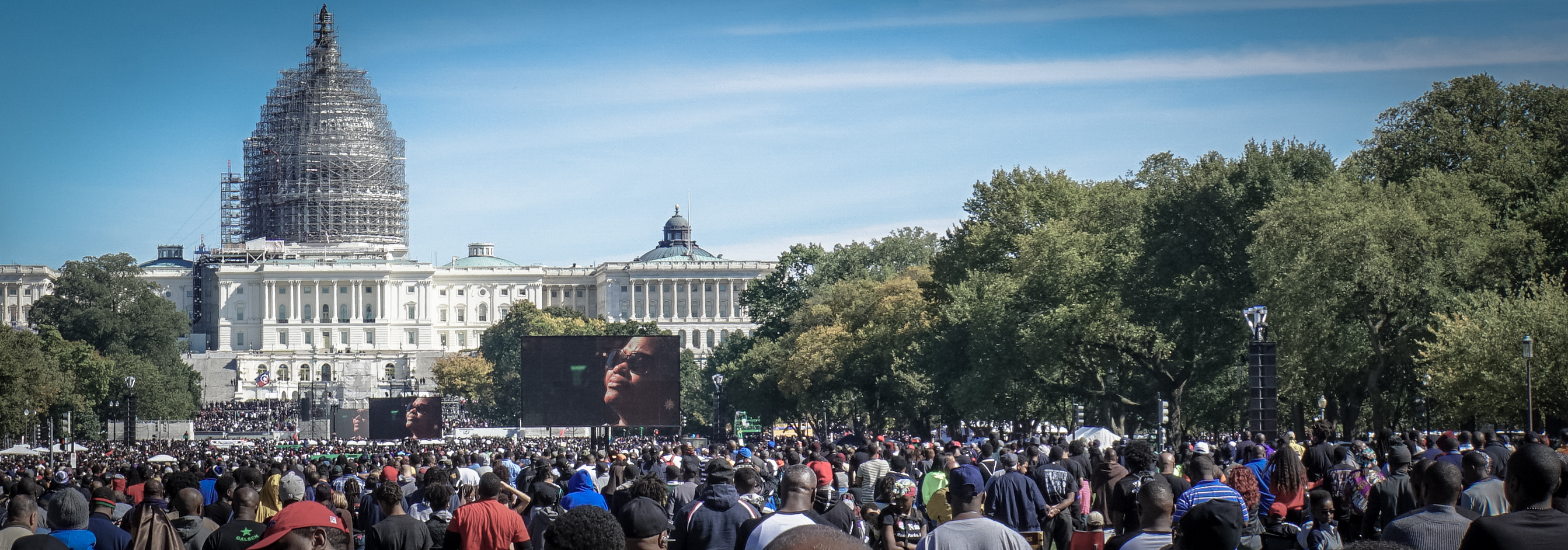
On Oct. 10, 96 UNCG students and three chaperones made the 24-hour trip to Washington D.C.’s National Mall to attend the 20th anniversary of the Million Man March.
Representatives from UNCG’s clubs and organizations spoke with The Carolinian about their experiences attending and organizing the march.
Joshua Leeper, junior and representative of UNCG’s Black Business Student Association described the atmosphere of the march as, “very peaceful,” he highlighted his experience as being one of a collective coming together to support a variety of different causes.
“Being in that type of setting [the march] with so many different people, just there for one cause; I can’t really explain it,” said Leeper.
Tiaira Moragne, junior and representative of UNCG’s Neo Black Society, described the march as an opportunity for minorities to assemble in protest and unity to raise awareness for a multitude of issues.
“It personally made me more aware of the issues, the injustices going on outside of our community. The march wasn’t limited to just African Americans, but Native Americans, Latinos, anyone who has been mistreated by our government,” said Moragne.
For Victoria Lartey, junior and star of the Youtube channel “College Hill PWI” [Predominately White Institution], the importance of the Million Man March was also personal to her experience as an African American.
“I think [what propelled us to attend was] because it affects us, African Americans, personally. What we were going for was about us, it was for taking a stand and moving forward. Because it was about us and for us, it’s like a new generation trying to make a movement in society,” said Lartey.
The emphasis of a diverse movement, particularly for UNCG students in attendance, is what Regina Da Silva, senior and NAACP and UNCG Student Government Association representative, pointed to in what attracted over a million people to the Million Man March.
“[There were] people from different age groups holding different signs that we read as we walked by, we saw different faces telling their stories too; throughout the march. Everyone congregated in the same location, we stood and watched people give their history of their specific Native groups and cultures, and more specifically, the influence they’ve had on America; and also, what was robbed from them. It was eye-opening,” said Da Silva.
Of the prominent speakers at the march, the club and organization representatives noted that the organizer of the original Million Man March in 1995, Minister Louis Farrakhan, leader of the Nation of Islam, captured the crowd’s imagination.
“Personally my favorite [speaker] was Minister Louis Farrakhan, it [his speech] was kind of like a call to young people, because we are the future, to become active, and fight for what we want, because the title of the march was ‘The Justice for All March,’ and it called us to fight for justice, and not stay complacent, but moving forward,” said Jane White, senior, and representative of Girl Talk, a UNCG Christian-based group centered around women empowerment.
White also called attention to those who spoke about police brutality, prominently the parents and family of Trayvon Martin, Michael Brown and Sandra Bland who spoke to inspire a movement for change.
“It [their speeches] made us feel more connected to their stories. Of course African Americans will feel connected, but to listen to the mothers [of people personally affected by police brutality] was powerful. A lot of different speakers spoke on that [police brutality], there was a woman who said that her being there today was not just to represent herself, but to represent her 17-year-old son, and fighting for his justice, that he would be able to do things that she was never capable to do in her lifetime. And so just being able to see the family members of the ones who have been murdered, definitely brought us a little closer to the things that have been going on,” said White.
In relation to discussions of police brutality, a moment that particularly struck Da Silva was a comment Farrakhan made about the Black Lives Matter movement.
“A big issue that was emphasized was that Black Lives Matter is not a moment, it’s a movement, which was also discussed at the march. Another thing he [Farrakhan] said, was ‘how are we still calling ourselves citizens when we’re still fighting for Civil Rights,’” said Da Silva.
Of those who make up a movement for social change and equality, Lartey addressed the the importance of connection between students at Historically Black Colleges and Universities and Predominantly White Institutions (PWI’s) at the march.
“I think it was also good, us [UNCG] being a PWI, to combine with other college students from other universities like Howard and Winston Salem State; to be in the moment with other universities, and not be so separate, as what usually happens. So, that was great to be able to mingle with other college students,” said Lartey.
While student organization and unity was an important in coordinating events such as the Million Man March, Da Silva credits the role of UNCG faculty members Porshe Chiles of the Office of Intercultural Affairs, the Business Manager for Campus Activities Board, Reshown Ward, and the African American and African Diaspora Studies program for providing much of the funds needed for students to attend the march.
“I think we should have more events like this [the Million Man March],” said White, “for this to be a diverse campus, I definitely think we should send more students out to events like this to kind of show off UNCG as a community.”

