
Mark Parent
Opinions Editor
On March 15, I will not be voting for Donald Trump.
To put it mildly, he’s not a conservative and does not represent my core values.
With that being said, if Donald Trump is the republican nominee for president—which is increasingly likely—I will be a full-fledged supporter of his campaign.
I mean, seriously, who would ever vote for Hillary Clinton? Throughout the course of her 2016 campaign, she has taken utterly impractical left-wing policy positions, repeatedly lied to the American public, shifted positions on critical issues in order to stay in line with public opinion and, of course, is tainted by persistent scandals.
So, to put it bluntly, I’ll never vote for Hillary Clinton; and neither should you.
Yet, if any student on our campus is bold enough to publicly proclaim his or her support for Trump, they will undoubtedly fall victim to verbal abuse and unsavory labels, such as bigot, homophobe, xenophobe, racist, stupid and much more.
Well, fear not Trump supporters, by next November you could easily be called by another name: winner.
That’s right, get ready for the classiest, most elegant presidency in American history.
But how does one respond to the plethora of criticisms associated with Trump’s candidacy? Well, let me tell you.
First of all, Trump and his supporters are not evil racists. Yes, I know he and his campaign often employ insensitive language on issues, such as illegal immigration; however, such rhetoric is not representative of a subordinated racial hatred. Instead, Trump and his supporters are simply tired of a federal government that incessantly debates the issue each election cycle. Voters, for the most part, just want this problem solved and the individuals who broke the law to suffer the proper consequences.
Next, Trump’s candidacy is emblematic of the utter stupidity of political correctness—especially among millennials. The policing of words and taboos on certain figures of speech have caused consternation among those making up the middle of America. Simply put, voters want results and progress, not to feel warm and fuzzy when confronting persistent failures.
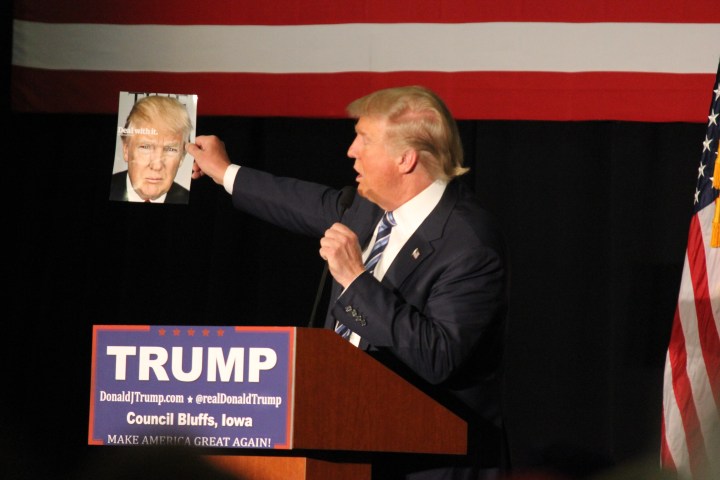
Also, Trump is bucking one aspect of the Washington Consensus: free trade. For most of the post-World War II era, free trade has been gospel. Both parties have willingly subordinated the interests of workers in order to ease access to foreign markets for major corporations. Trump understands that the outsourcing of jobs is highly unpopular among the American populace and repeatedly emphasizes his willingness to fight for these people. In a way, he’s given a voice to the voiceless.
Of course, fair trade isn’t the only economic tenet of Trump’s campaign; in fact, Trump understands that the key to rapid economic growth is competition. That’s why Trump has called for lower tax rates, fewer regulations, and the repatriation of corporate profits. After all, the entire country—especially our generation—has suffered through eight years of a sluggish economy that offers little hope. Trump’s policies—like it or not—would stimulate the economy.
On the foreign policy front, Trump is appealing to many voters because of his unwavering strength. Once again, this is in direct contrast to President Obama, who has folded repeatedly in foreign policy crises. Please, remember that over the last seven years we have seen dismal policy failures in Libya, Iraq and Syria—just to name a few.
But the reason that people have faith in Trump on complex issues, like foreign policy, is his insistence on surrounding himself with competent and learned advisers. In essence, Trump is the antithesis of a micromanager. And since the executive branch is massive, this quality is vital; simply put, in order for a president to be effective, he must be willing to trust his subordinates.
Lastly, it is important to highlight Trump’s unique ability to expand the average American’s interests in politics. You see, Americans are notoriously apathetic—especially at the local level—and the increased engagement on substantive issues must be viewed as a positive gain for the country.
As young people, we should be thrilled that people who never vote are not only turning up at the polls for the first time, but are actively participating in the public discourse. Of course, not being happy with this development would wreak of hypocrisy and political opportunism—that’s right, College Democrats, I’m looking at you and your voter registration drives.
I don’t expect you to like Donald Trump. I don’t expect you to vote for Donald Trump. But I do urge you to treat his supporters with respect and try to understand their political perspective.
It’s time for college students—and professors—to be open-minded and accepting of all individuals and their respective views. Oh, the irony is just too funny.
 THE CAROLINIAN