
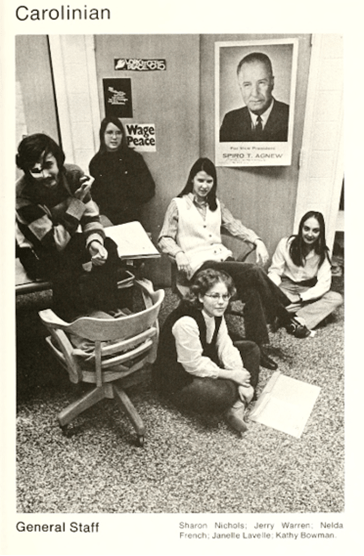
Nelda French (‘72), former staff writer, with Virginia Weaver, senior staff writer
Microwaved Beef is, usually, a column by Virginia Weaver that reexamines forgotten incidents in our fast-paced culture wars. However, for this edition, we’ve chosen to republish a classic piece from the archives. Nelda French (‘72) published a column for The Carolinian from 1970 to 1972. Enjoy this edition of French’s column, Taming of the Shrew, from October 27, 1970.
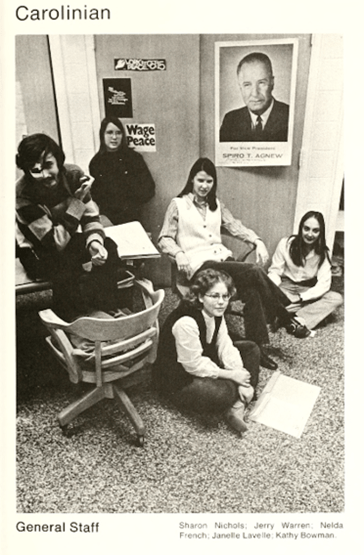
After standing in the rain for close to four hours to hear the silver-tongued prophet, Richard Nixon, speak in Asheville, I feel compelled to write my thoughts about present-day politics. It is a shame that one can know what a politician will say before he says it, but with Nixon, this is the case. The way one can have such foresight is by being slightly familiar with the ideologies before the American public. For a definition of “ideologies,” I refer to Erich Fromm’s book The Revolution of Hope. Fromm writes:
“Ideologies are ready-made thought-commodities spread by the press, the orators, the ideologists in order to manipulate the mass of people for purposes which have nothing to do with the ideology and are very often exactly the opposite… By its very nature, the ideology does not appeal to active thought, nor to active feeling. It is like the pill which excites or puts man to sleep.”
The ideologies which Nixon spoke about are peace, inflation, the environment, busing, drugs, pornography, organized crime and last but not least, student unrest (i.e.–lack of respect for law enforcement officers, bombing, burning and shouting down speakers even to the point of using obscenities.) The gist of his speech was that all the above-mentioned problems were in
existence before he came into office, but since taking office he has done all in his power to solve them. However, he was sure to mention that he could not do this all by himself which is why he needs the voting public and especially the Republicans to vote for him and other Republicans so that they can continue their fight against the evils of our society.
The major thing Nixon’s speech lacked was the freshness of ideas for people to think about. Rather, he discussed the so-called problems as though the government knew them well and knew how to attack them. Why, I ask, does he not trust the people with new ideas? Again. I turn to Erich Fromm for a definition of “ideas”:
“In contrast (to the ideology), the idea refers to what is real. It opens the eyes. It wakes men from their slumber. It requires them to think and to feel actively and to see something which they have not seen before… The force of ideas becomes all the greater in a situation where those who defend the status quo do not have ideas, and this is precisely the case of the present situation.”
Politics is a game of ideologies and the politician who can guess which things will appeal to the most people will get the most votes. Therefore, politicians are not really concerned with the welfare of the people, but with how to get the most votes and appease the most people while they are in office so that they can win in the next election. Yet they condemn young people for wanting “instant peace” because they offer no way to get this. Surely there are enough people with new ideas around who would offer solutions. Why do they attack college students? The answer is simple. We are a problem to the American public and it is good politics to speak out against student unrest. What is more negative than the ideologies Nixon outlined? It seems that he has defined certain public enemies and is reassuring the voters that he is out to get those enemies.
Frankly, I do not feel the least bit reassured, especially since I consider myself one of the enemies. Why can’t politics take a positive attitude and emphasize changes for the better rather than the rhetoric of oppression? What this country needs is not more politicians, but more radical humanists who are prepared to get things done that will benefit the American public by giving them hope, by giving them food for thought and action.
Column has been edited to shorten French’s quotations.

