
Caroline Turner, Opinions Editor
At the halfway point of the semester, we can all see the small, but present, light at the end of the so-called academic year. I consider myself to be a ProfessionalStudent™. All things considered I’m in the 20th grade and still counting on a few more years before I hang my student hat up and replace it with the prestigious (and a little silly) tam of doctoral glory. My point is, as a ProfessionalStudent™, I know all too well that the small light at the end of the tunnel is sometimes a train waiting to hit you, or a dumpster fire of all the promises you made to yourself early in the semester to stay on track with your writing. And reading. And dishes. And laundry. And a healthy sleep schedule.
Sometimes it just takes learning how to put out the fire to make all the difference.
I should probably confess something before I go any further: I am not naturally organized. I am not effortlessly productive. I am not the kind of person who writes 500 polished words a day before breakfast. I am someone who has set their academic kitchen on fire more than once and has found their way to safety before the damage sets in. I am someone who wrestles with executive dysfunction, periodic depressive fog, and the seductive logic of “future me will handle it,” which means that everything I’m about to share was learned the hard way.
So, here’s what I’ve learned as a ProfessionalStudent™ with a brain that occasionally forgets how time works: the goal isn’t to become the kind of person who never starts a fire. The goal is to build a fire station.
Over the years, I’ve assembled a small, slightly embarrassing, highly effective toolkit. It’s not glamorous, and it will certainly not be featured in any influencer’s productivity morning routine. But it has kept multiple semesters from collapsing into ash.
1. Body Doubling: Apparently, I Need a Witness
If you had told me in undergrad that the key to finishing a major project would be sitting silently in a Zoom or Teams call with another tired academic, I would have laughed. Though, I should have known from all the times my mother sat in my room and watched me clean because that was the only way I could get it done. (Thanks Mom!)
Body doubling—working alongside someone else, even if you’re not talking—has been one of the most effective interventions for my executive dysfunction. It turns out my brain behaves better when it knows someone else can see me not doing the thing.
There is something deeply humbling about discovering that what you needed all along was a study hall monitor. But it works. I should say that, for me, it only works if the person I’m body-doubling with will kindly but forcefully remind me that I should be working instead of talking.
2. AI as a Project Manager (Not Ghostwriter)
Left to my own devices, I will create timelines that assume I am a completely different human capable of productivity never seen. I outsource my realism.
I have my qualms with AI and its usage. I understand that it’s creating problems at a rate greater than we can fix them, but I aim to use it sparingly and to solve a problem I am heavily incapable of solving on my own.
AI has become my own personal assistant, managing my day-to-day, hour-to-hour calendar as needed, but not all the time. I know I have to read 100 sources between now and August, but on my own, I will agonize over where to start and how quickly I should be going. With AI, that agony is almost entirely alleviated. It will break my readings down into a painfully specific timeline, and it can do the same with my writing goals.
When the fire feels overwhelming, smaller tasks become controlled burns. I don’t need to read a book a day; I need to read a chapter or two and maybe an article. That is manageable. That I can do. And I can do it without becoming an academic zombie of my nightmares.
3. Pomodoro: Weaponizing the Clock
I do not trust myself with open-ended time. “Work all afternoon” is a fantasy. “Work for 25 minutes” is beautiful workflow bliss.
The Pomodoro technique works for me because it lowers the stakes. I’m not committing to productivity. I’m committing to 25 minutes of mild discomfort. After that, I get a break. Sometimes I stop and take the 5-minute break as outlined in the traditional Pomodoro technique. Sometimes I find myself in a groove that carries me to the end of my larger task.
The timer is the hero here, not my willpower.
4. The Kindergarten Reward System
Listen. I did not expect to need a sticker chart at this stage of my life. But the reality is, earning a little treat is a dopamine hit like no other. It doesn’t have to be a big reward. It’s often a coffee, an episode of my current reality TV obsession, or the deeply sacred ritual of a guilt-free nap when I complete my major goals for the day or week.
My rewards aren’t constant, but they are miniature celebrations of what I’ve accomplished when all I really wanted to do was play video games until my eyes melt.
Is a reward system juvenile? Sure. Is it effective? Absolutely.
Graduate school and higher education in general will try to convince you that suffering is noble. I have found that tiny, structured joy is far more sustainable.
This isn’t an exhaustive list for everyone’s academic firetruck. None of these strategies have cured my procrastination. None of them have eliminated my depression or repaired my executive dysfunction. But they did something realistic: they gave me tools to put out the flames.
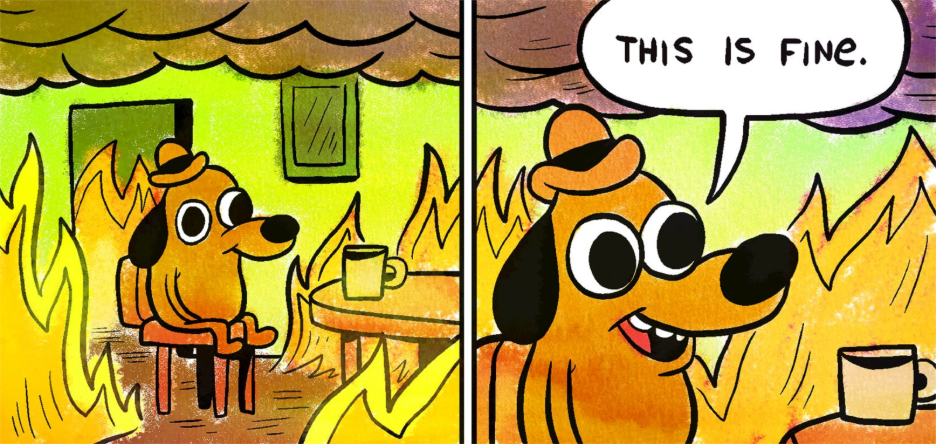
In short, my room is occasionally on fire. The deadlines loom. The light at the end of the tunnel flickers suspiciously. But I am not a grad student who will sit in the flames politely insisting, “This is fine.” I am the grad student with the timer, a body double, an obnoxiously specific task list, and a reward system fit for 5-year-old me. I, ProfessionalStudent™, have learned to keep a fire extinguisher within reach.
Headline image created by artist KC Green in 2013 for his webcomic series Gunshow.

