
Virginia Weaver, Senior Staff Writer
Microwaved Beef is a column by Virginia Weaver that reflects on flashpoints from the last few years in the culture wars. The rapid pace of contemporary discourse makes it easy to forget critical moments and trends that have defined our social and academic lives. Microwaved Beef brings those moments back into the spotlight. Today, however, we’re microwaving some beans.
Chaos broke out when, on January 2, 2021, podcaster and musician John Roderick posted a thread on Twitter describing how he had let his daughter figure out how to use a can opener instead of opening a can for her. According to Roderick’s thread, his daughter had asked him to open a can of baked beans. Instead of fulfilling her request, Roderick let her pout and whine for six hours as she learned to operate the can opener on her own.
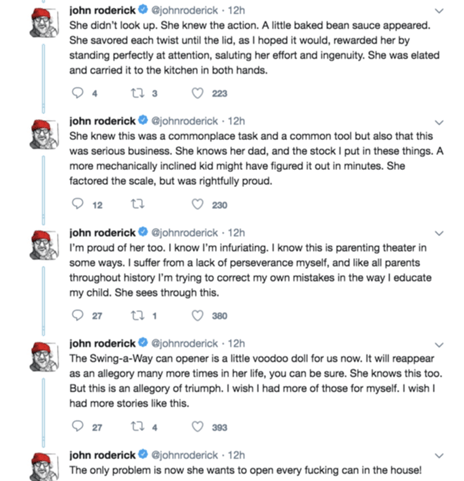
While Roderick clearly presented the story as one of triumph, for both him and his daughter, many Twitter users alleged that Roderick was teaching his daughter bad values or that he was even abusing her, as BBC coverage reported.
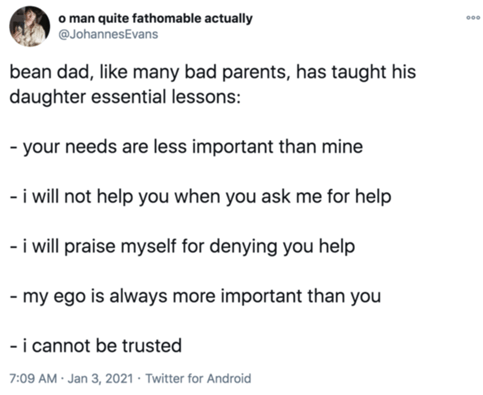
Of particular note to some respondents was a moment in Roderick’s thread in which he had told his daughter that neither he nor she would not eat until she had managed to open the can. Although some Twitter users took the story as a serious matter, others found in it an opportunity for humor. The memes quickly began to flow.
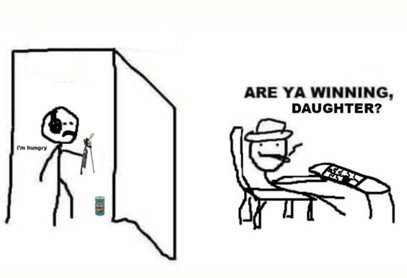
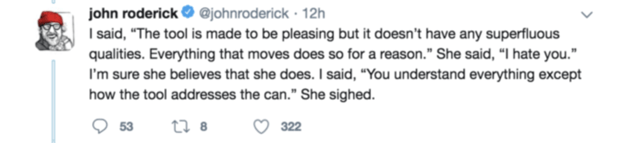
Users’ memes referenced many odd moments of Roderick’s narrative, including the fact that he was constructing a jigsaw puzzle during the ordeal, or his use of lofty phrases in describing the can opener to his daughter, particularly in the tweet below.
The negative attention Roderick gained from his controversial bean tale led to his career in unexpected directions. Twitter users began dredging Roderick’s posting history for problematic tweets, surfacing past antisemitic and racist jokes, alongside at least one dark joke in which he threatened to rape another Twitter user. These discoveries led the popular podcast My Brother, My Brother, and Me (MBMBaM) to remove a song by Roderick from their podcast’s intro as of January 3, 2021, a mere day after his viral thread went online.
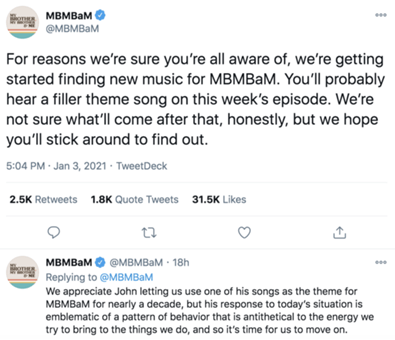
The podcast MBMBaM has weathered plenty of its own controversies over the years, but continuing to feature Roderick, increasingly known as “Bean Dad,” in light of his widely publicized and criticized tweeting history, would have been a disastrous PR move.
On January 4, John “Bean Dad” Roderick deactivated his Twitter account, and on January 5, three days after posting his viral thread, Roderick posted an apology to his personal website. He explained that he had exaggerated the details of the story: his daughter had also been laughing along and helping with the jigsaw puzzle, her mother had been nearby and amused at the situation, and Roderick had been sharing a snack with his daughter throughout her ordeal. He further explained: “I framed the story with me as the asshole dad because that’s my comedic persona and my fans and friends know it’s ‘a bit.’”
Some of the blowback Roderick received to his thread might be described as “context collapse,” which one scholarly online encyclopedia defines as “the phenomenon in digital communication where distinct social spheres or contexts intersect, leading to challenges in managing audience expectations, privacy boundaries, and self-presentation.” While journalist and podcaster Kat Rosenfield readily described being a “pedant” as Roderick’s “shtick,” most Twitter users would not know this about his persona. Context collapsed as thousands of readers unfamiliar with his style encountered it for the first time in a story that could seem troubling without the requisite awareness of its author’s style of comedy.
As for Roderick’s many self-acknowledgedly “racist, anti-Semitic, hurtful and slur-filled tweets,” he explained in his apology that he had thought he was being progressive through “taking the slurs of the oppressors and flipping them to mock racism, sexism, homophobia, and bigotry.” However, in his apology, he made clear that he now understood those tweets as inappropriate.
As pointed out by the hostesses of the popular culture criticism podcast Rehash, public apologies on social media often provoke negative reactions by default. When confronted with a situation like the “Bean Dad” hubbub, we’re challenged to ask, along with Maia, one of Rehash’s hostesses: “What do you owe the public?” Roderick’s reputation did not recover due to his apology, and “Bean Dad” became slang for bad and overly harsh parents online. Later in 2021, journalist and political consultant Liz Mair received backlash for alleging on Twitter that she burns her son’s Pokémon cards to punish his bad behaviour, quickly earning herself the moniker “Bean Dad 2.” The effectiveness of Roderick’s apology was nil, and the question remains: should he have taken a break from social media, as he promised to do in his apology anyway, without hopelessly apologizing in a way that could seem like groveling? By not opening a can of beans for his daughter, Bean Dad opened a can of worms for social media critics.
 THE CAROLINIAN