
Virginia Weaver, Senior Staff Writer
Microwaved Beef is a column by Virginia Weaver that reflects on flashpoints from the last few years in the culture wars. The rapid pace of contemporary discourse makes it easy to forget critical moments and trends that have defined our social and academic lives. Microwaved Beef brings those moments back into the spotlight.
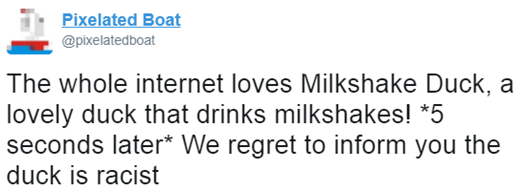
On June 12, 2016, artist Ben Ward, known on Twitter as @pixelatedboat, made Internet history with a tweet describing “milkshake duck”: “The whole internet loves Milkshake Duck, a lovely duck that drinks milkshakes! *5 seconds later* We regret to inform you the duck is racist”
The term “milkshake duck” seems to have entered the online lexicon as slang in early 2017. In June 2017, almost exactly a year after the original tweet, an Urban Dictionary user added an entry for “milkshake duck” and explained how the term had come to be used:
Someone who gains sudden fame for something nice and positive, only to soon after be revealed as a deeply flawed character with terrible opinions and/or a shady past, often involving corrosive social/political ideologies, which quickly tarnishes their fame and the good will people momentarily had towards them.
An Oxford Dictionaries blog post let readers know that the dictionary staff were keeping an eye on the term “milkshake duck,” having noted: “There are tweets from early 2017 using the hashtag #milkshakeduck demonstrating this kind of extended meaning, and scattered uses in blogs and on entertainment sites in the same time period, but the majority of usage of the term arises in June 2017[.]”
As the Oxford Dictionaries blog explains, the term caught on in June 2017 in reference to a video game creator, Tim Soret. Soret’s promising cyberpunk game, The Last Night, had generated buzz at that year’s E3. But as Adi Robertson explained at the time for The Verge, Soret’s contentious tweeting history soon came to light, drastically reducing excitement for his game. Robertson recounts:
In 2014, Soret wrote that The Last Night “takes place in a cyberpunk world where modern feminism won instead of egalitarianism,” appending the Gamergate hashtag. Around the same time, he claimed the game would show “the dangers of extreme progressivism,” and inquired about the possibility of using Gamergate mascot Vivian James in the game.
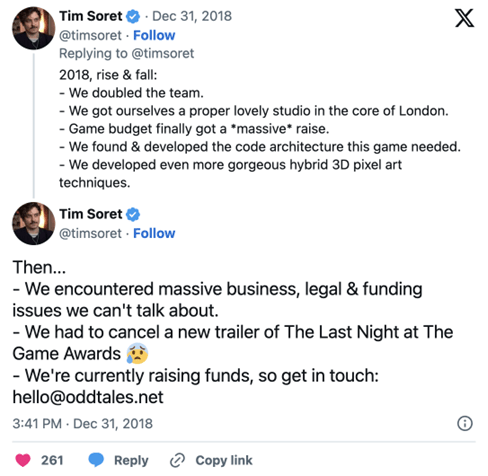
Soret disavowed the tweets. At the time of writing, The Last Night has yet to be released. However, Soret revealed in late 2018 that the game had faced “massive business, legal, & funding issues,” and it’s unclear how much these issues had to do with his milkshake duck status, so onlookers should make no assumptions.
Another popular example of a milkshake duck is “Sweater Guy,” real name Ken Bone. In 2016, Bone sat in the audience of a presidential debate wearing a bright red sweater. When an image of him at the debate, captured in the background beside former U.S. Secretary of State Hillary Clinton, went viral, Bone did his best to profit off his sudden fame, releasing “Bone Zone” merchandise and accepting at least one brand sponsorship from Uber. Within days, however, news outlets learned that Bone had a pseudonymous Reddit account on which he made disturbing comments about women’s bodies and admitted to enjoying nude photographs of celebrity women that had been disseminated without their consent in 2014. On Reddit, Bone also argued in favor of the killing of Trayvon Martin. Gizmodo, whose reporting first brought Bone’s Reddit behavior to the public’s awareness, entitled their initial article “Actually, Ken Bone Is Bad.” Bone’s image as a wholesome everyman did not survive the onslaught of reporting on his Reddit usage. The New York Times referred to his downfall after a mere few days of fame as the death of the “Ken Bone of our imaginations.”
The term “milkshake duck” caught on because it described a common Internet phenomenon, but also, likely, because it touches on many Internet users’ fears of having their own past Internet usage dredged up and brought back into the light. Online political commentators such as Lauren Southern, among others, with histories on the far-Right, struggle to shake their formerly extreme online personae. But such commentators are aware that their old content is already publicly known. Many Internet users, like Ken Bone, have years or decades of less public-facing online posts that may not represent their current selves but may surprisingly erupt into the public eye at an inopportune moment. Not all are aware that they are able to have their content removed from the Internet Archive, but even so, the Internet can be a permanent logbook. Who knows whether anyone has receipts in the form of screenshots? The milkshake duck represents not only figures in Internet history, but a prevalent dread, especially among younger people whose single-digit years may well be logged in the annals of digital lore.

